

PUFA (83.7%) in nigella seed oil. Overall, oleic acid (20%), linoleic acid (50–60%),
eicosadienoic acid (3%), and dihomolinoleic acid (10%) are found as chief unsaturated fatty acids, while palmitic acid and stearic acid are the major saturated fatty
acids along with α-sitosterol (44–54%) and stigmasterol (6.57–20.92% of total
unsaponifiable matter) (Islam et al. 2017).
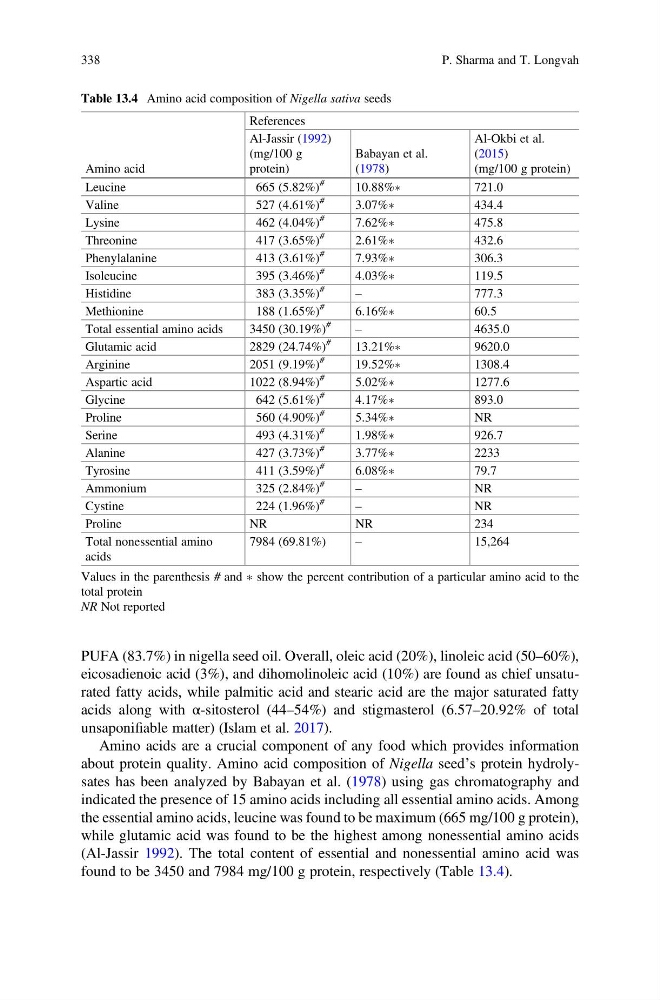
Amino acids are a crucial component of any food which provides information
about protein quality. Amino acid composition of Nigella seed’s protein hydrolysates has been analyzed by Babayan et al. (1978) using gas chromatography and
indicated the presence of 15 amino acids including all essential amino acids. Among
the essential amino acids, leucine was found to be maximum (665 mg/100 g protein),
while glutamic acid was found to be the highest among nonessential amino acids
(Al-Jassir 1992). The total content of essential and nonessential amino acid was
found to be 3450 and 7984 mg/100 g protein, respectively (Table 13.4).
Table 13.4 Amino acid composition of Nigella sativa seeds
Amino acid
References
Al-Jassir (1992)
(mg/100 g
protein)
Babayan et al.
(1978)
Al-Okbi et al.
(2015)
(mg/100 g protein)
Leucine
665 (5.82%)
#
10.88%Ã
721.0
Valine
527 (4.61%)
#
3.07%Ã
434.4
Lysine
462 (4.04%)
#
7.62%Ã
475.8
Threonine
417 (3.65%)
#
2.61%Ã
432.6
Phenylalanine
413 (3.61%)
#
7.93%Ã
306.3
Isoleucine
395 (3.46%)
#
4.03%Ã
119.5
Histidine
383 (3.35%)
#
–
777.3
Methionine
188 (1.65%)
#
6.16%Ã
60.5
Total essential amino acids
3450 (30.19%)
#
–
4635.0
Glutamic acid
2829 (24.74%)
#
13.21%Ã
9620.0
Arginine
2051 (9.19%)
#
19.52%Ã
1308.4
Aspartic acid
1022 (8.94%)
#
5.02%Ã
1277.6
Glycine
642 (5.61%)
#
4.17%Ã
893.0
Proline
560 (4.90%)
#
5.34%Ã
NR
Serine
493 (4.31%)
#
1.98%Ã
926.7
Alanine
427 (3.73%)
#
3.77%Ã
2233
Tyrosine
411 (3.59%)
#
6.08%Ã
79.7
Ammonium
325 (2.84%)
#
–
NR
Cystine
224 (1.96%)
#
–
NR
Proline
NR
NR
234
Total nonessential amino
acids
7984 (69.81%)
–
15,264
Values in the parenthesis # and à show the percent contribution of a particular amino acid to the
total protein
NR Not reported
338
P. Sharma and T. Longvah
eicosadienoic acid (3%), and dihomolinoleic acid (10%) are found as chief unsaturated fatty acids, while palmitic acid and stearic acid are the major saturated fatty
acids along with α-sitosterol (44–54%) and stigmasterol (6.57–20.92% of total
unsaponifiable matter) (Islam et al. 2017).
Amino acids are a crucial component of any food which provides information
about protein quality. Amino acid composition of Nigella seed’s protein hydrolysates has been analyzed by Babayan et al. (1978) using gas chromatography and
indicated the presence of 15 amino acids including all essential amino acids. Among
the essential amino acids, leucine was found to be maximum (665 mg/100 g protein),
while glutamic acid was found to be the highest among nonessential amino acids
(Al-Jassir 1992). The total content of essential and nonessential amino acid was
found to be 3450 and 7984 mg/100 g protein, respectively (Table 13.4).
Table 13.4 Amino acid composition of Nigella sativa seeds
Amino acid
References
Al-Jassir (1992)
(mg/100 g
protein)
Babayan et al.
(1978)
Al-Okbi et al.
(2015)
(mg/100 g protein)
Leucine
665 (5.82%)
#
10.88%Ã
721.0
Valine
527 (4.61%)
#
3.07%Ã
434.4
Lysine
462 (4.04%)
#
7.62%Ã
475.8
Threonine
417 (3.65%)
#
2.61%Ã
432.6
Phenylalanine
413 (3.61%)
#
7.93%Ã
306.3
Isoleucine
395 (3.46%)
#
4.03%Ã
119.5
Histidine
383 (3.35%)
#
–
777.3
Methionine
188 (1.65%)
#
6.16%Ã
60.5
Total essential amino acids
3450 (30.19%)
#
–
4635.0
Glutamic acid
2829 (24.74%)
#
13.21%Ã
9620.0
Arginine
2051 (9.19%)
#
19.52%Ã
1308.4
Aspartic acid
1022 (8.94%)
#
5.02%Ã
1277.6
Glycine
642 (5.61%)
#
4.17%Ã
893.0
Proline
560 (4.90%)
#
5.34%Ã
NR
Serine
493 (4.31%)
#
1.98%Ã
926.7
Alanine
427 (3.73%)
#
3.77%Ã
2233
Tyrosine
411 (3.59%)
#
6.08%Ã
79.7
Ammonium
325 (2.84%)
#
–
NR
Cystine
224 (1.96%)
#
–
NR
Proline
NR
NR
234
Total nonessential amino
acids
7984 (69.81%)
–
15,264
Values in the parenthesis # and à show the percent contribution of a particular amino acid to the
total protein
NR Not reported
338
P. Sharma and T. Longvah