

increases the water absorption index and water hydration capacity but also hardens
and expands the product to impart a fibrous texture (Horan 1974; Grasso et al. 2019;
Toldrà et al. 2019) and, thus, be used majorly as meat alternatives (Macedo-Silva
et al. 2001; Wong et al. 2019). In the dry form, they are incorporated in the
applications wherein during processing the juices liberated by the meats need to be
absorbed for a firm final product, for example, beef patties, sausages, pizza toppings,
frozen dinners, packaged dinners and soups, taco fillings, vegetarian foods, pet
foods, etc. On the other hand, the hydrated forms are handled just like any other
meat/perishable food (Lin et al. 2000; Hennenger 2002).
1.5.3 Fermented Soy Foods
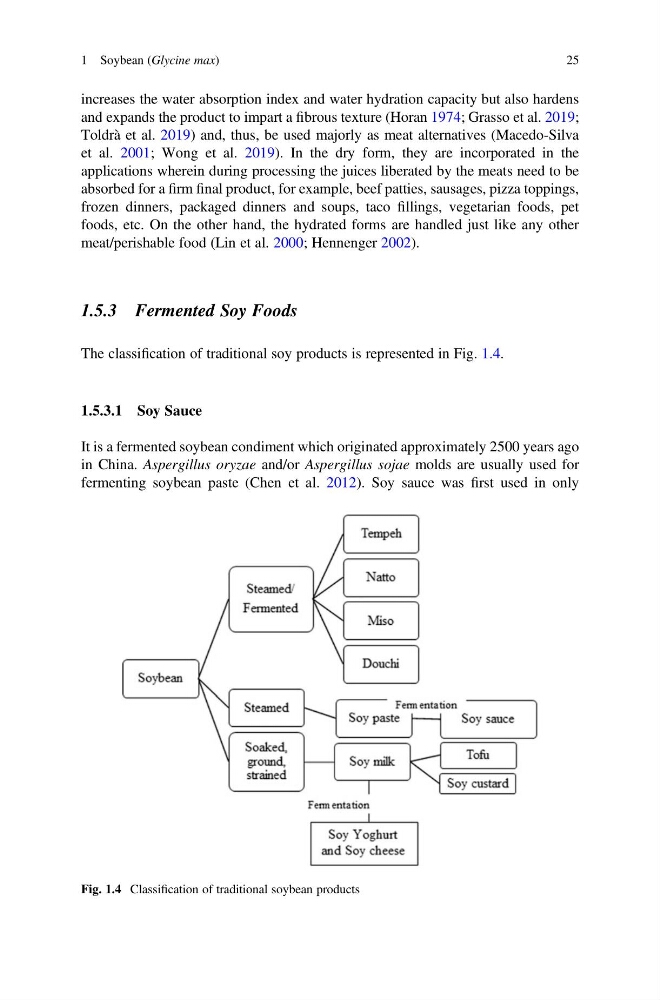
The classification of traditional soy products is represented in Fig. 1.4.
1.5.3.1 Soy Sauce
It is a fermented soybean condiment which originated approximately 2500 years ago
in China. Aspergillus oryzae and/or Aspergillus sojae molds are usually used for
fermenting soybean paste (Chen et al. 2012). Soy sauce was first used in only
Fig. 1.4 Classification of traditional soybean products
1 Soybean (Glycine max)
2 5
and expands the product to impart a fibrous texture (Horan 1974; Grasso et al. 2019;
Toldrà et al. 2019) and, thus, be used majorly as meat alternatives (Macedo-Silva
et al. 2001; Wong et al. 2019). In the dry form, they are incorporated in the
applications wherein during processing the juices liberated by the meats need to be
absorbed for a firm final product, for example, beef patties, sausages, pizza toppings,
frozen dinners, packaged dinners and soups, taco fillings, vegetarian foods, pet
foods, etc. On the other hand, the hydrated forms are handled just like any other
meat/perishable food (Lin et al. 2000; Hennenger 2002).
1.5.3 Fermented Soy Foods
The classification of traditional soy products is represented in Fig. 1.4.
1.5.3.1 Soy Sauce
It is a fermented soybean condiment which originated approximately 2500 years ago
in China. Aspergillus oryzae and/or Aspergillus sojae molds are usually used for
fermenting soybean paste (Chen et al. 2012). Soy sauce was first used in only
Fig. 1.4 Classification of traditional soybean products
1 Soybean (Glycine max)
2 5