

reduce the digestibility and bioavailability of nutrients by inhibiting digestive
enzymes and forming an insoluble mineral–protein complex in the gut (Soetan and
Oyewole 2009).
Phytate, phenolic compounds, lectin, enzyme inhibitors, saponins, and oxalates
are the anti-nutritional components present in abundant amount in sesame seeds and
have an impact on the gastrointestinal tract and thus affect human metabolism
(Nikmaram et al. 2017). Sesame seed coat contains oxalates (3–5%) and phytates
(2.25–3.5%), which form insoluble complexes with minerals (calcium, magnesium,
zinc, and iron) and ultimately interfere with their utilization (Adegunwa et al. 2012).
12.5.1 Phytates
Phytic acid is an important source of phosphorus and possesses a strong chelating
ability to form protein complex, thereby contributing to anti-nutritional effects
(Urbano et al. 2000). Phytates reduces bioavailability of minerals, impair protein
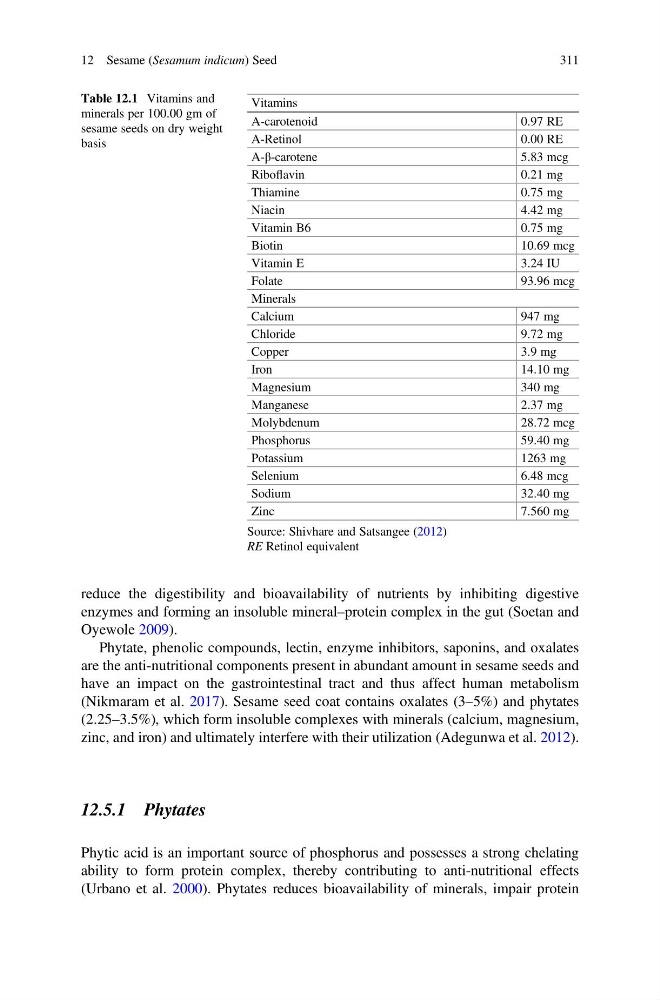
Table 12.1 Vitamins and
minerals per 100.00 gm of
sesame seeds on dry weight
basis
Vitamins
A-carotenoid
0.97 RE
A-Retinol
0.00 RE
A-β-carotene
5.83 mcg
Riboflavin
0.21 mg
Thiamine
0.75 mg
Niacin
4.42 mg
Vitamin B6
0.75 mg
Biotin
10.69 mcg
Vitamin E
3.24 IU
Folate
93.96 mcg
Minerals
Calcium
947 mg
Chloride
9.72 mg
Copper
3.9 mg
Iron
14.10 mg
Magnesium
340 mg
Manganese
2.37 mg
Molybdenum
28.72 mcg
Phosphorus
59.40 mg
Potassium
1263 mg
Selenium
6.48 mcg
Sodium
32.40 mg
Zinc
7.560 mg
Source: Shivhare and Satsangee (2012)
RE Retinol equivalent
12 Sesame (Sesamum indicum) Seed
311
enzymes and forming an insoluble mineral–protein complex in the gut (Soetan and
Oyewole 2009).
Phytate, phenolic compounds, lectin, enzyme inhibitors, saponins, and oxalates
are the anti-nutritional components present in abundant amount in sesame seeds and
have an impact on the gastrointestinal tract and thus affect human metabolism
(Nikmaram et al. 2017). Sesame seed coat contains oxalates (3–5%) and phytates
(2.25–3.5%), which form insoluble complexes with minerals (calcium, magnesium,
zinc, and iron) and ultimately interfere with their utilization (Adegunwa et al. 2012).
12.5.1 Phytates
Phytic acid is an important source of phosphorus and possesses a strong chelating
ability to form protein complex, thereby contributing to anti-nutritional effects
(Urbano et al. 2000). Phytates reduces bioavailability of minerals, impair protein
Table 12.1 Vitamins and
minerals per 100.00 gm of
sesame seeds on dry weight
basis
Vitamins
A-carotenoid
0.97 RE
A-Retinol
0.00 RE
A-β-carotene
5.83 mcg
Riboflavin
0.21 mg
Thiamine
0.75 mg
Niacin
4.42 mg
Vitamin B6
0.75 mg
Biotin
10.69 mcg
Vitamin E
3.24 IU
Folate
93.96 mcg
Minerals
Calcium
947 mg
Chloride
9.72 mg
Copper
3.9 mg
Iron
14.10 mg
Magnesium
340 mg
Manganese
2.37 mg
Molybdenum
28.72 mcg
Phosphorus
59.40 mg
Potassium
1263 mg
Selenium
6.48 mcg
Sodium
32.40 mg
Zinc
7.560 mg
Source: Shivhare and Satsangee (2012)
RE Retinol equivalent
12 Sesame (Sesamum indicum) Seed
311