

et al. 2011). Thus, this oil can be termed as “gourmet oil,” since it is recognized as
high-quality oil and appreciated for its taste, color, and healthy characteristics
(Ixtaina et al. 2015).
An advantage associated with chia seed in comparison to the commercial products rich in omega-3 fatty acids derived from fish, fish oil and fish meal, is that it has
no cholesterol (Tosco 2004) and free-form heavy metal contamination. Chia seed is
mainly valued for its oil content. Several methods can be applied for the extraction of
chia oil, but differences between the methods cause changes in oil yield, fatty acid
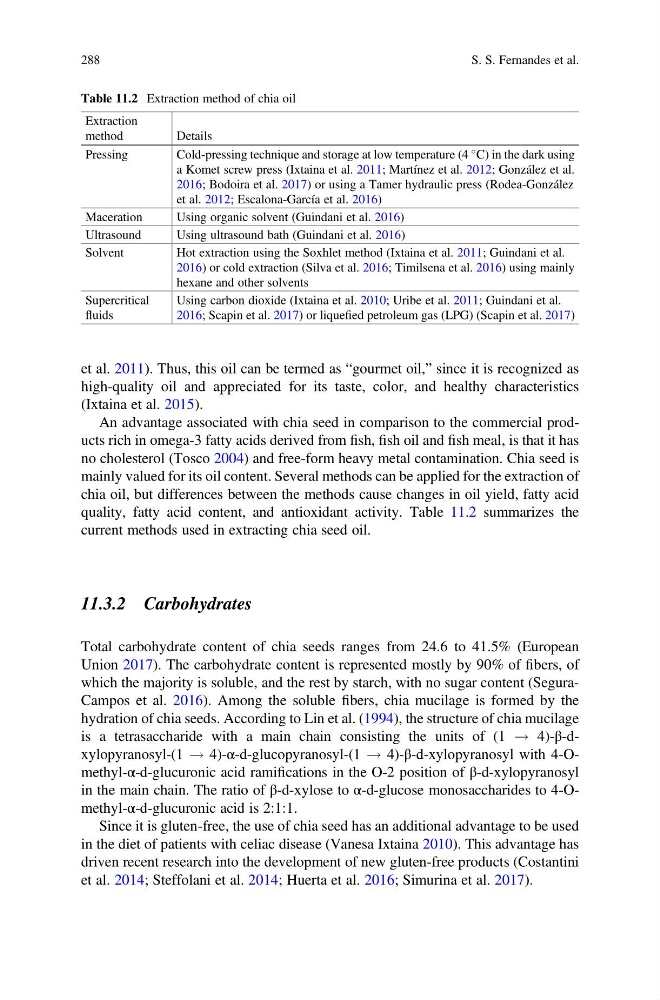
quality, fatty acid content, and antioxidant activity. Table 11.2 summarizes the
current methods used in extracting chia seed oil.
11.3.2 Carbohydrates
Total carbohydrate content of chia seeds ranges from 24.6 to 41.5% (European
Union 2017). The carbohydrate content is represented mostly by 90% of fibers, of
which the majority is soluble, and the rest by starch, with no sugar content (SeguraCampos et al. 2016). Among the soluble fibers, chia mucilage is formed by the
hydration of chia seeds. According to Lin et al. (1994), the structure of chia mucilage
is a tetrasaccharide with a main chain consisting the units of (1 ! 4)-β-dxylopyranosyl-(1 ! 4)-α-d-glucopyranosyl-(1 ! 4)-β-d-xylopyranosyl with 4-Omethyl-α-d-glucuronic acid ramifications in the O-2 position of β-d-xylopyranosyl
in the main chain. The ratio of β-d-xylose to α-d-glucose monosaccharides to 4-Omethyl-α-d-glucuronic acid is 2:1:1.
Since it is gluten-free, the use of chia seed has an additional advantage to be used
in the diet of patients with celiac disease (Vanesa Ixtaina 2010). This advantage has
driven recent research into the development of new gluten-free products (Costantini
et al. 2014; Steffolani et al. 2014; Huerta et al. 2016; Simurina et al. 2017).
Table 11.2 Extraction method of chia oil
Extraction
method
Details
Pressing
Cold-pressing technique and storage at low temperature (4
C) in the dark using
a Komet screw press (Ixtaina et al. 2011; Martínez et al. 2012; González et al.
2016; Bodoira et al. 2017) or using a Tamer hydraulic press (Rodea-González
et al. 2012; Escalona-García et al. 2016)
Maceration
Using organic solvent (Guindani et al. 2016)
Ultrasound
Using ultrasound bath (Guindani et al. 2016)
Solvent
Hot extraction using the Soxhlet method (Ixtaina et al. 2011; Guindani et al.
2016) or cold extraction (Silva et al. 2016; Timilsena et al. 2016) using mainly
hexane and other solvents
Supercritical
fluids
Using carbon dioxide (Ixtaina et al. 2010; Uribe et al. 2011; Guindani et al.
2016; Scapin et al. 2017) or liquefied petroleum gas (LPG) (Scapin et al. 2017)
288
S. S. Fernandes et al.
high-quality oil and appreciated for its taste, color, and healthy characteristics
(Ixtaina et al. 2015).
An advantage associated with chia seed in comparison to the commercial products rich in omega-3 fatty acids derived from fish, fish oil and fish meal, is that it has
no cholesterol (Tosco 2004) and free-form heavy metal contamination. Chia seed is
mainly valued for its oil content. Several methods can be applied for the extraction of
chia oil, but differences between the methods cause changes in oil yield, fatty acid
quality, fatty acid content, and antioxidant activity. Table 11.2 summarizes the
current methods used in extracting chia seed oil.
11.3.2 Carbohydrates
Total carbohydrate content of chia seeds ranges from 24.6 to 41.5% (European
Union 2017). The carbohydrate content is represented mostly by 90% of fibers, of
which the majority is soluble, and the rest by starch, with no sugar content (SeguraCampos et al. 2016). Among the soluble fibers, chia mucilage is formed by the
hydration of chia seeds. According to Lin et al. (1994), the structure of chia mucilage
is a tetrasaccharide with a main chain consisting the units of (1 ! 4)-β-dxylopyranosyl-(1 ! 4)-α-d-glucopyranosyl-(1 ! 4)-β-d-xylopyranosyl with 4-Omethyl-α-d-glucuronic acid ramifications in the O-2 position of β-d-xylopyranosyl
in the main chain. The ratio of β-d-xylose to α-d-glucose monosaccharides to 4-Omethyl-α-d-glucuronic acid is 2:1:1.
Since it is gluten-free, the use of chia seed has an additional advantage to be used
in the diet of patients with celiac disease (Vanesa Ixtaina 2010). This advantage has
driven recent research into the development of new gluten-free products (Costantini
et al. 2014; Steffolani et al. 2014; Huerta et al. 2016; Simurina et al. 2017).
Table 11.2 Extraction method of chia oil
Extraction
method
Details
Pressing
Cold-pressing technique and storage at low temperature (4
C) in the dark using
a Komet screw press (Ixtaina et al. 2011; Martínez et al. 2012; González et al.
2016; Bodoira et al. 2017) or using a Tamer hydraulic press (Rodea-González
et al. 2012; Escalona-García et al. 2016)
Maceration
Using organic solvent (Guindani et al. 2016)
Ultrasound
Using ultrasound bath (Guindani et al. 2016)
Solvent
Hot extraction using the Soxhlet method (Ixtaina et al. 2011; Guindani et al.
2016) or cold extraction (Silva et al. 2016; Timilsena et al. 2016) using mainly
hexane and other solvents
Supercritical
fluids
Using carbon dioxide (Ixtaina et al. 2010; Uribe et al. 2011; Guindani et al.
2016; Scapin et al. 2017) or liquefied petroleum gas (LPG) (Scapin et al. 2017)
288
S. S. Fernandes et al.