

10.4.5 Minerals and Vitamins
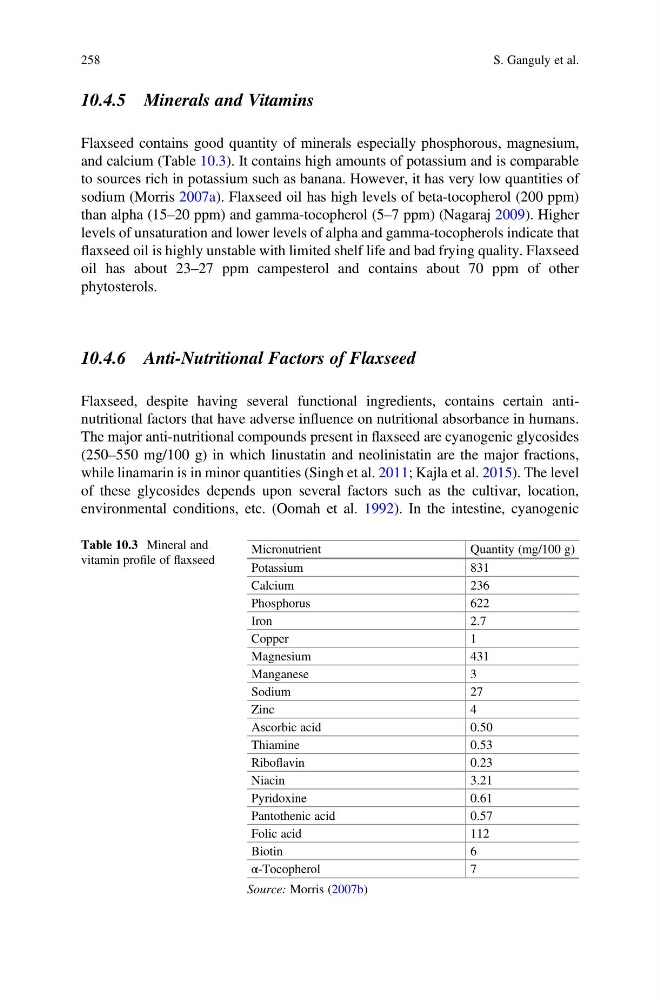
Flaxseed contains good quantity of minerals especially phosphorous, magnesium,
and calcium (Table 10.3). It contains high amounts of potassium and is comparable
to sources rich in potassium such as banana. However, it has very low quantities of
sodium (Morris 2007a). Flaxseed oil has high levels of beta-tocopherol (200 ppm)
than alpha (15–20 ppm) and gamma-tocopherol (5–7 ppm) (Nagaraj 2009). Higher
levels of unsaturation and lower levels of alpha and gamma-tocopherols indicate that
flaxseed oil is highly unstable with limited shelf life and bad frying quality. Flaxseed
oil has about 23–27 ppm campesterol and contains about 70 ppm of other
phytosterols.
10.4.6 Anti-Nutritional Factors of Flaxseed
Flaxseed, despite having several functional ingredients, contains certain antinutritional factors that have adverse influence on nutritional absorbance in humans.
The major anti-nutritional compounds present in flaxseed are cyanogenic glycosides
(250–550 mg/100 g) in which linustatin and neolinistatin are the major fractions,
while linamarin is in minor quantities (Singh et al. 2011; Kajla et al. 2015). The level
of these glycosides depends upon several factors such as the cultivar, location,
environmental conditions, etc. (Oomah et al. 1992). In the intestine, cyanogenic
Table 10.3 Mineral and
vitamin profile of flaxseed
Micronutrient
Quantity (mg/100 g)
Potassium
831
Calcium
236
Phosphorus
622
Iron
2.7
Copper
1
Magnesium
431
Manganese
3
Sodium
27
Zinc
4
Ascorbic acid
0.50
Thiamine
0.53
Riboflavin
0.23
Niacin
3.21
Pyridoxine
0.61
Pantothenic acid
0.57
Folic acid
112
Biotin
6
α-Tocopherol
7
Source: Morris (2007b)
258
S. Ganguly et al.
Flaxseed contains good quantity of minerals especially phosphorous, magnesium,
and calcium (Table 10.3). It contains high amounts of potassium and is comparable
to sources rich in potassium such as banana. However, it has very low quantities of
sodium (Morris 2007a). Flaxseed oil has high levels of beta-tocopherol (200 ppm)
than alpha (15–20 ppm) and gamma-tocopherol (5–7 ppm) (Nagaraj 2009). Higher
levels of unsaturation and lower levels of alpha and gamma-tocopherols indicate that
flaxseed oil is highly unstable with limited shelf life and bad frying quality. Flaxseed
oil has about 23–27 ppm campesterol and contains about 70 ppm of other
phytosterols.
10.4.6 Anti-Nutritional Factors of Flaxseed
Flaxseed, despite having several functional ingredients, contains certain antinutritional factors that have adverse influence on nutritional absorbance in humans.
The major anti-nutritional compounds present in flaxseed are cyanogenic glycosides
(250–550 mg/100 g) in which linustatin and neolinistatin are the major fractions,
while linamarin is in minor quantities (Singh et al. 2011; Kajla et al. 2015). The level
of these glycosides depends upon several factors such as the cultivar, location,
environmental conditions, etc. (Oomah et al. 1992). In the intestine, cyanogenic
Table 10.3 Mineral and
vitamin profile of flaxseed
Micronutrient
Quantity (mg/100 g)
Potassium
831
Calcium
236
Phosphorus
622
Iron
2.7
Copper
1
Magnesium
431
Manganese
3
Sodium
27
Zinc
4
Ascorbic acid
0.50
Thiamine
0.53
Riboflavin
0.23
Niacin
3.21
Pyridoxine
0.61
Pantothenic acid
0.57
Folic acid
112
Biotin
6
α-Tocopherol
7
Source: Morris (2007b)
258
S. Ganguly et al.