

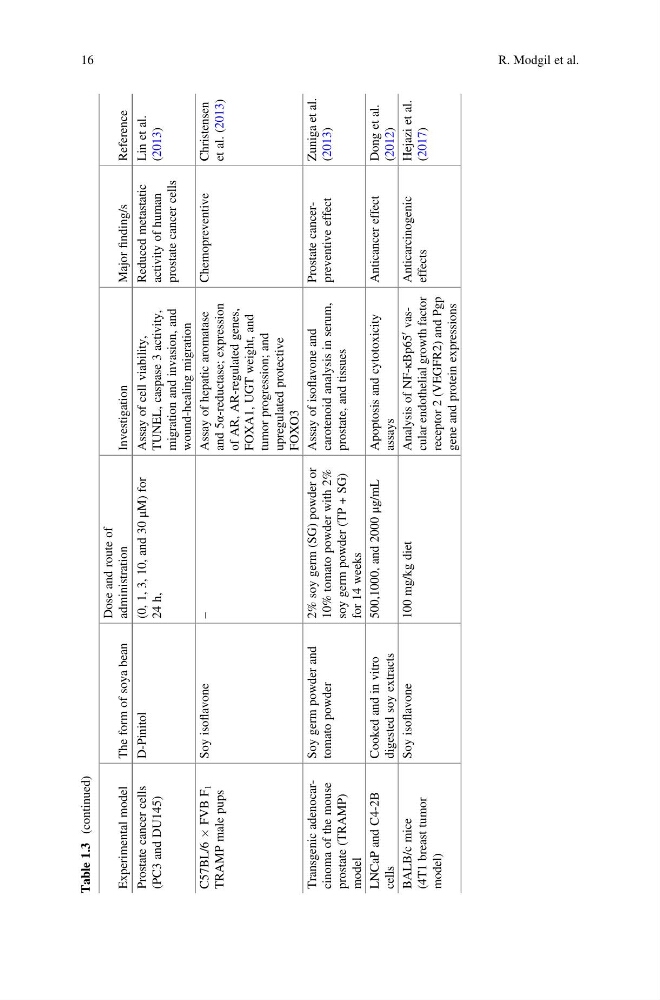
Table 1.3
(continued)
Experimental model
The form of soya bean
Dose and route of
administration
Investigation
Major
finding/s
Reference
Prostate cancer cells
(PC3 and DU145)
D-Pinitol
(0, 1, 3, 10, and 30
μM) for
24 h,
Assay of cell viability,
TUNEL, caspase 3 activity,
migration and invasion, and
wound-healing migration
Reduced metastatic
activity of human
prostate cancer cells
Lin et al.
(2013)
C57BL/6
 FVB F
1
TRAMP male pups
Soy isoflavone
–
Assay of hepatic aromatase
and 5α-reductase; expression
of AR, AR-regulated genes,
FOXA1, UGT weight, and
tumor progression; and
upregulated protective
FOXO3
Chemopreventive
Christensen
et al. (2013)
Transgenic adenocarcinoma of the mouse
prostate (TRAMP)
model
Soy germ powder and
tomato powder
2% soy germ (SG) powder or
10% tomato powder with 2%
soy germ powder (TP + SG)
for 14 weeks
Assay of isoflavone and
carotenoid analysis in serum,
prostate, and tissues
Prostate cancerpreventive effect
Zuniga et al.
(2013)
LNCaP and C4-2B
cells
Cooked and in vitro
digested soy extracts
500,1000, and 2000
μg/mL
Apoptosis and cytotoxicity
assays
Anticancer effect
Dong et al.
(2012)
BALB/c mice
(4T1 breast tumor
model)
Soy isoflavone
100 mg/kg diet
Analysis of NF-κBp65
0
vascular endothelial growth factor
receptor 2 (VEGFR2) and Pgp
gene and protein expressions
Anticarcinogenic
effects
Hejazi et al.
(2017)
16
R. Modgil et al.
(continued)
Experimental model
The form of soya bean
Dose and route of
administration
Investigation
Major
finding/s
Reference
Prostate cancer cells
(PC3 and DU145)
D-Pinitol
(0, 1, 3, 10, and 30
μM) for
24 h,
Assay of cell viability,
TUNEL, caspase 3 activity,
migration and invasion, and
wound-healing migration
Reduced metastatic
activity of human
prostate cancer cells
Lin et al.
(2013)
C57BL/6
 FVB F
1
TRAMP male pups
Soy isoflavone
–
Assay of hepatic aromatase
and 5α-reductase; expression
of AR, AR-regulated genes,
FOXA1, UGT weight, and
tumor progression; and
upregulated protective
FOXO3
Chemopreventive
Christensen
et al. (2013)
Transgenic adenocarcinoma of the mouse
prostate (TRAMP)
model
Soy germ powder and
tomato powder
2% soy germ (SG) powder or
10% tomato powder with 2%
soy germ powder (TP + SG)
for 14 weeks
Assay of isoflavone and
carotenoid analysis in serum,
prostate, and tissues
Prostate cancerpreventive effect
Zuniga et al.
(2013)
LNCaP and C4-2B
cells
Cooked and in vitro
digested soy extracts
500,1000, and 2000
μg/mL
Apoptosis and cytotoxicity
assays
Anticancer effect
Dong et al.
(2012)
BALB/c mice
(4T1 breast tumor
model)
Soy isoflavone
100 mg/kg diet
Analysis of NF-κBp65
0
vascular endothelial growth factor
receptor 2 (VEGFR2) and Pgp
gene and protein expressions
Anticarcinogenic
effects
Hejazi et al.
(2017)
16
R. Modgil et al.