

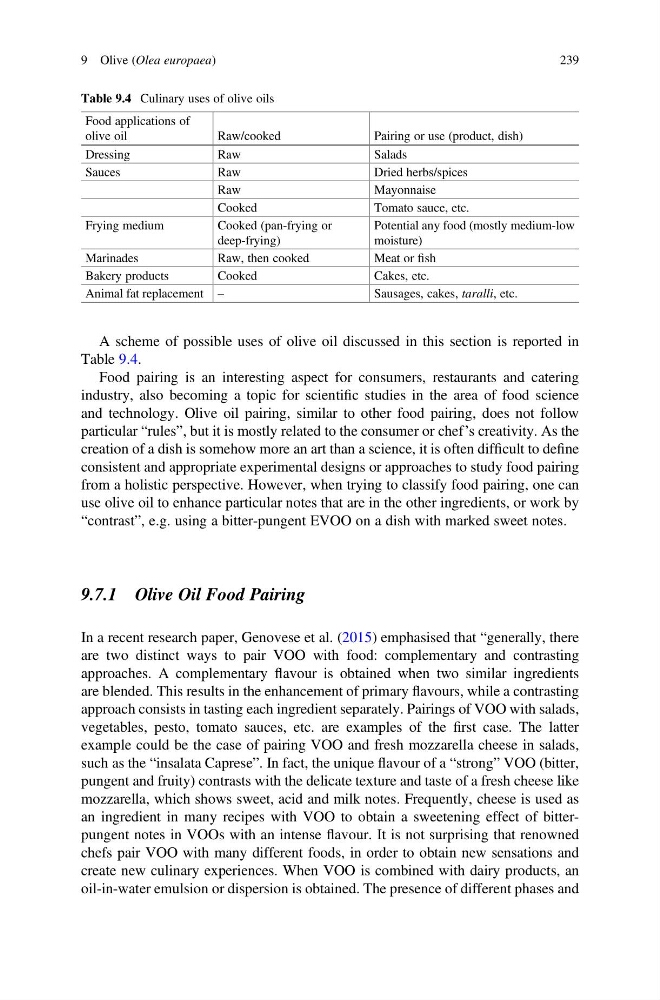
A scheme of possible uses of olive oil discussed in this section is reported in
Table 9.4.
Food pairing is an interesting aspect for consumers, restaurants and catering
industry, also becoming a topic for scientific studies in the area of food science
and technology. Olive oil pairing, similar to other food pairing, does not follow
particular “rules”, but it is mostly related to the consumer or chef’s creativity. As the
creation of a dish is somehow more an art than a science, it is often difficult to define
consistent and appropriate experimental designs or approaches to study food pairing
from a holistic perspective. However, when trying to classify food pairing, one can
use olive oil to enhance particular notes that are in the other ingredients, or work by
“contrast”, e.g. using a bitter-pungent EVOO on a dish with marked sweet notes.
9.7.1 Olive Oil Food Pairing
In a recent research paper, Genovese et al. (2015) emphasised that “generally, there
are two distinct ways to pair VOO with food: complementary and contrasting
approaches. A complementary flavour is obtained when two similar ingredients
are blended. This results in the enhancement of primary flavours, while a contrasting
approach consists in tasting each ingredient separately. Pairings of VOO with salads,
vegetables, pesto, tomato sauces, etc. are examples of the first case. The latter
example could be the case of pairing VOO and fresh mozzarella cheese in salads,
such as the “insalata Caprese”. In fact, the unique flavour of a “strong” VOO (bitter,
pungent and fruity) contrasts with the delicate texture and taste of a fresh cheese like
mozzarella, which shows sweet, acid and milk notes. Frequently, cheese is used as
an ingredient in many recipes with VOO to obtain a sweetening effect of bitterpungent notes in VOOs with an intense flavour. It is not surprising that renowned
chefs pair VOO with many different foods, in order to obtain new sensations and
create new culinary experiences. When VOO is combined with dairy products, an
oil-in-water emulsion or dispersion is obtained. The presence of different phases and
Table 9.4 Culinary uses of olive oils
Food applications of
olive oil
Raw/cooked
Pairing or use (product, dish)
Dressing
Raw
Salads
Sauces
Raw
Dried herbs/spices
Raw
Mayonnaise
Cooked
Tomato sauce, etc.
Frying medium
Cooked (pan-frying or
deep-frying)
Potential any food (mostly medium-low
moisture)
Marinades
Raw, then cooked
Meat or fish
Bakery products
Cooked
Cakes, etc.
Animal fat replacement –
Sausages, cakes, taralli, etc.
9 Olive (Olea europaea)
239
Table 9.4.
Food pairing is an interesting aspect for consumers, restaurants and catering
industry, also becoming a topic for scientific studies in the area of food science
and technology. Olive oil pairing, similar to other food pairing, does not follow
particular “rules”, but it is mostly related to the consumer or chef’s creativity. As the
creation of a dish is somehow more an art than a science, it is often difficult to define
consistent and appropriate experimental designs or approaches to study food pairing
from a holistic perspective. However, when trying to classify food pairing, one can
use olive oil to enhance particular notes that are in the other ingredients, or work by
“contrast”, e.g. using a bitter-pungent EVOO on a dish with marked sweet notes.
9.7.1 Olive Oil Food Pairing
In a recent research paper, Genovese et al. (2015) emphasised that “generally, there
are two distinct ways to pair VOO with food: complementary and contrasting
approaches. A complementary flavour is obtained when two similar ingredients
are blended. This results in the enhancement of primary flavours, while a contrasting
approach consists in tasting each ingredient separately. Pairings of VOO with salads,
vegetables, pesto, tomato sauces, etc. are examples of the first case. The latter
example could be the case of pairing VOO and fresh mozzarella cheese in salads,
such as the “insalata Caprese”. In fact, the unique flavour of a “strong” VOO (bitter,
pungent and fruity) contrasts with the delicate texture and taste of a fresh cheese like
mozzarella, which shows sweet, acid and milk notes. Frequently, cheese is used as
an ingredient in many recipes with VOO to obtain a sweetening effect of bitterpungent notes in VOOs with an intense flavour. It is not surprising that renowned
chefs pair VOO with many different foods, in order to obtain new sensations and
create new culinary experiences. When VOO is combined with dairy products, an
oil-in-water emulsion or dispersion is obtained. The presence of different phases and
Table 9.4 Culinary uses of olive oils
Food applications of
olive oil
Raw/cooked
Pairing or use (product, dish)
Dressing
Raw
Salads
Sauces
Raw
Dried herbs/spices
Raw
Mayonnaise
Cooked
Tomato sauce, etc.
Frying medium
Cooked (pan-frying or
deep-frying)
Potential any food (mostly medium-low
moisture)
Marinades
Raw, then cooked
Meat or fish
Bakery products
Cooked
Cakes, etc.
Animal fat replacement –
Sausages, cakes, taralli, etc.
9 Olive (Olea europaea)
239