

(e.g. NaOH); however, many variants exist depending on the location, traditional
practices and the desired characteristics of the final product (Piperno et al. 2004).
The composition of table olives can vary depending on the processing, as shown in
Table 9.3.
Table olives can show a wide range of colours, from green to turning colour or
completely black. They can undergo fermentation, but it is not necessary when
methods involving only the use of alkaline treatments are applied. Sevillan of
Spanish-style olives are green olives debittered with NaOH, followed by several
washing treatments to remove the sodium hydroxide. The olives are eventually
stored in brine to allow fermentation. Castelvetrano-style olives are produced by
adding NaOH and salt almost at the same time, by leaving the alkaline brine for
8–10 days. Compared to the Spanish style, Castelvetrano-style olives are softened
more quickly and have a deeper green colour. Other traditional treatments include
the use of lime and ash, which have been historically used as a way to alkalinise the
olives in order to debitter the product. The “natural turning colour olives” are
produced using sodium chloride only, to stimulate the microflora that starts the
fermentation process, typically under anaerobic conditions. Itrana-style green olives
are produced by using an initial immersion in water (without salt) for 10–30 days,
after which salt is added and fermentation takes place up to 6 months. Other typical
table olives are produced by manually crushing the fruit after harvesting and
washing the olives several times by leaving them in water. Another production
method includes the use of very well ripe olives (black colour), which are packed
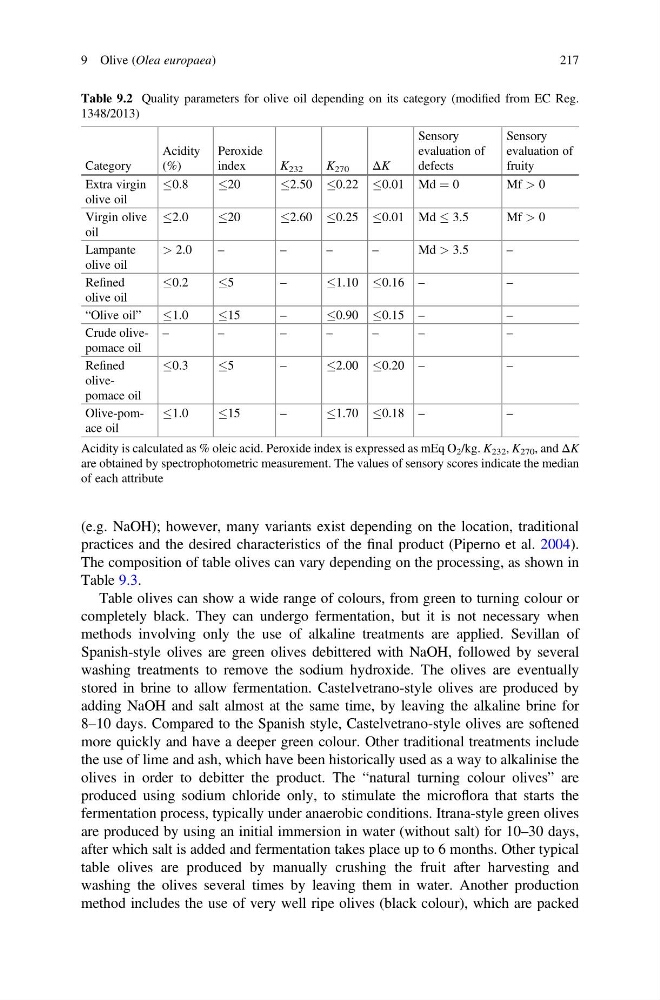
Table 9.2 Quality parameters for olive oil depending on its category (modified from EC Reg.
1348/2013)
Category
Acidity
(%)
Peroxide
index
K 232
K 270
ΔK
Sensory
evaluation of
defects
Sensory
evaluation of
fruity
Extra virgin
olive oil
0.8
20
2.50
0.22
0.01 Md ¼ 0
M f> 0
Virgin olive
oil
2.0
20
2.60
0.25
0.01 Md 3.5
Mf > 0
Lampante
olive oil
> 2.0
–
–
–
–
Md > 3.5
–
Refined
olive oil
0.2
5
–
1.10
0.16 –
–
“Olive oil”
1.0
15
–
0.90
0.15 –
–
Crude olivepomace oil
–
–
–
–
–
–
–
Refined
olivepomace oil
0.3
5
–
2.00
0.20 –
–
Olive-pomace oil
1.0
15
–
1.70
0.18 –
–
Acidity is calculated as % oleic acid. Peroxide index is expressed as mEq O 2 /kg. K 232 , K 270 , and ΔK
are obtained by spectrophotometric measurement. The values of sensory scores indicate the median
of each attribute
9 Olive (Olea europaea)
217
practices and the desired characteristics of the final product (Piperno et al. 2004).
The composition of table olives can vary depending on the processing, as shown in
Table 9.3.
Table olives can show a wide range of colours, from green to turning colour or
completely black. They can undergo fermentation, but it is not necessary when
methods involving only the use of alkaline treatments are applied. Sevillan of
Spanish-style olives are green olives debittered with NaOH, followed by several
washing treatments to remove the sodium hydroxide. The olives are eventually
stored in brine to allow fermentation. Castelvetrano-style olives are produced by
adding NaOH and salt almost at the same time, by leaving the alkaline brine for
8–10 days. Compared to the Spanish style, Castelvetrano-style olives are softened
more quickly and have a deeper green colour. Other traditional treatments include
the use of lime and ash, which have been historically used as a way to alkalinise the
olives in order to debitter the product. The “natural turning colour olives” are
produced using sodium chloride only, to stimulate the microflora that starts the
fermentation process, typically under anaerobic conditions. Itrana-style green olives
are produced by using an initial immersion in water (without salt) for 10–30 days,
after which salt is added and fermentation takes place up to 6 months. Other typical
table olives are produced by manually crushing the fruit after harvesting and
washing the olives several times by leaving them in water. Another production
method includes the use of very well ripe olives (black colour), which are packed
Table 9.2 Quality parameters for olive oil depending on its category (modified from EC Reg.
1348/2013)
Category
Acidity
(%)
Peroxide
index
K 232
K 270
ΔK
Sensory
evaluation of
defects
Sensory
evaluation of
fruity
Extra virgin
olive oil
0.8
20
2.50
0.22
0.01 Md ¼ 0
M f> 0
Virgin olive
oil
2.0
20
2.60
0.25
0.01 Md 3.5
Mf > 0
Lampante
olive oil
> 2.0
–
–
–
–
Md > 3.5
–
Refined
olive oil
0.2
5
–
1.10
0.16 –
–
“Olive oil”
1.0
15
–
0.90
0.15 –
–
Crude olivepomace oil
–
–
–
–
–
–
–
Refined
olivepomace oil
0.3
5
–
2.00
0.20 –
–
Olive-pomace oil
1.0
15
–
1.70
0.18 –
–
Acidity is calculated as % oleic acid. Peroxide index is expressed as mEq O 2 /kg. K 232 , K 270 , and ΔK
are obtained by spectrophotometric measurement. The values of sensory scores indicate the median
of each attribute
9 Olive (Olea europaea)
217