

8.1 Origin and History of Usage
Brassica nigra or black mustard seeds belong to the family Brassicaceae and order
Brassicales. The family Brassicaceae itself has 338 genera and 3709 species
(Monsalve et al. 2001). The word ‘mustard’ was derived from the European practice
of mixing the sweet ‘must’ of old wine with crushed seeds of B. nigra to form a hot
paste (‘hot must’ or ‘mustum ardens’), hence the modern term ‘mustard’ (Hemingway 1976). Plants belonging to the genus Brassica including B. nigra are primarily
grown as condiments (Alam et al. 2011; Augustine et al. 2014; Warwick et al. 2006;
Monsalve et al. 2001). These plants can be easily distinguished from other flowering
plants as they have cruciferous flowers (Augustine et al. 2014). The B. nigra plant
grows up to 2 m and requires no vernalization for flower induction. The flowers are
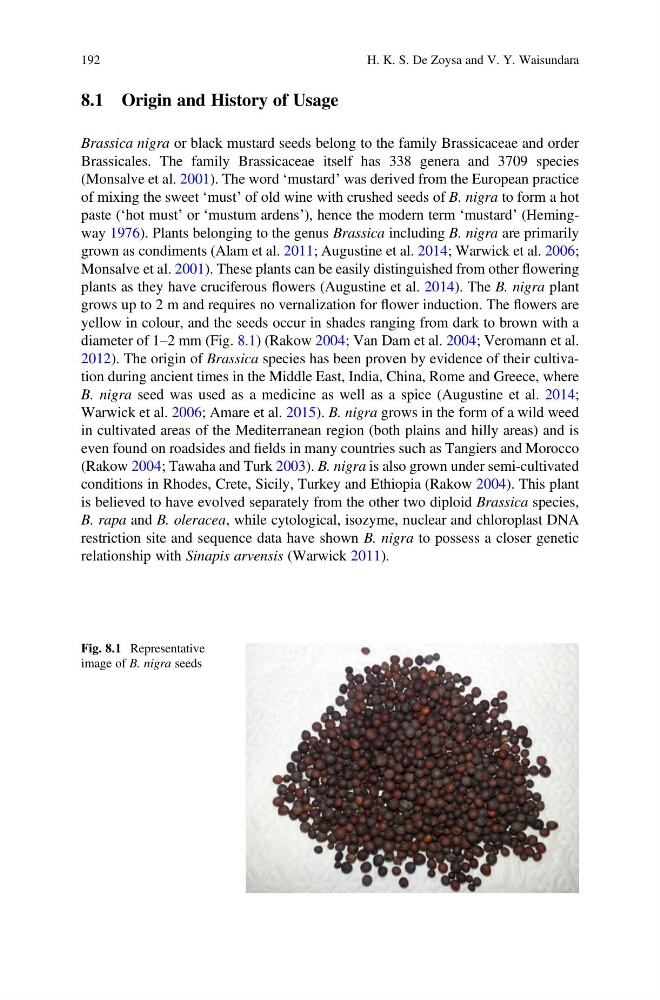
yellow in colour, and the seeds occur in shades ranging from dark to brown with a
diameter of 1–2 mm (Fig. 8.1) (Rakow 2004; Van Dam et al. 2004; Veromann et al.
2012). The origin of Brassica species has been proven by evidence of their cultivation during ancient times in the Middle East, India, China, Rome and Greece, where
B. nigra seed was used as a medicine as well as a spice (Augustine et al. 2014;
Warwick et al. 2006; Amare et al. 2015). B. nigra grows in the form of a wild weed
in cultivated areas of the Mediterranean region (both plains and hilly areas) and is
even found on roadsides and fields in many countries such as Tangiers and Morocco
(Rakow 2004; Tawaha and Turk 2003). B. nigra is also grown under semi-cultivated
conditions in Rhodes, Crete, Sicily, Turkey and Ethiopia (Rakow 2004). This plant
is believed to have evolved separately from the other two diploid Brassica species,
B. rapa and B. oleracea, while cytological, isozyme, nuclear and chloroplast DNA
restriction site and sequence data have shown B. nigra to possess a closer genetic
relationship with Sinapis arvensis (Warwick 2011).
Fig. 8.1 Representative
image of B. nigra seeds
192
H. K. S. De Zoysa and V. Y. Waisundara
Brassica nigra or black mustard seeds belong to the family Brassicaceae and order
Brassicales. The family Brassicaceae itself has 338 genera and 3709 species
(Monsalve et al. 2001). The word ‘mustard’ was derived from the European practice
of mixing the sweet ‘must’ of old wine with crushed seeds of B. nigra to form a hot
paste (‘hot must’ or ‘mustum ardens’), hence the modern term ‘mustard’ (Hemingway 1976). Plants belonging to the genus Brassica including B. nigra are primarily
grown as condiments (Alam et al. 2011; Augustine et al. 2014; Warwick et al. 2006;
Monsalve et al. 2001). These plants can be easily distinguished from other flowering
plants as they have cruciferous flowers (Augustine et al. 2014). The B. nigra plant
grows up to 2 m and requires no vernalization for flower induction. The flowers are
yellow in colour, and the seeds occur in shades ranging from dark to brown with a
diameter of 1–2 mm (Fig. 8.1) (Rakow 2004; Van Dam et al. 2004; Veromann et al.
2012). The origin of Brassica species has been proven by evidence of their cultivation during ancient times in the Middle East, India, China, Rome and Greece, where
B. nigra seed was used as a medicine as well as a spice (Augustine et al. 2014;
Warwick et al. 2006; Amare et al. 2015). B. nigra grows in the form of a wild weed
in cultivated areas of the Mediterranean region (both plains and hilly areas) and is
even found on roadsides and fields in many countries such as Tangiers and Morocco
(Rakow 2004; Tawaha and Turk 2003). B. nigra is also grown under semi-cultivated
conditions in Rhodes, Crete, Sicily, Turkey and Ethiopia (Rakow 2004). This plant
is believed to have evolved separately from the other two diploid Brassica species,
B. rapa and B. oleracea, while cytological, isozyme, nuclear and chloroplast DNA
restriction site and sequence data have shown B. nigra to possess a closer genetic
relationship with Sinapis arvensis (Warwick 2011).
Fig. 8.1 Representative
image of B. nigra seeds
192
H. K. S. De Zoysa and V. Y. Waisundara