

7.3.2 Coconut Kernel
Coconut kernel also called coconut meat is the endosperm of the fruit covered by a
brown-colored layer called testa. Generally, the dried coconut kernel is used for the
extraction of coconut oil. The virgin coconut oil is the one that is extracted from
dried kernel or copra and doesn’t go any chemical refining process. The percentage
oil in the kernel is the measure of the richness of coconut kernel. The weight of
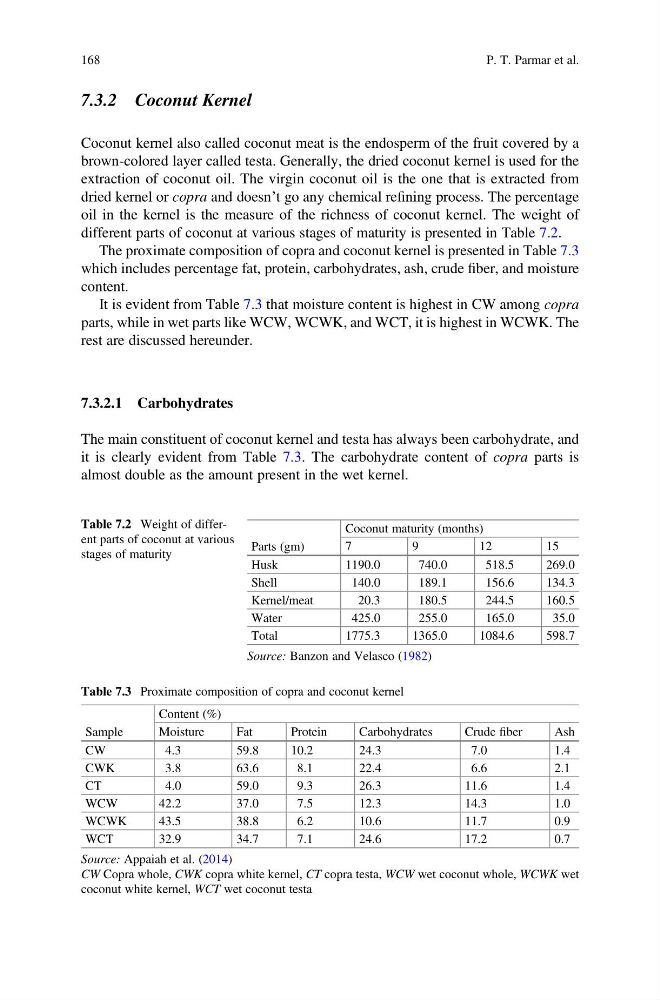
different parts of coconut at various stages of maturity is presented in Table 7.2.
The proximate composition of copra and coconut kernel is presented in Table 7.3
which includes percentage fat, protein, carbohydrates, ash, crude fiber, and moisture
content.
It is evident from Table 7.3 that moisture content is highest in CW among copra
parts, while in wet parts like WCW, WCWK, and WCT, it is highest in WCWK. The
rest are discussed hereunder.
7.3.2.1 Carbohydrates
The main constituent of coconut kernel and testa has always been carbohydrate, and
it is clearly evident from Table 7.3. The carbohydrate content of copra parts is
almost double as the amount present in the wet kernel.
Table 7.2 Weight of different parts of coconut at various
stages of maturity
Parts (gm)
Coconut maturity (months)
7
9
12
15
Husk
1190.0
740.0
518.5
269.0
Shell
140.0
189.1
156.6
134.3
Kernel/meat
20.3
180.5
244.5
160.5
Water
425.0
255.0
165.0
35.0
Total
1775.3
1365.0
1084.6
598.7
Source: Banzon and Velasco (1982)
Table 7.3 Proximate composition of copra and coconut kernel
Sample
Content (%)
Moisture
Fat
Protein
Carbohydrates
Crude fiber
Ash
CW
4.3
59.8
10.2
24.3
7.0
1.4
CWK
3.8
63.6
8.1
22.4
6.6
2.1
CT
4.0
59.0
9.3
26.3
11.6
1.4
WCW
42.2
37.0
7.5
12.3
14.3
1.0
WCWK
43.5
38.8
6.2
10.6
11.7
0.9
WCT
32.9
34.7
7.1
24.6
17.2
0.7
Source: Appaiah et al. (2014)
CW Copra whole, CWK copra white kernel, CT copra testa, WCW wet coconut whole, WCWK wet
coconut white kernel, WCT wet coconut testa
168
P. T. Parmar et al.
Coconut kernel also called coconut meat is the endosperm of the fruit covered by a
brown-colored layer called testa. Generally, the dried coconut kernel is used for the
extraction of coconut oil. The virgin coconut oil is the one that is extracted from
dried kernel or copra and doesn’t go any chemical refining process. The percentage
oil in the kernel is the measure of the richness of coconut kernel. The weight of
different parts of coconut at various stages of maturity is presented in Table 7.2.
The proximate composition of copra and coconut kernel is presented in Table 7.3
which includes percentage fat, protein, carbohydrates, ash, crude fiber, and moisture
content.
It is evident from Table 7.3 that moisture content is highest in CW among copra
parts, while in wet parts like WCW, WCWK, and WCT, it is highest in WCWK. The
rest are discussed hereunder.
7.3.2.1 Carbohydrates
The main constituent of coconut kernel and testa has always been carbohydrate, and
it is clearly evident from Table 7.3. The carbohydrate content of copra parts is
almost double as the amount present in the wet kernel.
Table 7.2 Weight of different parts of coconut at various
stages of maturity
Parts (gm)
Coconut maturity (months)
7
9
12
15
Husk
1190.0
740.0
518.5
269.0
Shell
140.0
189.1
156.6
134.3
Kernel/meat
20.3
180.5
244.5
160.5
Water
425.0
255.0
165.0
35.0
Total
1775.3
1365.0
1084.6
598.7
Source: Banzon and Velasco (1982)
Table 7.3 Proximate composition of copra and coconut kernel
Sample
Content (%)
Moisture
Fat
Protein
Carbohydrates
Crude fiber
Ash
CW
4.3
59.8
10.2
24.3
7.0
1.4
CWK
3.8
63.6
8.1
22.4
6.6
2.1
CT
4.0
59.0
9.3
26.3
11.6
1.4
WCW
42.2
37.0
7.5
12.3
14.3
1.0
WCWK
43.5
38.8
6.2
10.6
11.7
0.9
WCT
32.9
34.7
7.1
24.6
17.2
0.7
Source: Appaiah et al. (2014)
CW Copra whole, CWK copra white kernel, CT copra testa, WCW wet coconut whole, WCWK wet
coconut white kernel, WCT wet coconut testa
168
P. T. Parmar et al.