

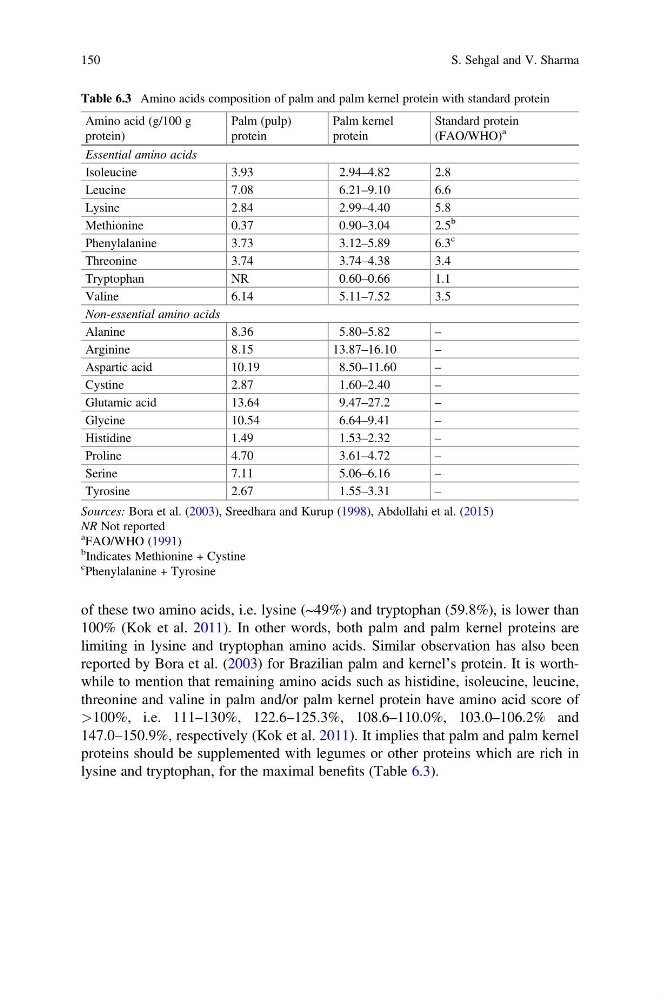
of these two amino acids, i.e. lysine (~49%) and tryptophan (59.8%), is lower than
100% (Kok et al. 2011). In other words, both palm and palm kernel proteins are
limiting in lysine and tryptophan amino acids. Similar observation has also been
reported by Bora et al. (2003) for Brazilian palm and kernel’s protein. It is worthwhile to mention that remaining amino acids such as histidine, isoleucine, leucine,
threonine and valine in palm and/or palm kernel protein have amino acid score of
>100%, i.e. 111–130%, 122.6–125.3%, 108.6–110.0%, 103.0–106.2% and
147.0–150.9%, respectively (Kok et al. 2011). It implies that palm and palm kernel
proteins should be supplemented with legumes or other proteins which are rich in
lysine and tryptophan, for the maximal benefits (Table 6.3).
Table 6.3 Amino acids composition of palm and palm kernel protein with standard protein
Amino acid (g/100 g
protein)
Palm (pulp)
protein
Palm kernel
protein
Standard protein
(FAO/WHO)
a
Essential amino acids
Isoleucine
3.93
2.94–4.82
2.8
Leucine
7.08
6.21–9.10
6.6
Lysine
2.84
2.99–4.40
5.8
Methionine
0.37
0.90–3.04
2.5
b
Phenylalanine
3.73
3.12–5.89
6.3
c
Threonine
3.74
3.74–4.38
3.4
Tryptophan
NR
0.60–0.66
1.1
Valine
6.14
5.11–7.52
3.5
Non-essential amino acids
Alanine
8.36
5.80–5.82
–
Arginine
8.15
13.87–16.10
–
Aspartic acid
10.19
8.50–11.60
–
Cystine
2.87
1.60–2.40
–
Glutamic acid
13.64
9.47–27.2
–
Glycine
10.54
6.64–9.41
–
Histidine
1.49
1.53–2.32
–
Proline
4.70
3.61–4.72
–
Serine
7.11
5.06–6.16
–
Tyrosine
2.67
1.55–3.31
–
Sources: Bora et al. (2003), Sreedhara and Kurup (1998), Abdollahi et al. (2015)
NR Not reported
a FAO/WHO (1991)
b
Indicates Methionine + Cystine
c Phenylalanine + Tyrosine
150
S. Sehgal and V. Sharma
100% (Kok et al. 2011). In other words, both palm and palm kernel proteins are
limiting in lysine and tryptophan amino acids. Similar observation has also been
reported by Bora et al. (2003) for Brazilian palm and kernel’s protein. It is worthwhile to mention that remaining amino acids such as histidine, isoleucine, leucine,
threonine and valine in palm and/or palm kernel protein have amino acid score of
>100%, i.e. 111–130%, 122.6–125.3%, 108.6–110.0%, 103.0–106.2% and
147.0–150.9%, respectively (Kok et al. 2011). It implies that palm and palm kernel
proteins should be supplemented with legumes or other proteins which are rich in
lysine and tryptophan, for the maximal benefits (Table 6.3).
Table 6.3 Amino acids composition of palm and palm kernel protein with standard protein
Amino acid (g/100 g
protein)
Palm (pulp)
protein
Palm kernel
protein
Standard protein
(FAO/WHO)
a
Essential amino acids
Isoleucine
3.93
2.94–4.82
2.8
Leucine
7.08
6.21–9.10
6.6
Lysine
2.84
2.99–4.40
5.8
Methionine
0.37
0.90–3.04
2.5
b
Phenylalanine
3.73
3.12–5.89
6.3
c
Threonine
3.74
3.74–4.38
3.4
Tryptophan
NR
0.60–0.66
1.1
Valine
6.14
5.11–7.52
3.5
Non-essential amino acids
Alanine
8.36
5.80–5.82
–
Arginine
8.15
13.87–16.10
–
Aspartic acid
10.19
8.50–11.60
–
Cystine
2.87
1.60–2.40
–
Glutamic acid
13.64
9.47–27.2
–
Glycine
10.54
6.64–9.41
–
Histidine
1.49
1.53–2.32
–
Proline
4.70
3.61–4.72
–
Serine
7.11
5.06–6.16
–
Tyrosine
2.67
1.55–3.31
–
Sources: Bora et al. (2003), Sreedhara and Kurup (1998), Abdollahi et al. (2015)
NR Not reported
a FAO/WHO (1991)
b
Indicates Methionine + Cystine
c Phenylalanine + Tyrosine
150
S. Sehgal and V. Sharma