

functions in plant ecosystems. Some flavonoids are brightly colored, imparting color
to the flower which in turn attract insects for pollination. Another property of
flavonoids is their astringency (Tanwar et al. 2018) which also indicates their role
in plant immunity (Brunetti et al. 2013). Overview of plant flavonoids and their
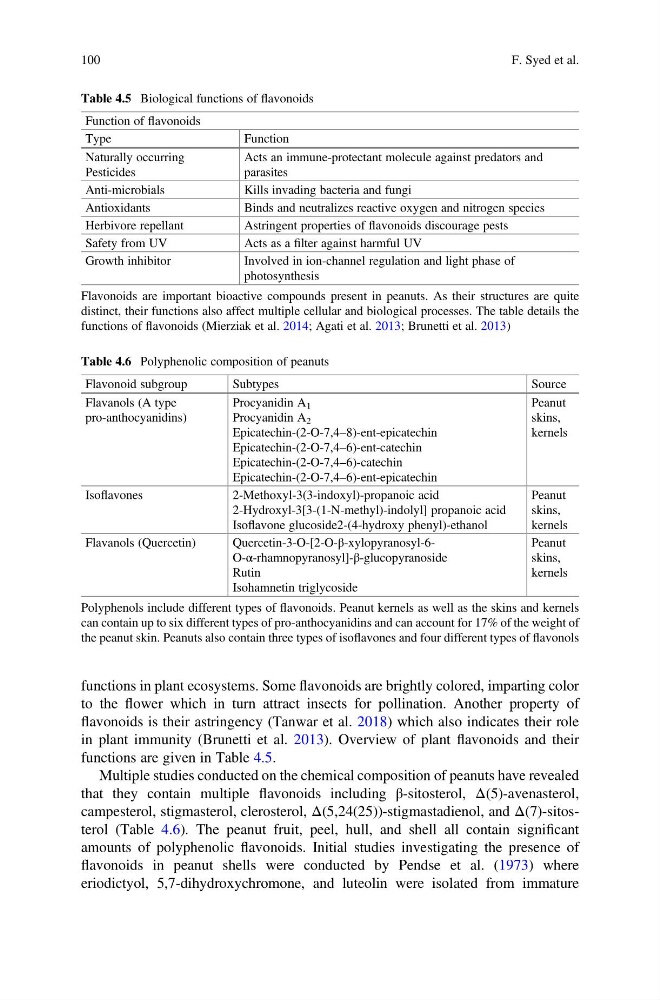
functions are given in Table 4.5.
Multiple studies conducted on the chemical composition of peanuts have revealed
that they contain multiple flavonoids including β-sitosterol, Δ(5)-avenasterol,
campesterol, stigmasterol, clerosterol, Δ(5,24(25))-stigmastadienol, and Δ(7)-sitosterol (Table 4.6). The peanut fruit, peel, hull, and shell all contain significant
amounts of polyphenolic flavonoids. Initial studies investigating the presence of
flavonoids in peanut shells were conducted by Pendse et al. (1973) where
eriodictyol, 5,7-dihydroxychromone, and luteolin were isolated from immature
Table 4.5 Biological functions of flavonoids
Function of flavonoids
Type
Function
Naturally occurring
Pesticides
Acts an immune-protectant molecule against predators and
parasites
Anti-microbials
Kills invading bacteria and fungi
Antioxidants
Binds and neutralizes reactive oxygen and nitrogen species
Herbivore repellant
Astringent properties of flavonoids discourage pests
Safety from UV
Acts as a filter against harmful UV
Growth inhibitor
Involved in ion-channel regulation and light phase of
photosynthesis
Flavonoids are important bioactive compounds present in peanuts. As their structures are quite
distinct, their functions also affect multiple cellular and biological processes. The table details the
functions of flavonoids (Mierziak et al. 2014; Agati et al. 2013; Brunetti et al. 2013)
Table 4.6 Polyphenolic composition of peanuts
Flavonoid subgroup
Subtypes
Source
Flavanols (A type
pro-anthocyanidins)
Procyanidin A 1
Procyanidin A 2
Epicatechin-(2-O-7,4–8)-ent-epicatechin
Epicatechin-(2-O-7,4–6)-ent-catechin
Epicatechin-(2-O-7,4–6)-catechin
Epicatechin-(2-O-7,4–6)-ent-epicatechin
Peanut
skins,
kernels
Isoflavones
2-Methoxyl-3(3-indoxyl)-propanoic acid
2-Hydroxyl-3[3-(1-N-methyl)-indolyl] propanoic acid
Isoflavone glucoside2-(4-hydroxy phenyl)-ethanol
Peanut
skins,
kernels
Flavanols (Quercetin)
Quercetin-3-O-[2-O-β-xylopyranosyl-6O-α-rhamnopyranosyl]-β-glucopyranoside
Rutin
Isohamnetin triglycoside
Peanut
skins,
kernels
Polyphenols include different types of flavonoids. Peanut kernels as well as the skins and kernels
can contain up to six different types of pro-anthocyanidins and can account for 17% of the weight of
the peanut skin. Peanuts also contain three types of isoflavones and four different types of flavonols
100
F. Syed et al.
to the flower which in turn attract insects for pollination. Another property of
flavonoids is their astringency (Tanwar et al. 2018) which also indicates their role
in plant immunity (Brunetti et al. 2013). Overview of plant flavonoids and their
functions are given in Table 4.5.
Multiple studies conducted on the chemical composition of peanuts have revealed
that they contain multiple flavonoids including β-sitosterol, Δ(5)-avenasterol,
campesterol, stigmasterol, clerosterol, Δ(5,24(25))-stigmastadienol, and Δ(7)-sitosterol (Table 4.6). The peanut fruit, peel, hull, and shell all contain significant
amounts of polyphenolic flavonoids. Initial studies investigating the presence of
flavonoids in peanut shells were conducted by Pendse et al. (1973) where
eriodictyol, 5,7-dihydroxychromone, and luteolin were isolated from immature
Table 4.5 Biological functions of flavonoids
Function of flavonoids
Type
Function
Naturally occurring
Pesticides
Acts an immune-protectant molecule against predators and
parasites
Anti-microbials
Kills invading bacteria and fungi
Antioxidants
Binds and neutralizes reactive oxygen and nitrogen species
Herbivore repellant
Astringent properties of flavonoids discourage pests
Safety from UV
Acts as a filter against harmful UV
Growth inhibitor
Involved in ion-channel regulation and light phase of
photosynthesis
Flavonoids are important bioactive compounds present in peanuts. As their structures are quite
distinct, their functions also affect multiple cellular and biological processes. The table details the
functions of flavonoids (Mierziak et al. 2014; Agati et al. 2013; Brunetti et al. 2013)
Table 4.6 Polyphenolic composition of peanuts
Flavonoid subgroup
Subtypes
Source
Flavanols (A type
pro-anthocyanidins)
Procyanidin A 1
Procyanidin A 2
Epicatechin-(2-O-7,4–8)-ent-epicatechin
Epicatechin-(2-O-7,4–6)-ent-catechin
Epicatechin-(2-O-7,4–6)-catechin
Epicatechin-(2-O-7,4–6)-ent-epicatechin
Peanut
skins,
kernels
Isoflavones
2-Methoxyl-3(3-indoxyl)-propanoic acid
2-Hydroxyl-3[3-(1-N-methyl)-indolyl] propanoic acid
Isoflavone glucoside2-(4-hydroxy phenyl)-ethanol
Peanut
skins,
kernels
Flavanols (Quercetin)
Quercetin-3-O-[2-O-β-xylopyranosyl-6O-α-rhamnopyranosyl]-β-glucopyranoside
Rutin
Isohamnetin triglycoside
Peanut
skins,
kernels
Polyphenols include different types of flavonoids. Peanut kernels as well as the skins and kernels
can contain up to six different types of pro-anthocyanidins and can account for 17% of the weight of
the peanut skin. Peanuts also contain three types of isoflavones and four different types of flavonols
100
F. Syed et al.