

500 mm of water, and loamy-sandy soil that has a pH of 5.9–7. Additionally,
potassium, phosphorus, magnesium, and other micronutrients are necessary for a
higher peanut yield. Moreover, peanut root nodules contain nitrogen-fixing bacteria
that enrich the nitrogen content of the soil and in turn reduce the consumption of
nitrogen fertilizers.
A. hypogea continues to flower even after an initial round of pollination and
fertilization; this results in mature as well as developing pods, and hence, the harvest
must be carefully timed to avoid unripe pods (if removed too early) or overly ripe
pods that tend to remain in the ground (if removed too late) (Vellidis et al. 2014).
During harvesting, the entire plant is uprooted, and the pods are used for human
consumption or oil production, whereas the leaves and stalks are used as animal
feed. Conventionally, the A. hypogea plant was pulled by hand, inverted, and left on
the ground to dry with the pods exposed to the air. After a period of 3–4 days, the
pods loose approximately 75% of their moisture, and at this point the peanuts are
shaken to remove the dry pods from the bush. Currently, the harvesting process is
accomplished through machines that in the first step uproot the plant and invert it on
the soil; the pods are dried and threshed to separate the pods from the bush (Vellidis
et al. 2014).
Storage is also crucial for the peanuts where moisture content is of utmost
importance. After the harvest, the peanuts must be stored in a dry place; otherwise
there is a risk of development of mold Aspergillus flavus which produces aflatoxin, a
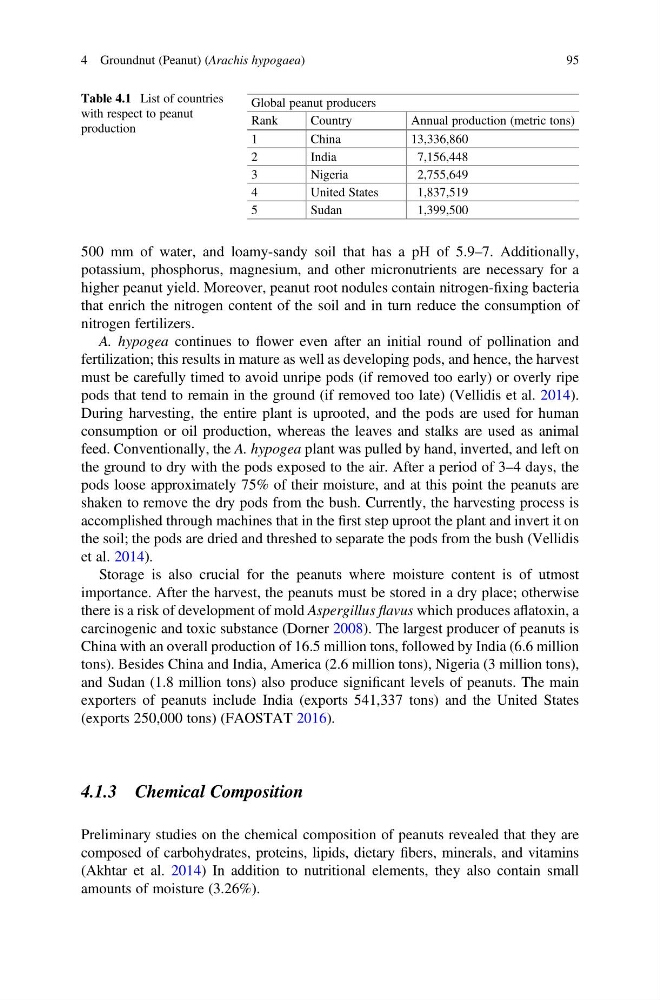
carcinogenic and toxic substance (Dorner 2008). The largest producer of peanuts is
China with an overall production of 16.5 million tons, followed by India (6.6 million
tons). Besides China and India, America (2.6 million tons), Nigeria (3 million tons),
and Sudan (1.8 million tons) also produce significant levels of peanuts. The main
exporters of peanuts include India (exports 541,337 tons) and the United States
(exports 250,000 tons) (FAOSTAT 2016).
4.1.3 Chemical Composition
Preliminary studies on the chemical composition of peanuts revealed that they are
composed of carbohydrates, proteins, lipids, dietary fibers, minerals, and vitamins
(Akhtar et al. 2014) In addition to nutritional elements, they also contain small
amounts of moisture (3.26%).
Table 4.1 List of countries
with respect to peanut
production
Global peanut producers
Rank
Country
Annual production (metric tons)
1
China
13,336,860
2
India
7,156,448
3
Nigeria
2,755,649
4
United States
1,837,519
5
Sudan
1,399,500
4 Groundnut (Peanut) (Arachis hypogaea)
9 5
potassium, phosphorus, magnesium, and other micronutrients are necessary for a
higher peanut yield. Moreover, peanut root nodules contain nitrogen-fixing bacteria
that enrich the nitrogen content of the soil and in turn reduce the consumption of
nitrogen fertilizers.
A. hypogea continues to flower even after an initial round of pollination and
fertilization; this results in mature as well as developing pods, and hence, the harvest
must be carefully timed to avoid unripe pods (if removed too early) or overly ripe
pods that tend to remain in the ground (if removed too late) (Vellidis et al. 2014).
During harvesting, the entire plant is uprooted, and the pods are used for human
consumption or oil production, whereas the leaves and stalks are used as animal
feed. Conventionally, the A. hypogea plant was pulled by hand, inverted, and left on
the ground to dry with the pods exposed to the air. After a period of 3–4 days, the
pods loose approximately 75% of their moisture, and at this point the peanuts are
shaken to remove the dry pods from the bush. Currently, the harvesting process is
accomplished through machines that in the first step uproot the plant and invert it on
the soil; the pods are dried and threshed to separate the pods from the bush (Vellidis
et al. 2014).
Storage is also crucial for the peanuts where moisture content is of utmost
importance. After the harvest, the peanuts must be stored in a dry place; otherwise
there is a risk of development of mold Aspergillus flavus which produces aflatoxin, a
carcinogenic and toxic substance (Dorner 2008). The largest producer of peanuts is
China with an overall production of 16.5 million tons, followed by India (6.6 million
tons). Besides China and India, America (2.6 million tons), Nigeria (3 million tons),
and Sudan (1.8 million tons) also produce significant levels of peanuts. The main
exporters of peanuts include India (exports 541,337 tons) and the United States
(exports 250,000 tons) (FAOSTAT 2016).
4.1.3 Chemical Composition
Preliminary studies on the chemical composition of peanuts revealed that they are
composed of carbohydrates, proteins, lipids, dietary fibers, minerals, and vitamins
(Akhtar et al. 2014) In addition to nutritional elements, they also contain small
amounts of moisture (3.26%).
Table 4.1 List of countries
with respect to peanut
production
Global peanut producers
Rank
Country
Annual production (metric tons)
1
China
13,336,860
2
India
7,156,448
3
Nigeria
2,755,649
4
United States
1,837,519
5
Sudan
1,399,500
4 Groundnut (Peanut) (Arachis hypogaea)
9 5