

2.1 Energy as a Commercial Entity
37
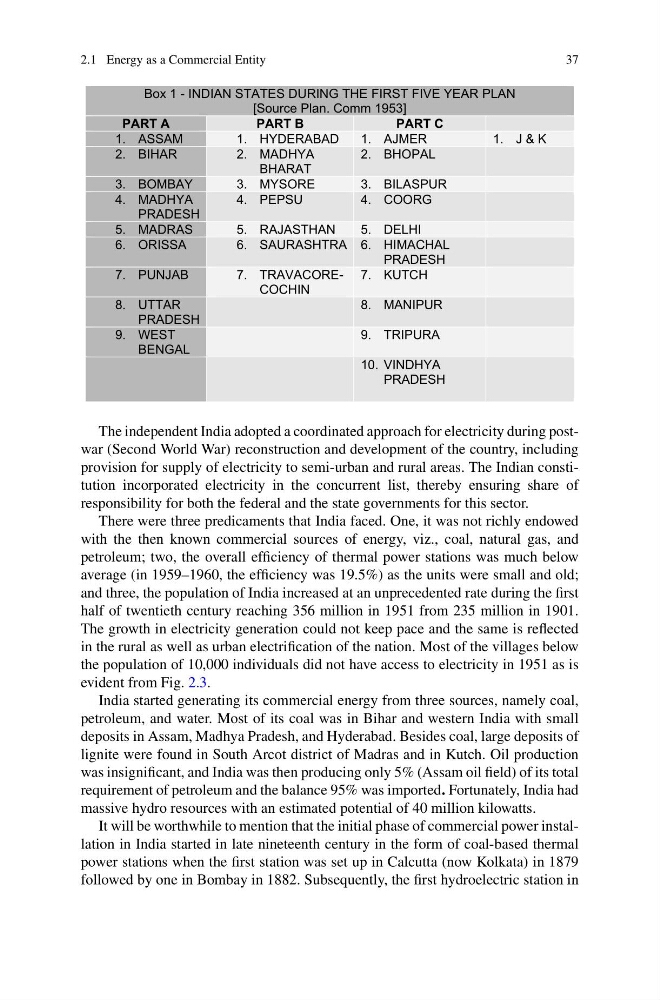
Box 1 - INDIAN STATES DURING THE FIRST FIVE YEAR PLAN
[Source Plan. Comm 1953]
PART A
PART B
PART C
1. ASSAM
1. HYDERABAD
1. AJMER
1. J & K
2. BIHAR
2. MADHYA
BHARAT
2. BHOPAL
3. BOMBAY
3. MYSORE
3. BILASPUR
4. MADHYA
PRADESH
4. PEPSU
4. COORG
5. MADRAS
5. RAJASTHAN
5. DELHI
6. ORISSA
6. SAURASHTRA 6. HIMACHAL
PRADESH
7. PUNJAB
7. TRAVACORECOCHIN
7. KUTCH
8. UTTAR
PRADESH
8. MANIPUR
9. WEST
BENGAL
9. TRIPURA
10. VINDHYA
PRADESH
The independent India adopted a coordinated approach for electricity during postwar (Second World War) reconstruction and development of the country, including
provision for supply of electricity to semi-urban and rural areas. The Indian constitution incorporated electricity in the concurrent list, thereby ensuring share of
responsibility for both the federal and the state governments for this sector.
There were three predicaments that India faced. One, it was not richly endowed
with the then known commercial sources of energy, viz., coal, natural gas, and
petroleum; two, the overall efficiency of thermal power stations was much below
average (in 1959–1960, the efficiency was 19.5%) as the units were small and old;
and three, the population of India increased at an unprecedented rate during the first
half of twentieth century reaching 356 million in 1951 from 235 million in 1901.
The growth in electricity generation could not keep pace and the same is reflected
in the rural as well as urban electrification of the nation. Most of the villages below
the population of 10,000 individuals did not have access to electricity in 1951 as is
evident from Fig. 2.3.
India started generating its commercial energy from three sources, namely coal,
petroleum, and water. Most of its coal was in Bihar and western India with small
deposits in Assam, Madhya Pradesh, and Hyderabad. Besides coal, large deposits of
lignite were found in South Arcot district of Madras and in Kutch. Oil production
was insignificant, and India was then producing only 5% (Assam oil field) of its total
requirement of petroleum and the balance 95% was imported. Fortunately, India had
massive hydro resources with an estimated potential of 40 million kilowatts.
It will be worthwhile to mention that the initial phase of commercial power installation in India started in late nineteenth century in the form of coal-based thermal
power stations when the first station was set up in Calcutta (now Kolkata) in 1879
followed by one in Bombay in 1882. Subsequently, the first hydroelectric station in
37
Box 1 - INDIAN STATES DURING THE FIRST FIVE YEAR PLAN
[Source Plan. Comm 1953]
PART A
PART B
PART C
1. ASSAM
1. HYDERABAD
1. AJMER
1. J & K
2. BIHAR
2. MADHYA
BHARAT
2. BHOPAL
3. BOMBAY
3. MYSORE
3. BILASPUR
4. MADHYA
PRADESH
4. PEPSU
4. COORG
5. MADRAS
5. RAJASTHAN
5. DELHI
6. ORISSA
6. SAURASHTRA 6. HIMACHAL
PRADESH
7. PUNJAB
7. TRAVACORECOCHIN
7. KUTCH
8. UTTAR
PRADESH
8. MANIPUR
9. WEST
BENGAL
9. TRIPURA
10. VINDHYA
PRADESH
The independent India adopted a coordinated approach for electricity during postwar (Second World War) reconstruction and development of the country, including
provision for supply of electricity to semi-urban and rural areas. The Indian constitution incorporated electricity in the concurrent list, thereby ensuring share of
responsibility for both the federal and the state governments for this sector.
There were three predicaments that India faced. One, it was not richly endowed
with the then known commercial sources of energy, viz., coal, natural gas, and
petroleum; two, the overall efficiency of thermal power stations was much below
average (in 1959–1960, the efficiency was 19.5%) as the units were small and old;
and three, the population of India increased at an unprecedented rate during the first
half of twentieth century reaching 356 million in 1951 from 235 million in 1901.
The growth in electricity generation could not keep pace and the same is reflected
in the rural as well as urban electrification of the nation. Most of the villages below
the population of 10,000 individuals did not have access to electricity in 1951 as is
evident from Fig. 2.3.
India started generating its commercial energy from three sources, namely coal,
petroleum, and water. Most of its coal was in Bihar and western India with small
deposits in Assam, Madhya Pradesh, and Hyderabad. Besides coal, large deposits of
lignite were found in South Arcot district of Madras and in Kutch. Oil production
was insignificant, and India was then producing only 5% (Assam oil field) of its total
requirement of petroleum and the balance 95% was imported. Fortunately, India had
massive hydro resources with an estimated potential of 40 million kilowatts.
It will be worthwhile to mention that the initial phase of commercial power installation in India started in late nineteenth century in the form of coal-based thermal
power stations when the first station was set up in Calcutta (now Kolkata) in 1879
followed by one in Bombay in 1882. Subsequently, the first hydroelectric station in