

22
1 Energy Security and Sustainability: An Overview
barrel) and then went up. Such fluctuations affect the foreign cash reserves in
fast-growing economies on the one hand and domestic production on the other.
5. Sustainability and quality: Since climate change impacts are real and are
been felt across the globe, quality of energy especially clean, renewable, uninterrupted, and sustainable source is the only option for future. At present, there
are many questions regarding sustainability of energy derived from solar and
wind and other renewable sources. The technology for conversion of renewable sources to energy is evolving and expensive vis-à-vis non-renewables.
Global annual investment in renewables is mere USD 300 billion annually as
compared to trillions of dollars of investment in coal, gas, and oil. With almost
85% vehicles predicted to run on internal combustion engine and China and
India accelerating their reliance on coal, the sustainability aspect will remain a
big question till the middle of this century.
6. Response time to transition: Pollution, radiation effects, and climate change
threats have forced the world to phase out non-renewable faster than expected
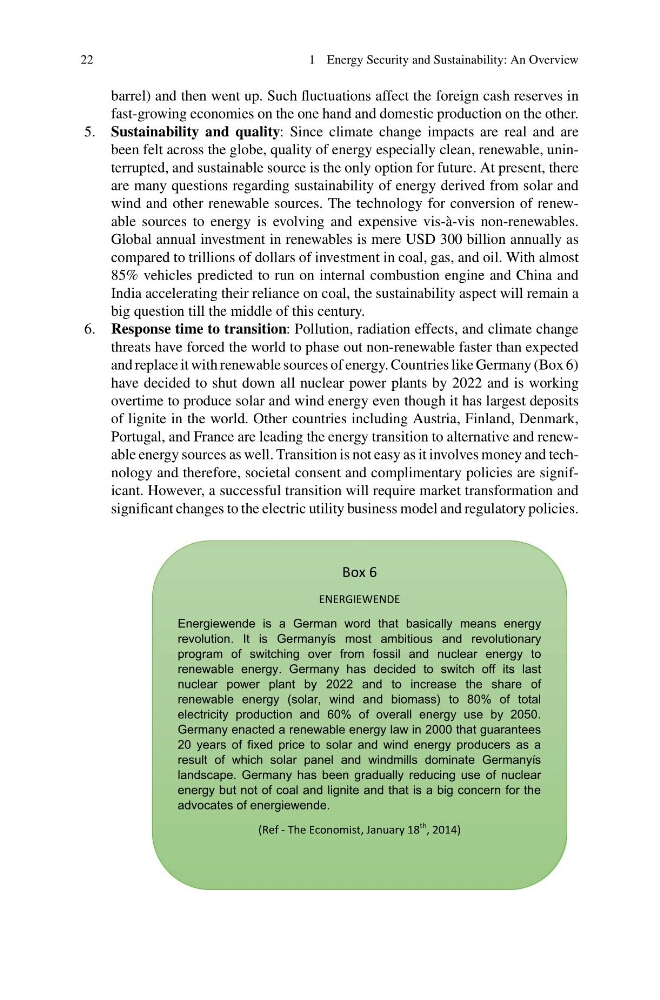
and replace it with renewable sources of energy. Countries like Germany (Box 6)
have decided to shut down all nuclear power plants by 2022 and is working
overtime to produce solar and wind energy even though it has largest deposits
of lignite in the world. Other countries including Austria, Finland, Denmark,
Portugal, and France are leading the energy transition to alternative and renewable energy sources as well. Transition is not easy as it involves money and technology and therefore, societal consent and complimentary policies are significant. However, a successful transition will require market transformation and
significant changes to the electric utility business model and regulatory policies.
Box 6
ENERGIEWENDE
Energiewende is a German word that basically means energy
revolution. It is Germanyís most ambitious and revolutionary
program of switching over from fossil and nuclear energy to
renewable energy. Germany has decided to switch off its last
nuclear power plant by 2022 and to increase the share of
renewable energy (solar, wind and biomass) to 80% of total
electricity production and 60% of overall energy use by 2050.
Germany enacted a renewable energy law in 2000 that guarantees
20 years of fixed price to solar and wind energy producers as a
result of which solar panel and windmills dominate Germanyís
landscape. Germany has been gradually reducing use of nuclear
energy but not of coal and lignite and that is a big concern for the
advocates of energiewende.
(Ref - The Economist, January 18
th
, 2014)
1 Energy Security and Sustainability: An Overview
barrel) and then went up. Such fluctuations affect the foreign cash reserves in
fast-growing economies on the one hand and domestic production on the other.
5. Sustainability and quality: Since climate change impacts are real and are
been felt across the globe, quality of energy especially clean, renewable, uninterrupted, and sustainable source is the only option for future. At present, there
are many questions regarding sustainability of energy derived from solar and
wind and other renewable sources. The technology for conversion of renewable sources to energy is evolving and expensive vis-à-vis non-renewables.
Global annual investment in renewables is mere USD 300 billion annually as
compared to trillions of dollars of investment in coal, gas, and oil. With almost
85% vehicles predicted to run on internal combustion engine and China and
India accelerating their reliance on coal, the sustainability aspect will remain a
big question till the middle of this century.
6. Response time to transition: Pollution, radiation effects, and climate change
threats have forced the world to phase out non-renewable faster than expected
and replace it with renewable sources of energy. Countries like Germany (Box 6)
have decided to shut down all nuclear power plants by 2022 and is working
overtime to produce solar and wind energy even though it has largest deposits
of lignite in the world. Other countries including Austria, Finland, Denmark,
Portugal, and France are leading the energy transition to alternative and renewable energy sources as well. Transition is not easy as it involves money and technology and therefore, societal consent and complimentary policies are significant. However, a successful transition will require market transformation and
significant changes to the electric utility business model and regulatory policies.
Box 6
ENERGIEWENDE
Energiewende is a German word that basically means energy
revolution. It is Germanyís most ambitious and revolutionary
program of switching over from fossil and nuclear energy to
renewable energy. Germany has decided to switch off its last
nuclear power plant by 2022 and to increase the share of
renewable energy (solar, wind and biomass) to 80% of total
electricity production and 60% of overall energy use by 2050.
Germany enacted a renewable energy law in 2000 that guarantees
20 years of fixed price to solar and wind energy producers as a
result of which solar panel and windmills dominate Germanyís
landscape. Germany has been gradually reducing use of nuclear
energy but not of coal and lignite and that is a big concern for the
advocates of energiewende.
(Ref - The Economist, January 18
th
, 2014)