

1.3 The Paradox of Energy Security and Sustainability
13
(Source-UNDP, HDR 2016]
AREA
INDICATOR
PERCENT SCORE
EducaƟon
School aƩainment: no household member
has completed at least six years of
schooling.
16.7
School aƩendance: a school-age child (up to
grade 8) is not aƩending school.
16.7
Health
NutriƟon: based on body mass index for
adults and by the height-for-age score
16.7
Child mortality: based on death of a child
five years prior to the survey.
16.7
Living Standard
Electricity: No access to electricity.
5.6
Drinking water: No access to clean drinking
water or having access through a source
that is located 30 minutes away or more by
walking.
5.6
SanitaƟon: No access to improved
sanitaƟon faciliƟes or having access only to
shared improved sanitaƟon faciliƟes.
5.6
Cooking fuel: using dung, wood or charcoal.
5.6
Having a home with dirt, sand or dung floor.
5.6
Assets: No access to at least one asset of
informaƟon (radio, television or telephone)
or having at least one asset related to
informaƟon but not having at least one
asset related to mobility (bike, motorbike,
car, truck, animal cart or motorboat) or at
least one asset related to livelihood
(refrigerator, arable land or livestock).
5.6
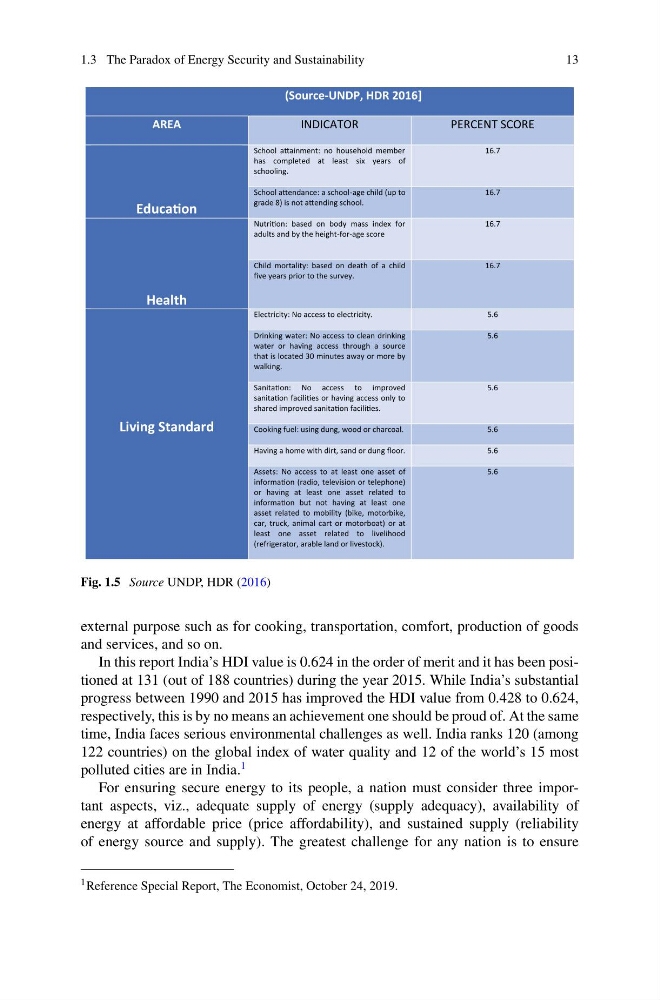
Fig. 1.5 Source UNDP, HDR (2016)
external purpose such as for cooking, transportation, comfort, production of goods
and services, and so on.
In this report India’s HDI value is 0.624 in the order of merit and it has been positioned at 131 (out of 188 countries) during the year 2015. While India’s substantial
progress between 1990 and 2015 has improved the HDI value from 0.428 to 0.624,
respectively, this is by no means an achievement one should be proud of. At the same
time, India faces serious environmental challenges as well. India ranks 120 (among
122 countries) on the global index of water quality and 12 of the world’s 15 most
polluted cities are in India.
1
For ensuring secure energy to its people, a nation must consider three important aspects, viz., adequate supply of energy (supply adequacy), availability of
energy at affordable price (price affordability), and sustained supply (reliability
of energy source and supply). The greatest challenge for any nation is to ensure
1 Reference Special Report, The Economist, October 24, 2019.
13
(Source-UNDP, HDR 2016]
AREA
INDICATOR
PERCENT SCORE
EducaƟon
School aƩainment: no household member
has completed at least six years of
schooling.
16.7
School aƩendance: a school-age child (up to
grade 8) is not aƩending school.
16.7
Health
NutriƟon: based on body mass index for
adults and by the height-for-age score
16.7
Child mortality: based on death of a child
five years prior to the survey.
16.7
Living Standard
Electricity: No access to electricity.
5.6
Drinking water: No access to clean drinking
water or having access through a source
that is located 30 minutes away or more by
walking.
5.6
SanitaƟon: No access to improved
sanitaƟon faciliƟes or having access only to
shared improved sanitaƟon faciliƟes.
5.6
Cooking fuel: using dung, wood or charcoal.
5.6
Having a home with dirt, sand or dung floor.
5.6
Assets: No access to at least one asset of
informaƟon (radio, television or telephone)
or having at least one asset related to
informaƟon but not having at least one
asset related to mobility (bike, motorbike,
car, truck, animal cart or motorboat) or at
least one asset related to livelihood
(refrigerator, arable land or livestock).
5.6
Fig. 1.5 Source UNDP, HDR (2016)
external purpose such as for cooking, transportation, comfort, production of goods
and services, and so on.
In this report India’s HDI value is 0.624 in the order of merit and it has been positioned at 131 (out of 188 countries) during the year 2015. While India’s substantial
progress between 1990 and 2015 has improved the HDI value from 0.428 to 0.624,
respectively, this is by no means an achievement one should be proud of. At the same
time, India faces serious environmental challenges as well. India ranks 120 (among
122 countries) on the global index of water quality and 12 of the world’s 15 most
polluted cities are in India.
1
For ensuring secure energy to its people, a nation must consider three important aspects, viz., adequate supply of energy (supply adequacy), availability of
energy at affordable price (price affordability), and sustained supply (reliability
of energy source and supply). The greatest challenge for any nation is to ensure
1 Reference Special Report, The Economist, October 24, 2019.