

5.7 Fourth Industrial Revolution and Global Energy Prospects
191
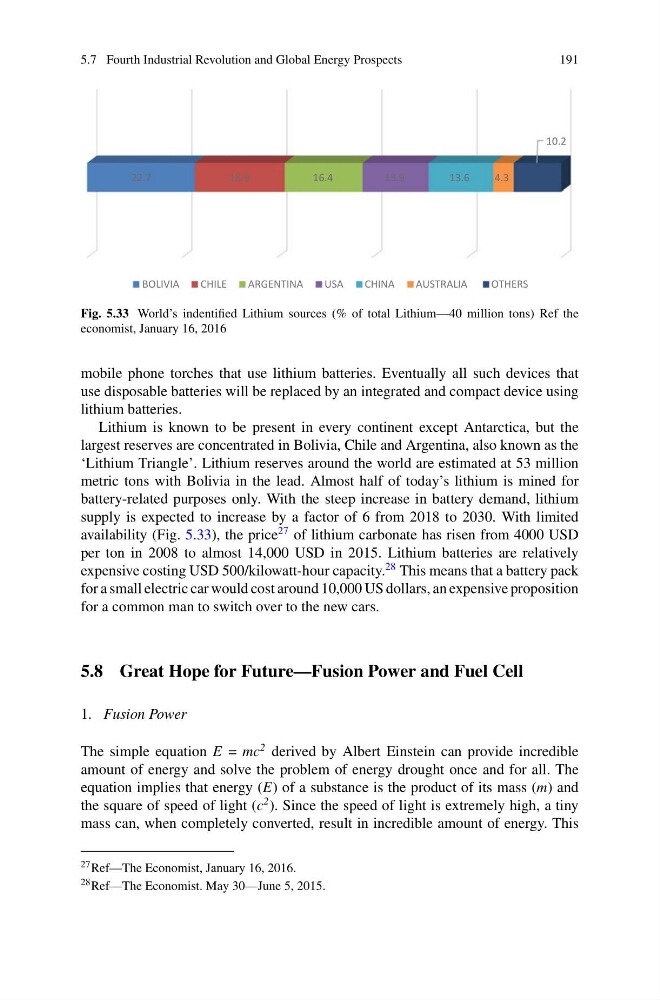
22.7
18.9
16.4
13.9
13.6
4.3
10.2
BOLIVIA
CHILE
ARGENTINA
USA
CHINA
AUSTRALIA
OTHERS
Fig. 5.33 World’s indentified Lithium sources (% of total Lithium—40 million tons) Ref the
economist, January 16, 2016
mobile phone torches that use lithium batteries. Eventually all such devices that
use disposable batteries will be replaced by an integrated and compact device using
lithium batteries.
Lithium is known to be present in every continent except Antarctica, but the
largest reserves are concentrated in Bolivia, Chile and Argentina, also known as the
‘Lithium Triangle’. Lithium reserves around the world are estimated at 53 million
metric tons with Bolivia in the lead. Almost half of today’s lithium is mined for
battery-related purposes only. With the steep increase in battery demand, lithium
supply is expected to increase by a factor of 6 from 2018 to 2030. With limited
availability (Fig. 5.33), the price
27 of lithium carbonate has risen from 4000 USD
per ton in 2008 to almost 14,000 USD in 2015. Lithium batteries are relatively
expensive costing USD 500/kilowatt-hour capacity.
28 This means that a battery pack
for a small electric car would cost around 10,000 US dollars, an expensive proposition
for a common man to switch over to the new cars.
5.8 Great Hope for Future—Fusion Power and Fuel Cell
1. Fusion Power
The simple equation E = mc
2 derived by Albert Einstein can provide incredible
amount of energy and solve the problem of energy drought once and for all. The
equation implies that energy (E) of a substance is the product of its mass (m) and
the square of speed of light (c
2 ). Since the speed of light is extremely high, a tiny
mass can, when completely converted, result in incredible amount of energy. This
27 Ref—The Economist, January 16, 2016.
28 Ref—The Economist. May 30—June 5, 2015.
191
22.7
18.9
16.4
13.9
13.6
4.3
10.2
BOLIVIA
CHILE
ARGENTINA
USA
CHINA
AUSTRALIA
OTHERS
Fig. 5.33 World’s indentified Lithium sources (% of total Lithium—40 million tons) Ref the
economist, January 16, 2016
mobile phone torches that use lithium batteries. Eventually all such devices that
use disposable batteries will be replaced by an integrated and compact device using
lithium batteries.
Lithium is known to be present in every continent except Antarctica, but the
largest reserves are concentrated in Bolivia, Chile and Argentina, also known as the
‘Lithium Triangle’. Lithium reserves around the world are estimated at 53 million
metric tons with Bolivia in the lead. Almost half of today’s lithium is mined for
battery-related purposes only. With the steep increase in battery demand, lithium
supply is expected to increase by a factor of 6 from 2018 to 2030. With limited
availability (Fig. 5.33), the price
27 of lithium carbonate has risen from 4000 USD
per ton in 2008 to almost 14,000 USD in 2015. Lithium batteries are relatively
expensive costing USD 500/kilowatt-hour capacity.
28 This means that a battery pack
for a small electric car would cost around 10,000 US dollars, an expensive proposition
for a common man to switch over to the new cars.
5.8 Great Hope for Future—Fusion Power and Fuel Cell
1. Fusion Power
The simple equation E = mc
2 derived by Albert Einstein can provide incredible
amount of energy and solve the problem of energy drought once and for all. The
equation implies that energy (E) of a substance is the product of its mass (m) and
the square of speed of light (c
2 ). Since the speed of light is extremely high, a tiny
mass can, when completely converted, result in incredible amount of energy. This
27 Ref—The Economist, January 16, 2016.
28 Ref—The Economist. May 30—June 5, 2015.