

180
5 Fourth Industrial Revolution and India
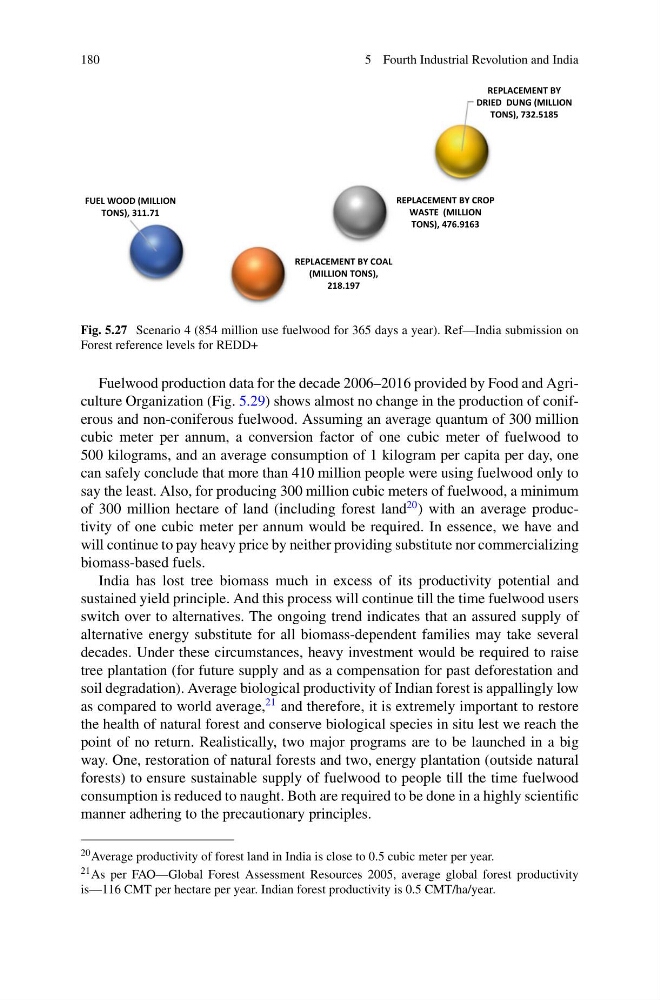
FUEL WOOD (MILLION
TONS), 311.71
REPLACEMENT BY COAL
(MILLION TONS),
218.197
REPLACEMENT BY CROP
WASTE (MILLION
TONS), 476.9163
REPLACEMENT BY
DRIED DUNG (MILLION
TONS), 732.5185
Fig. 5.27 Scenario 4 (854 million use fuelwood for 365 days a year). Ref—India submission on
Forest reference levels for REDD+
Fuelwood production data for the decade 2006–2016 provided by Food and Agriculture Organization (Fig. 5.29) shows almost no change in the production of coniferous and non-coniferous fuelwood. Assuming an average quantum of 300 million
cubic meter per annum, a conversion factor of one cubic meter of fuelwood to
500 kilograms, and an average consumption of 1 kilogram per capita per day, one
can safely conclude that more than 410 million people were using fuelwood only to
say the least. Also, for producing 300 million cubic meters of fuelwood, a minimum
of 300 million hectare of land (including forest land
20 ) with an average productivity of one cubic meter per annum would be required. In essence, we have and
will continue to pay heavy price by neither providing substitute nor commercializing
biomass-based fuels.
India has lost tree biomass much in excess of its productivity potential and
sustained yield principle. And this process will continue till the time fuelwood users
switch over to alternatives. The ongoing trend indicates that an assured supply of
alternative energy substitute for all biomass-dependent families may take several
decades. Under these circumstances, heavy investment would be required to raise
tree plantation (for future supply and as a compensation for past deforestation and
soil degradation). Average biological productivity of Indian forest is appallingly low
as compared to world average,
21 and therefore, it is extremely important to restore
the health of natural forest and conserve biological species in situ lest we reach the
point of no return. Realistically, two major programs are to be launched in a big
way. One, restoration of natural forests and two, energy plantation (outside natural
forests) to ensure sustainable supply of fuelwood to people till the time fuelwood
consumption is reduced to naught. Both are required to be done in a highly scientific
manner adhering to the precautionary principles.
20 Average productivity of forest land in India is close to 0.5 cubic meter per year.
21 As per FAO—Global Forest Assessment Resources 2005, average global forest productivity
is—116 CMT per hectare per year. Indian forest productivity is 0.5 CMT/ha/year.
5 Fourth Industrial Revolution and India
FUEL WOOD (MILLION
TONS), 311.71
REPLACEMENT BY COAL
(MILLION TONS),
218.197
REPLACEMENT BY CROP
WASTE (MILLION
TONS), 476.9163
REPLACEMENT BY
DRIED DUNG (MILLION
TONS), 732.5185
Fig. 5.27 Scenario 4 (854 million use fuelwood for 365 days a year). Ref—India submission on
Forest reference levels for REDD+
Fuelwood production data for the decade 2006–2016 provided by Food and Agriculture Organization (Fig. 5.29) shows almost no change in the production of coniferous and non-coniferous fuelwood. Assuming an average quantum of 300 million
cubic meter per annum, a conversion factor of one cubic meter of fuelwood to
500 kilograms, and an average consumption of 1 kilogram per capita per day, one
can safely conclude that more than 410 million people were using fuelwood only to
say the least. Also, for producing 300 million cubic meters of fuelwood, a minimum
of 300 million hectare of land (including forest land
20 ) with an average productivity of one cubic meter per annum would be required. In essence, we have and
will continue to pay heavy price by neither providing substitute nor commercializing
biomass-based fuels.
India has lost tree biomass much in excess of its productivity potential and
sustained yield principle. And this process will continue till the time fuelwood users
switch over to alternatives. The ongoing trend indicates that an assured supply of
alternative energy substitute for all biomass-dependent families may take several
decades. Under these circumstances, heavy investment would be required to raise
tree plantation (for future supply and as a compensation for past deforestation and
soil degradation). Average biological productivity of Indian forest is appallingly low
as compared to world average,
21 and therefore, it is extremely important to restore
the health of natural forest and conserve biological species in situ lest we reach the
point of no return. Realistically, two major programs are to be launched in a big
way. One, restoration of natural forests and two, energy plantation (outside natural
forests) to ensure sustainable supply of fuelwood to people till the time fuelwood
consumption is reduced to naught. Both are required to be done in a highly scientific
manner adhering to the precautionary principles.
20 Average productivity of forest land in India is close to 0.5 cubic meter per year.
21 As per FAO—Global Forest Assessment Resources 2005, average global forest productivity
is—116 CMT per hectare per year. Indian forest productivity is 0.5 CMT/ha/year.