

5.3 Carbon-Based Economies Will Eventually Prove Cataclysmic
163
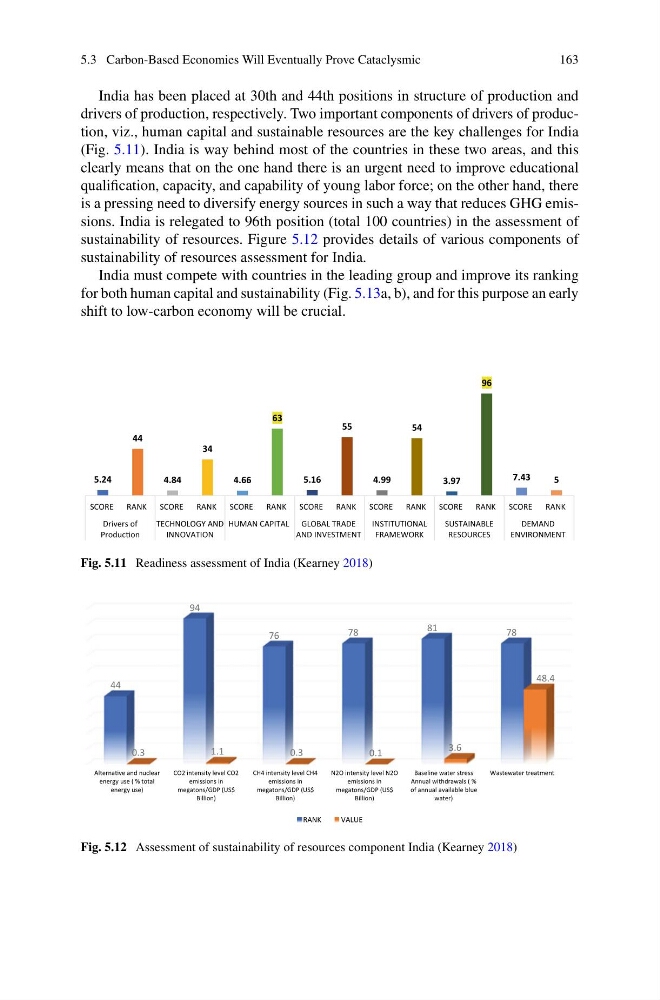
India has been placed at 30th and 44th positions in structure of production and
drivers of production, respectively. Two important components of drivers of production, viz., human capital and sustainable resources are the key challenges for India
(Fig. 5.11). India is way behind most of the countries in these two areas, and this
clearly means that on the one hand there is an urgent need to improve educational
qualification, capacity, and capability of young labor force; on the other hand, there
is a pressing need to diversify energy sources in such a way that reduces GHG emissions. India is relegated to 96th position (total 100 countries) in the assessment of
sustainability of resources. Figure 5.12 provides details of various components of
sustainability of resources assessment for India.
India must compete with countries in the leading group and improve its ranking
for both human capital and sustainability (Fig. 5.13a, b), and for this purpose an early
shift to low-carbon economy will be crucial.
5.24
44
4.84
34
4.66
63
5.16
55
4.99
54
3.97
96
7.43
5
SCORE RANK
SCORE RANK
SCORE RANK
SCORE RANK
SCORE RANK SCORE
RANK SCORE
RANK
Drivers of
Produc
TECHNOLOGY AND
INNOVATION
HUMAN CAPITAL GLOBAL TRADE
AND INVESTMENT
INSTITUTIONAL
FRAMEWORK
SUSTAINABLE
RESOURCES
DEMAND
ENVIRONMENT
Fig. 5.11 Readiness assessment of India (Kearney 2018)
Alternave and nuclear
energy use ( % total
energy use)
CO2 intensity level CO2
emissions in
megatons/GDP (US$
Billion)
CH4 intensity level CH4
emissions in
megatons/GDP (US$
Billion)
N2O intensity level N2O
emissions in
megatons/GDP (US$
Billion)
Baseline water stress
Annual withdrawals ( %
of annual available blue
water)
Wastewater treatment
44
94
76
78
81
78
0.3
1.1
0.3
0.1
3.6
48.4
RANK
VALUE
Fig. 5.12 Assessment of sustainability of resources component India (Kearney 2018)
163
India has been placed at 30th and 44th positions in structure of production and
drivers of production, respectively. Two important components of drivers of production, viz., human capital and sustainable resources are the key challenges for India
(Fig. 5.11). India is way behind most of the countries in these two areas, and this
clearly means that on the one hand there is an urgent need to improve educational
qualification, capacity, and capability of young labor force; on the other hand, there
is a pressing need to diversify energy sources in such a way that reduces GHG emissions. India is relegated to 96th position (total 100 countries) in the assessment of
sustainability of resources. Figure 5.12 provides details of various components of
sustainability of resources assessment for India.
India must compete with countries in the leading group and improve its ranking
for both human capital and sustainability (Fig. 5.13a, b), and for this purpose an early
shift to low-carbon economy will be crucial.
5.24
44
4.84
34
4.66
63
5.16
55
4.99
54
3.97
96
7.43
5
SCORE RANK
SCORE RANK
SCORE RANK
SCORE RANK
SCORE RANK SCORE
RANK SCORE
RANK
Drivers of
Produc
TECHNOLOGY AND
INNOVATION
HUMAN CAPITAL GLOBAL TRADE
AND INVESTMENT
INSTITUTIONAL
FRAMEWORK
SUSTAINABLE
RESOURCES
DEMAND
ENVIRONMENT
Fig. 5.11 Readiness assessment of India (Kearney 2018)
Alternave and nuclear
energy use ( % total
energy use)
CO2 intensity level CO2
emissions in
megatons/GDP (US$
Billion)
CH4 intensity level CH4
emissions in
megatons/GDP (US$
Billion)
N2O intensity level N2O
emissions in
megatons/GDP (US$
Billion)
Baseline water stress
Annual withdrawals ( %
of annual available blue
water)
Wastewater treatment
44
94
76
78
81
78
0.3
1.1
0.3
0.1
3.6
48.4
RANK
VALUE
Fig. 5.12 Assessment of sustainability of resources component India (Kearney 2018)