

148
5 Fourth Industrial Revolution and India
industrial revolutions, the fourth is evolving at an exponential rather than a linear pace.
Moreover, it is disrupting almost every industry in every country. And the breadth and depth
of these changes herald the transformation of entire systems of production, management,
and governance.
Most of us are conversant with the first industrial revolution that used coal and
water and generated steam power to mechanize production. This was followed by
second phase during late nineteenth century to generate electric power for mass
production. The third phase which started in early twentieth century used electronics
and information technology to automate manufacturing. The world has now moved
into the fourth phase of industrial revolution—the digital revolution that started sometimes during the middle of the last century. The fourth revolution is characterized
by digital tools that generate, store, analyze, communicate, and assist in decision
making as and when required. Computers, super computers, mobile phones, drones,
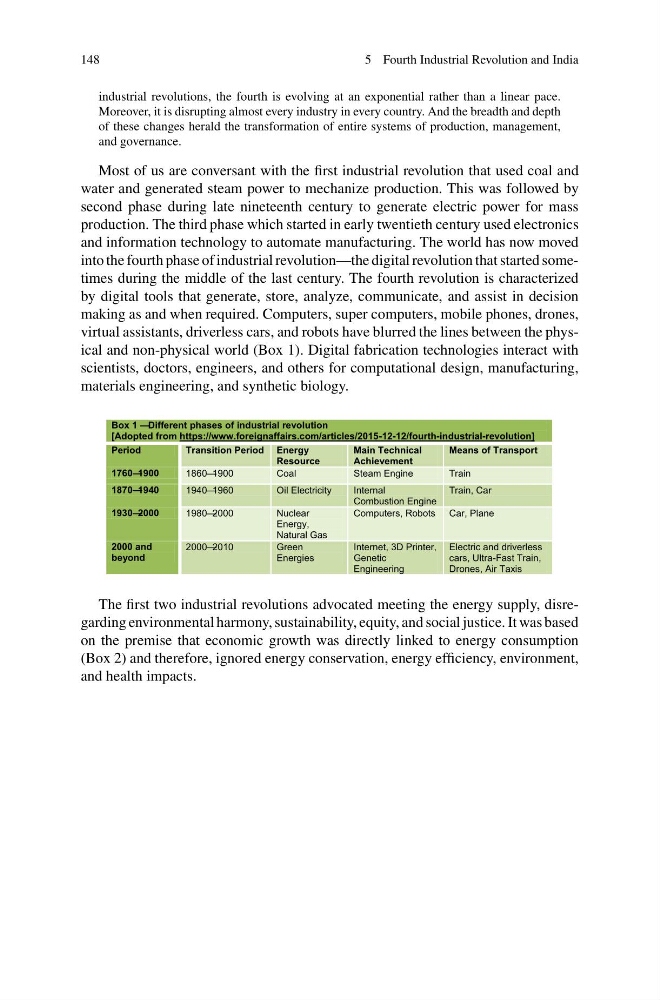
virtual assistants, driverless cars, and robots have blurred the lines between the physical and non-physical world (Box 1). Digital fabrication technologies interact with
scientists, doctors, engineers, and others for computational design, manufacturing,
materials engineering, and synthetic biology.
Box 1 –Different phases of industrial revolution
[Adopted from https://www.foreignaffairs.com/articles/2015-12-12/fourth-industrial-revolution]
Period
Transition Period Energy
Resource
Main Technical
Achievement
Means of Transport
1760– 1900
1860– 1900
Coal
Steam Engine
Train
1870– 1940
1940– 1960
Oil Electricity
Internal
Combustion Engine
Train, Car
1930– 2000
1980– 2000
Nuclear
Energy,
Natural Gas
Computers, Robots Car, Plane
2000 and
beyond
2000– 2010
Green
Energies
Internet, 3D Printer,
Genetic
Engineering
Electric and driverless
cars, Ultra-Fast Train,
Drones, Air Taxis
The first two industrial revolutions advocated meeting the energy supply, disregarding environmental harmony, sustainability, equity, and social justice. It was based
on the premise that economic growth was directly linked to energy consumption
(Box 2) and therefore, ignored energy conservation, energy efficiency, environment,
and health impacts.
5 Fourth Industrial Revolution and India
industrial revolutions, the fourth is evolving at an exponential rather than a linear pace.
Moreover, it is disrupting almost every industry in every country. And the breadth and depth
of these changes herald the transformation of entire systems of production, management,
and governance.
Most of us are conversant with the first industrial revolution that used coal and
water and generated steam power to mechanize production. This was followed by
second phase during late nineteenth century to generate electric power for mass
production. The third phase which started in early twentieth century used electronics
and information technology to automate manufacturing. The world has now moved
into the fourth phase of industrial revolution—the digital revolution that started sometimes during the middle of the last century. The fourth revolution is characterized
by digital tools that generate, store, analyze, communicate, and assist in decision
making as and when required. Computers, super computers, mobile phones, drones,
virtual assistants, driverless cars, and robots have blurred the lines between the physical and non-physical world (Box 1). Digital fabrication technologies interact with
scientists, doctors, engineers, and others for computational design, manufacturing,
materials engineering, and synthetic biology.
Box 1 –Different phases of industrial revolution
[Adopted from https://www.foreignaffairs.com/articles/2015-12-12/fourth-industrial-revolution]
Period
Transition Period Energy
Resource
Main Technical
Achievement
Means of Transport
1760– 1900
1860– 1900
Coal
Steam Engine
Train
1870– 1940
1940– 1960
Oil Electricity
Internal
Combustion Engine
Train, Car
1930– 2000
1980– 2000
Nuclear
Energy,
Natural Gas
Computers, Robots Car, Plane
2000 and
beyond
2000– 2010
Green
Energies
Internet, 3D Printer,
Genetic
Engineering
Electric and driverless
cars, Ultra-Fast Train,
Drones, Air Taxis
The first two industrial revolutions advocated meeting the energy supply, disregarding environmental harmony, sustainability, equity, and social justice. It was based
on the premise that economic growth was directly linked to energy consumption
(Box 2) and therefore, ignored energy conservation, energy efficiency, environment,
and health impacts.