

3.5 Impediments to Electricity Generation
97
3.5.4 Gas
Energy experts term the current period as ‘golden age of gas’ for the specific reason
that fast-rising demand particularly from emerging economies for power generation
and transport is the best approach to displace coal by 2040 if not earlier. Millions
of tons of new capacity are coming on stream. Natural gas is undoubtedly one of
the best alternatives to coal-based thermal power plants (in terms of carbon dioxide
reduction). It is the second most used fuel in power generation having 8% of India’s
installed capacity. Unfortunately, the known natural gas reserves are only about 0.7%
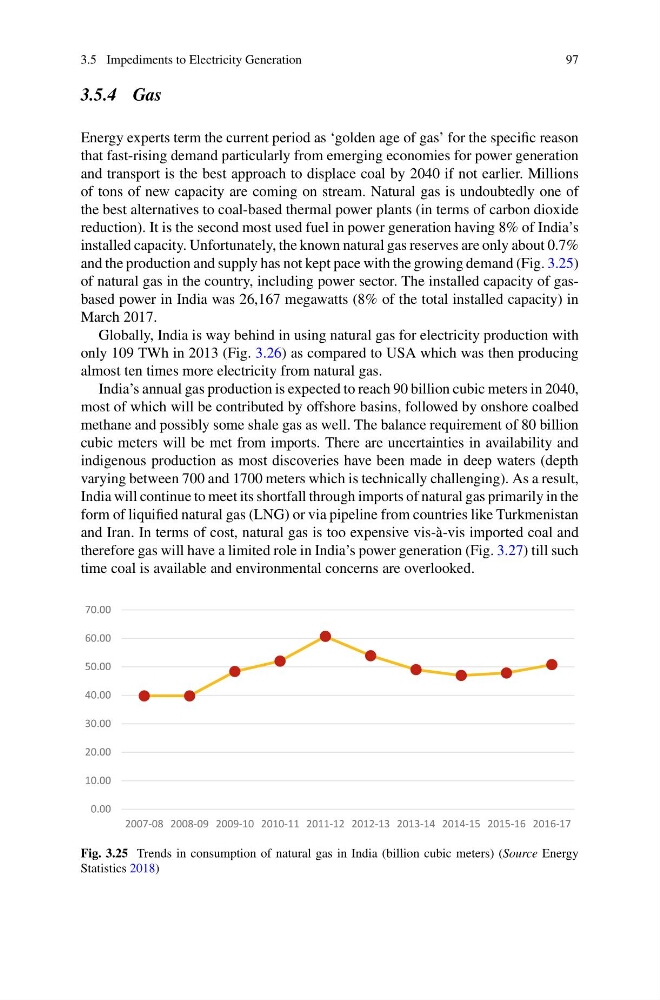
and the production and supply has not kept pace with the growing demand (Fig. 3.25)
of natural gas in the country, including power sector. The installed capacity of gasbased power in India was 26,167 megawatts (8% of the total installed capacity) in
March 2017.
Globally, India is way behind in using natural gas for electricity production with
only 109 TWh in 2013 (Fig. 3.26) as compared to USA which was then producing
almost ten times more electricity from natural gas.
India’s annual gas production is expected to reach 90 billion cubic meters in 2040,
most of which will be contributed by offshore basins, followed by onshore coalbed
methane and possibly some shale gas as well. The balance requirement of 80 billion
cubic meters will be met from imports. There are uncertainties in availability and
indigenous production as most discoveries have been made in deep waters (depth
varying between 700 and 1700 meters which is technically challenging). As a result,
India will continue to meet its shortfall through imports of natural gas primarily in the
form of liquified natural gas (LNG) or via pipeline from countries like Turkmenistan
and Iran. In terms of cost, natural gas is too expensive vis-à-vis imported coal and
therefore gas will have a limited role in India’s power generation (Fig. 3.27) till such
time coal is available and environmental concerns are overlooked.
0.00
10.00
20.00
30.00
40.00
50.00
60.00
70.00
2007-08 2008-09 2009-10 2010-11 2011-12 2012-13 2013-14 2014-15 2015-16 2016-17
Fig. 3.25 Trends in consumption of natural gas in India (billion cubic meters) (Source Energy
Statistics 2018)
97
3.5.4 Gas
Energy experts term the current period as ‘golden age of gas’ for the specific reason
that fast-rising demand particularly from emerging economies for power generation
and transport is the best approach to displace coal by 2040 if not earlier. Millions
of tons of new capacity are coming on stream. Natural gas is undoubtedly one of
the best alternatives to coal-based thermal power plants (in terms of carbon dioxide
reduction). It is the second most used fuel in power generation having 8% of India’s
installed capacity. Unfortunately, the known natural gas reserves are only about 0.7%
and the production and supply has not kept pace with the growing demand (Fig. 3.25)
of natural gas in the country, including power sector. The installed capacity of gasbased power in India was 26,167 megawatts (8% of the total installed capacity) in
March 2017.
Globally, India is way behind in using natural gas for electricity production with
only 109 TWh in 2013 (Fig. 3.26) as compared to USA which was then producing
almost ten times more electricity from natural gas.
India’s annual gas production is expected to reach 90 billion cubic meters in 2040,
most of which will be contributed by offshore basins, followed by onshore coalbed
methane and possibly some shale gas as well. The balance requirement of 80 billion
cubic meters will be met from imports. There are uncertainties in availability and
indigenous production as most discoveries have been made in deep waters (depth
varying between 700 and 1700 meters which is technically challenging). As a result,
India will continue to meet its shortfall through imports of natural gas primarily in the
form of liquified natural gas (LNG) or via pipeline from countries like Turkmenistan
and Iran. In terms of cost, natural gas is too expensive vis-à-vis imported coal and
therefore gas will have a limited role in India’s power generation (Fig. 3.27) till such
time coal is available and environmental concerns are overlooked.
0.00
10.00
20.00
30.00
40.00
50.00
60.00
70.00
2007-08 2008-09 2009-10 2010-11 2011-12 2012-13 2013-14 2014-15 2015-16 2016-17
Fig. 3.25 Trends in consumption of natural gas in India (billion cubic meters) (Source Energy
Statistics 2018)