

3.1 Mixing Elements
55
(a)
(b)
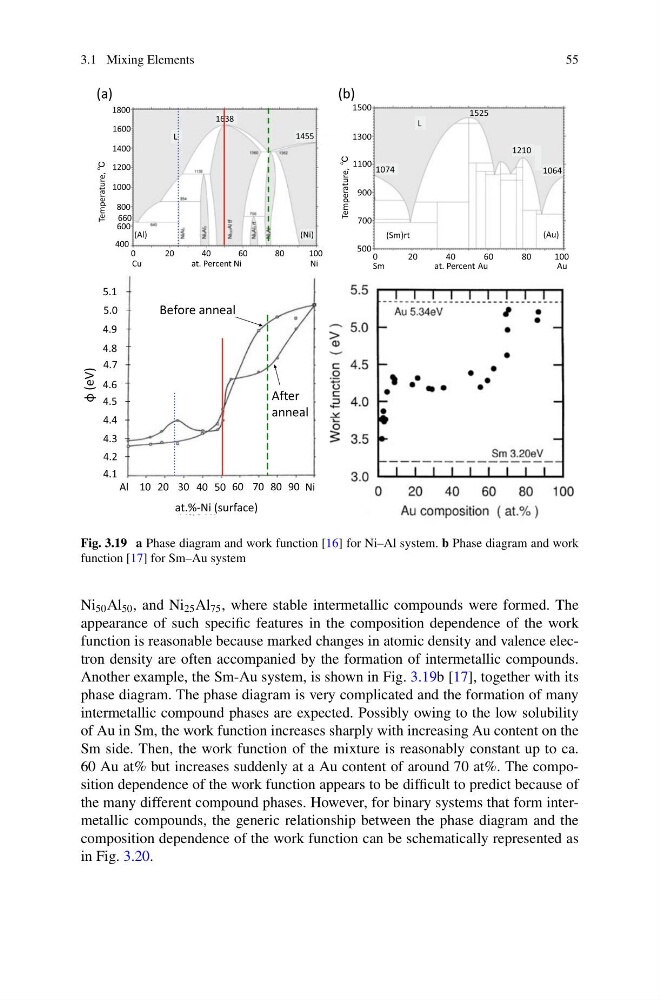
Fig. 3.19 a Phase diagram and work function [16] for Ni–Al system. b Phase diagram and work
function [17] for Sm–Au system
Ni 50 Al 50 , and Ni 25 Al 75 , where stable intermetallic compounds were formed. The
appearance of such specific features in the composition dependence of the work
function is reasonable because marked changes in atomic density and valence electron density are often accompanied by the formation of intermetallic compounds.
Another example, the Sm-Au system, is shown in Fig. 3.19b [17], together with its
phase diagram. The phase diagram is very complicated and the formation of many
intermetallic compound phases are expected. Possibly owing to the low solubility
of Au in Sm, the work function increases sharply with increasing Au content on the
Sm side. Then, the work function of the mixture is reasonably constant up to ca.
60 Au at% but increases suddenly at a Au content of around 70 at%. The composition dependence of the work function appears to be difficult to predict because of
the many different compound phases. However, for binary systems that form intermetallic compounds, the generic relationship between the phase diagram and the
composition dependence of the work function can be schematically represented as
in Fig. 3.20.
55
(a)
(b)
Fig. 3.19 a Phase diagram and work function [16] for Ni–Al system. b Phase diagram and work
function [17] for Sm–Au system
Ni 50 Al 50 , and Ni 25 Al 75 , where stable intermetallic compounds were formed. The
appearance of such specific features in the composition dependence of the work
function is reasonable because marked changes in atomic density and valence electron density are often accompanied by the formation of intermetallic compounds.
Another example, the Sm-Au system, is shown in Fig. 3.19b [17], together with its
phase diagram. The phase diagram is very complicated and the formation of many
intermetallic compound phases are expected. Possibly owing to the low solubility
of Au in Sm, the work function increases sharply with increasing Au content on the
Sm side. Then, the work function of the mixture is reasonably constant up to ca.
60 Au at% but increases suddenly at a Au content of around 70 at%. The composition dependence of the work function appears to be difficult to predict because of
the many different compound phases. However, for binary systems that form intermetallic compounds, the generic relationship between the phase diagram and the
composition dependence of the work function can be schematically represented as
in Fig. 3.20.