

3.1 Mixing Elements
53
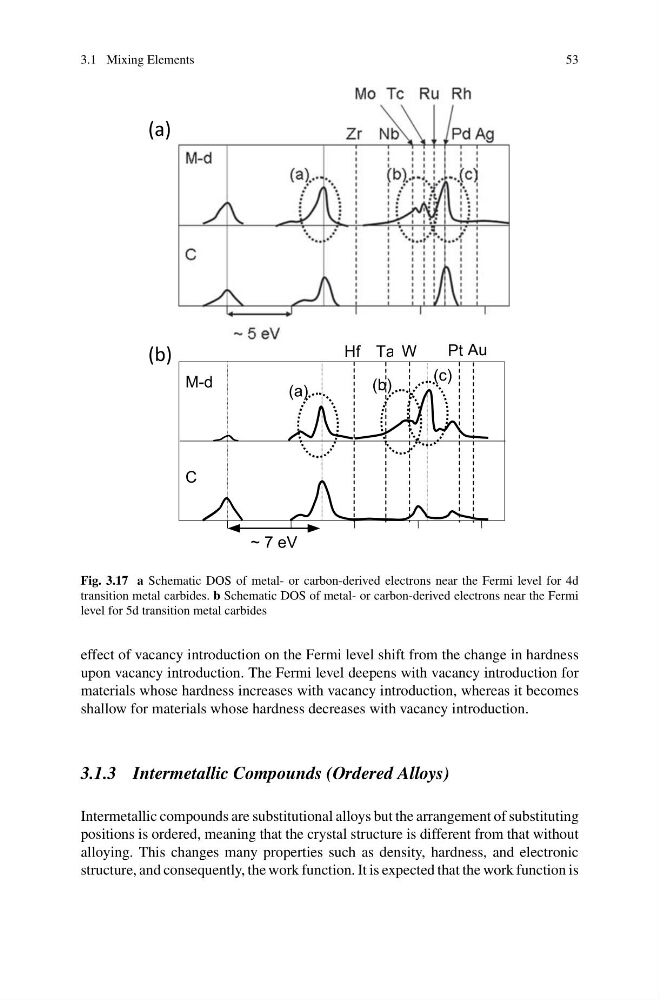
Fig. 3.17 a Schematic DOS of metal- or carbon-derived electrons near the Fermi level for 4d
transition metal carbides. b Schematic DOS of metal- or carbon-derived electrons near the Fermi
level for 5d transition metal carbides
effect of vacancy introduction on the Fermi level shift from the change in hardness
upon vacancy introduction. The Fermi level deepens with vacancy introduction for
materials whose hardness increases with vacancy introduction, whereas it becomes
shallow for materials whose hardness decreases with vacancy introduction.
3.1.3 Intermetallic Compounds (Ordered Alloys)
Intermetallic compounds are substitutional alloys but the arrangement of substituting
positions is ordered, meaning that the crystal structure is different from that without
alloying. This changes many properties such as density, hardness, and electronic
structure, and consequently, the work function. It is expected that the work function is
53
Fig. 3.17 a Schematic DOS of metal- or carbon-derived electrons near the Fermi level for 4d
transition metal carbides. b Schematic DOS of metal- or carbon-derived electrons near the Fermi
level for 5d transition metal carbides
effect of vacancy introduction on the Fermi level shift from the change in hardness
upon vacancy introduction. The Fermi level deepens with vacancy introduction for
materials whose hardness increases with vacancy introduction, whereas it becomes
shallow for materials whose hardness decreases with vacancy introduction.
3.1.3 Intermetallic Compounds (Ordered Alloys)
Intermetallic compounds are substitutional alloys but the arrangement of substituting
positions is ordered, meaning that the crystal structure is different from that without
alloying. This changes many properties such as density, hardness, and electronic
structure, and consequently, the work function. It is expected that the work function is