

44
3 Modification of the Work Function
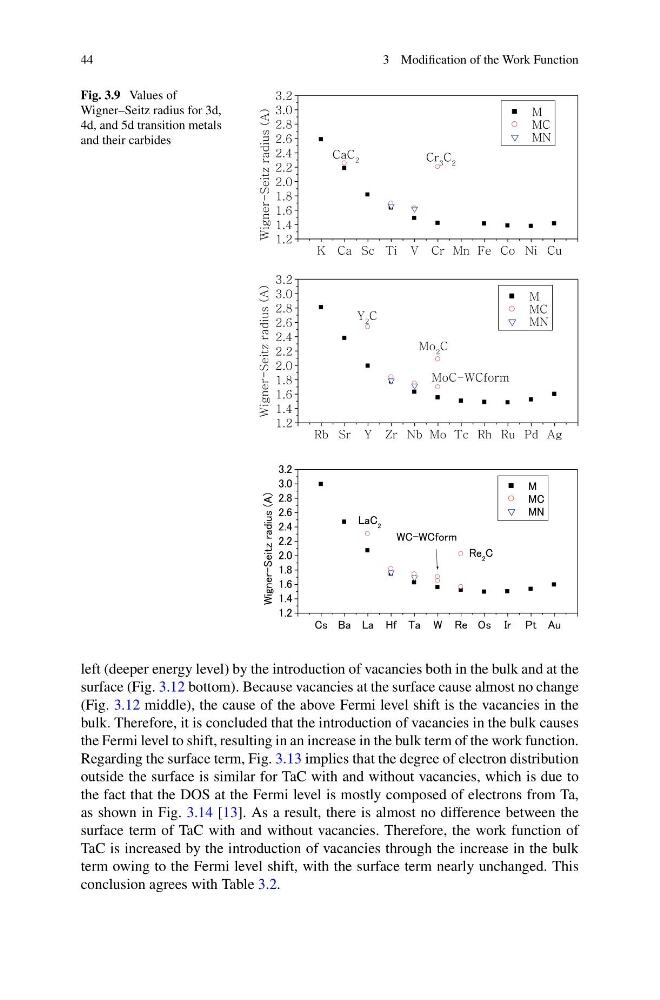
Fig. 3.9 Values of
Wigner–Seitz radius for 3d,
4d, and 5d transition metals
and their carbides
left (deeper energy level) by the introduction of vacancies both in the bulk and at the
surface (Fig. 3.12 bottom). Because vacancies at the surface cause almost no change
(Fig. 3.12 middle), the cause of the above Fermi level shift is the vacancies in the
bulk. Therefore, it is concluded that the introduction of vacancies in the bulk causes
the Fermi level to shift, resulting in an increase in the bulk term of the work function.
Regarding the surface term, Fig. 3.13 implies that the degree of electron distribution
outside the surface is similar for TaC with and without vacancies, which is due to
the fact that the DOS at the Fermi level is mostly composed of electrons from Ta,
as shown in Fig. 3.14 [13]. As a result, there is almost no difference between the
surface term of TaC with and without vacancies. Therefore, the work function of
TaC is increased by the introduction of vacancies through the increase in the bulk
term owing to the Fermi level shift, with the surface term nearly unchanged. This
conclusion agrees with Table 3.2.
3 Modification of the Work Function
Fig. 3.9 Values of
Wigner–Seitz radius for 3d,
4d, and 5d transition metals
and their carbides
left (deeper energy level) by the introduction of vacancies both in the bulk and at the
surface (Fig. 3.12 bottom). Because vacancies at the surface cause almost no change
(Fig. 3.12 middle), the cause of the above Fermi level shift is the vacancies in the
bulk. Therefore, it is concluded that the introduction of vacancies in the bulk causes
the Fermi level to shift, resulting in an increase in the bulk term of the work function.
Regarding the surface term, Fig. 3.13 implies that the degree of electron distribution
outside the surface is similar for TaC with and without vacancies, which is due to
the fact that the DOS at the Fermi level is mostly composed of electrons from Ta,
as shown in Fig. 3.14 [13]. As a result, there is almost no difference between the
surface term of TaC with and without vacancies. Therefore, the work function of
TaC is increased by the introduction of vacancies through the increase in the bulk
term owing to the Fermi level shift, with the surface term nearly unchanged. This
conclusion agrees with Table 3.2.