

28
2 What is the Work Function?: Definition and Factors …
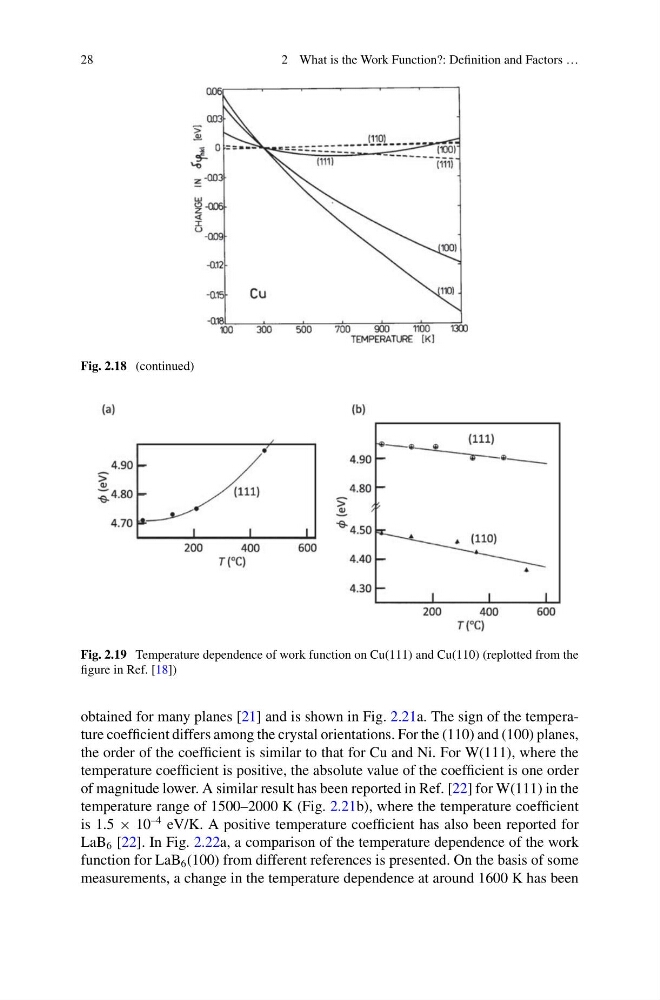
Fig. 2.18 (continued)
Fig. 2.19 Temperature dependence of work function on Cu(111) and Cu(110) (replotted from the
figure in Ref. [18])
obtained for many planes [21] and is shown in Fig. 2.21a. The sign of the temperature coefficient differs among the crystal orientations. For the (110) and (100) planes,
the order of the coefficient is similar to that for Cu and Ni. For W(111), where the
temperature coefficient is positive, the absolute value of the coefficient is one order
of magnitude lower. A similar result has been reported in Ref. [22] for W(111) in the
temperature range of 1500–2000 K (Fig. 2.21b), where the temperature coefficient
is 1.5 × 10
–4 eV/K. A positive temperature coefficient has also been reported for
LaB 6 [22]. In Fig. 2.22a, a comparison of the temperature dependence of the work
function for LaB 6 (100) from different references is presented. On the basis of some
measurements, a change in the temperature dependence at around 1600 K has been
2 What is the Work Function?: Definition and Factors …
Fig. 2.18 (continued)
Fig. 2.19 Temperature dependence of work function on Cu(111) and Cu(110) (replotted from the
figure in Ref. [18])
obtained for many planes [21] and is shown in Fig. 2.21a. The sign of the temperature coefficient differs among the crystal orientations. For the (110) and (100) planes,
the order of the coefficient is similar to that for Cu and Ni. For W(111), where the
temperature coefficient is positive, the absolute value of the coefficient is one order
of magnitude lower. A similar result has been reported in Ref. [22] for W(111) in the
temperature range of 1500–2000 K (Fig. 2.21b), where the temperature coefficient
is 1.5 × 10
–4 eV/K. A positive temperature coefficient has also been reported for
LaB 6 [22]. In Fig. 2.22a, a comparison of the temperature dependence of the work
function for LaB 6 (100) from different references is presented. On the basis of some
measurements, a change in the temperature dependence at around 1600 K has been