

24
2 What is the Work Function?: Definition and Factors …
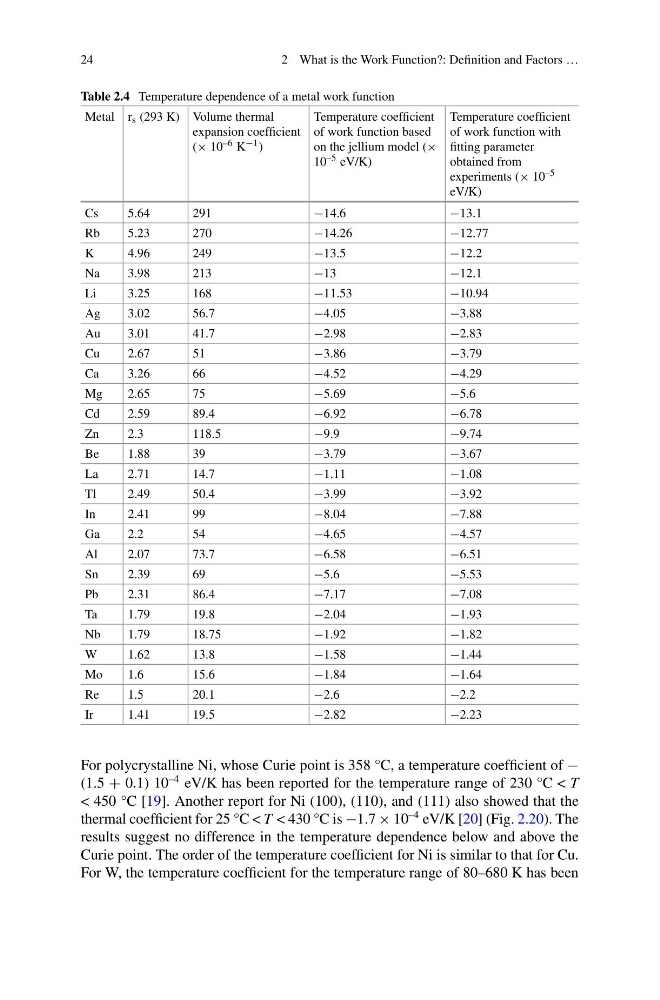
Table 2.4 Temperature dependence of a metal work function
Metal r s (293 K) Volume thermal
expansion coefficient
(× 10 –6 K −1 )
Temperature coefficient
of work function based
on the jellium model (×
10 –5 eV/K)
Temperature coefficient
of work function with
fitting parameter
obtained from
experiments (× 10 –5
eV/K)
Cs
5.64
291
−14.6
−13.1
Rb
5.23
270
−14.26
−12.77
K
4.96
249
−13.5
−12.2
Na
3.98
213
−13
−12.1
Li
3.25
168
−11.53
−10.94
Ag
3.02
56.7
−4.05
−3.88
Au
3.01
41.7
−2.98
−2.83
Cu
2.67
51
−3.86
−3.79
Ca
3.26
66
−4.52
−4.29
Mg
2.65
75
−5.69
−5.6
Cd
2.59
89.4
−6.92
−6.78
Zn
2.3
118.5
−9.9
−9.74
Be
1.88
39
−3.79
−3.67
La
2.71
14.7
−1.11
−1.08
Tl
2.49
50.4
−3.99
−3.92
In
2.41
99
−8.04
−7.88
Ga
2.2
54
−4.65
−4.57
Al
2.07
73.7
−6.58
−6.51
Sn
2.39
69
−5.6
−5.53
Pb
2.31
86.4
−7.17
−7.08
Ta
1.79
19.8
−2.04
−1.93
Nb
1.79
18.75
−1.92
−1.82
W
1.62
13.8
−1.58
−1.44
Mo
1.6
15.6
−1.84
−1.64
Re
1.5
20.1
−2.6
−2.2
Ir
1.41
19.5
−2.82
−2.23
For polycrystalline Ni, whose Curie point is 358 °C, a temperature coefficient of −
(1.5 + 0.1) 10
–4 eV/K has been reported for the temperature range of 230 °C < T
< 450 °C [19]. Another report for Ni (100), (110), and (111) also showed that the
thermal coefficient for 25 °C < T < 430 °C is −1.7 × 10
–4 eV/K [20] (Fig. 2.20). The
results suggest no difference in the temperature dependence below and above the
Curie point. The order of the temperature coefficient for Ni is similar to that for Cu.
For W, the temperature coefficient for the temperature range of 80–680 K has been
2 What is the Work Function?: Definition and Factors …
Table 2.4 Temperature dependence of a metal work function
Metal r s (293 K) Volume thermal
expansion coefficient
(× 10 –6 K −1 )
Temperature coefficient
of work function based
on the jellium model (×
10 –5 eV/K)
Temperature coefficient
of work function with
fitting parameter
obtained from
experiments (× 10 –5
eV/K)
Cs
5.64
291
−14.6
−13.1
Rb
5.23
270
−14.26
−12.77
K
4.96
249
−13.5
−12.2
Na
3.98
213
−13
−12.1
Li
3.25
168
−11.53
−10.94
Ag
3.02
56.7
−4.05
−3.88
Au
3.01
41.7
−2.98
−2.83
Cu
2.67
51
−3.86
−3.79
Ca
3.26
66
−4.52
−4.29
Mg
2.65
75
−5.69
−5.6
Cd
2.59
89.4
−6.92
−6.78
Zn
2.3
118.5
−9.9
−9.74
Be
1.88
39
−3.79
−3.67
La
2.71
14.7
−1.11
−1.08
Tl
2.49
50.4
−3.99
−3.92
In
2.41
99
−8.04
−7.88
Ga
2.2
54
−4.65
−4.57
Al
2.07
73.7
−6.58
−6.51
Sn
2.39
69
−5.6
−5.53
Pb
2.31
86.4
−7.17
−7.08
Ta
1.79
19.8
−2.04
−1.93
Nb
1.79
18.75
−1.92
−1.82
W
1.62
13.8
−1.58
−1.44
Mo
1.6
15.6
−1.84
−1.64
Re
1.5
20.1
−2.6
−2.2
Ir
1.41
19.5
−2.82
−2.23
For polycrystalline Ni, whose Curie point is 358 °C, a temperature coefficient of −
(1.5 + 0.1) 10
–4 eV/K has been reported for the temperature range of 230 °C < T
< 450 °C [19]. Another report for Ni (100), (110), and (111) also showed that the
thermal coefficient for 25 °C < T < 430 °C is −1.7 × 10
–4 eV/K [20] (Fig. 2.20). The
results suggest no difference in the temperature dependence below and above the
Curie point. The order of the temperature coefficient for Ni is similar to that for Cu.
For W, the temperature coefficient for the temperature range of 80–680 K has been