

128
7 Utilization of Interface Potential
Fig. 7.1 Schematic illustration of different interface terminations (interface bonding) for the same
metal (M)–oxide (A x O y ) interface, where two different terminations, A–M and O–M bonding, are
possible
valence band maximum of a semiconductor or insulator) depends on the interfaceterminating species even for the same metal–oxide material combination [7]. The
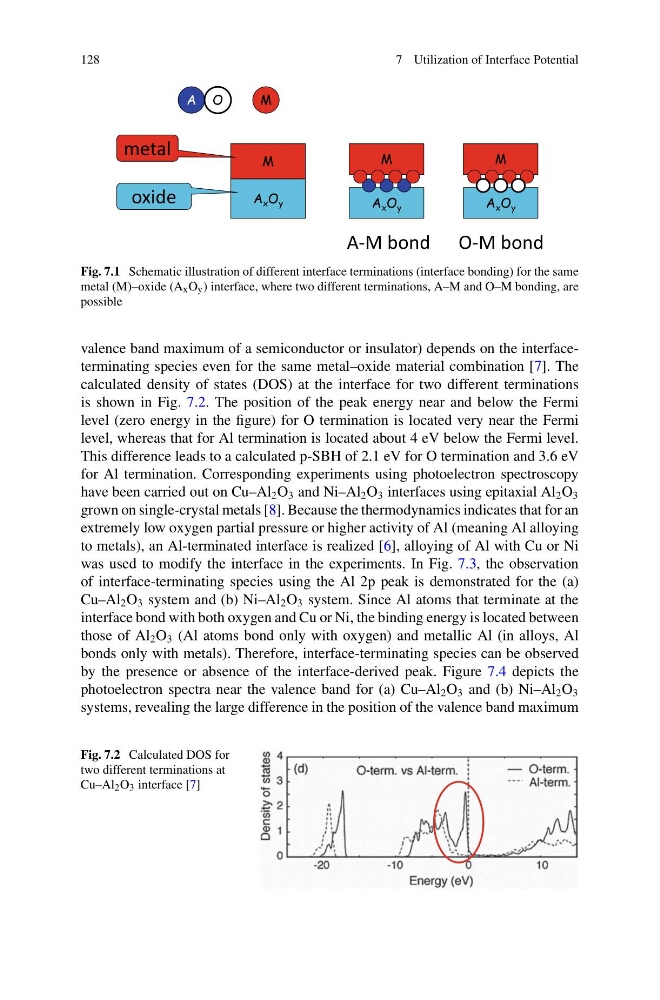
calculated density of states (DOS) at the interface for two different terminations
is shown in Fig. 7.2. The position of the peak energy near and below the Fermi
level (zero energy in the figure) for O termination is located very near the Fermi
level, whereas that for Al termination is located about 4 eV below the Fermi level.
This difference leads to a calculated p-SBH of 2.1 eV for O termination and 3.6 eV
for Al termination. Corresponding experiments using photoelectron spectroscopy
have been carried out on Cu–Al 2 O 3 and Ni–Al 2 O 3 interfaces using epitaxial Al 2 O 3
grown on single-crystal metals [8]. Because the thermodynamics indicates that for an
extremely low oxygen partial pressure or higher activity of Al (meaning Al alloying
to metals), an Al-terminated interface is realized [6], alloying of Al with Cu or Ni
was used to modify the interface in the experiments. In Fig. 7.3, the observation
of interface-terminating species using the Al 2p peak is demonstrated for the (a)
Cu–Al 2 O 3 system and (b) Ni–Al 2 O 3 system. Since Al atoms that terminate at the
interface bond with both oxygen and Cu or Ni, the binding energy is located between
those of Al 2 O 3 (Al atoms bond only with oxygen) and metallic Al (in alloys, Al
bonds only with metals). Therefore, interface-terminating species can be observed
by the presence or absence of the interface-derived peak. Figure 7.4 depicts the
photoelectron spectra near the valence band for (a) Cu–Al 2 O 3 and (b) Ni–Al 2 O 3
systems, revealing the large difference in the position of the valence band maximum
Fig. 7.2 Calculated DOS for
two different terminations at
Cu–Al 2 O 3 interface [7]
7 Utilization of Interface Potential
Fig. 7.1 Schematic illustration of different interface terminations (interface bonding) for the same
metal (M)–oxide (A x O y ) interface, where two different terminations, A–M and O–M bonding, are
possible
valence band maximum of a semiconductor or insulator) depends on the interfaceterminating species even for the same metal–oxide material combination [7]. The
calculated density of states (DOS) at the interface for two different terminations
is shown in Fig. 7.2. The position of the peak energy near and below the Fermi
level (zero energy in the figure) for O termination is located very near the Fermi
level, whereas that for Al termination is located about 4 eV below the Fermi level.
This difference leads to a calculated p-SBH of 2.1 eV for O termination and 3.6 eV
for Al termination. Corresponding experiments using photoelectron spectroscopy
have been carried out on Cu–Al 2 O 3 and Ni–Al 2 O 3 interfaces using epitaxial Al 2 O 3
grown on single-crystal metals [8]. Because the thermodynamics indicates that for an
extremely low oxygen partial pressure or higher activity of Al (meaning Al alloying
to metals), an Al-terminated interface is realized [6], alloying of Al with Cu or Ni
was used to modify the interface in the experiments. In Fig. 7.3, the observation
of interface-terminating species using the Al 2p peak is demonstrated for the (a)
Cu–Al 2 O 3 system and (b) Ni–Al 2 O 3 system. Since Al atoms that terminate at the
interface bond with both oxygen and Cu or Ni, the binding energy is located between
those of Al 2 O 3 (Al atoms bond only with oxygen) and metallic Al (in alloys, Al
bonds only with metals). Therefore, interface-terminating species can be observed
by the presence or absence of the interface-derived peak. Figure 7.4 depicts the
photoelectron spectra near the valence band for (a) Cu–Al 2 O 3 and (b) Ni–Al 2 O 3
systems, revealing the large difference in the position of the valence band maximum
Fig. 7.2 Calculated DOS for
two different terminations at
Cu–Al 2 O 3 interface [7]