

6.2 Origin of Nonideality
117
be utilized to establish an ideal contact on the interface, which is intrinsically a
nonideal contact. Another viewpoint is the utilization of either a band-based picture
or an interface-bonding picture. In the band-based picture, the formation of interface
states is considered, while an electric dipole formed by a polarized chemical bond at
the interface is considered in the interface-bonding picture. Different sources of interface states have been proposed. The two main sources considered are a metal-induced
gap states (MIGS) and a disorder-induced gap states (DIGS).
6.2.1 Metal-Induced Gap States (MIGS) Model
The idea of the MIGS model [5, 6] is briefly explained below. Metal electrons near
the Fermi level penetrate into the semiconductor at the interface (similarly to electrons at the surface penetrating into vacuum in Chap. 2 (Fig. 2.6)). The valence and
conduction bands of the semiconductor branch into many states (interface states) in
the energy band gap at the interface owing to the nonperiodicity of electrons. The
interface states should have a mixed character comprising both valence and conduction bands. The proportion of each type of band will depend on the energy position
of the interface states: the closer to the valence band, the greater the proportion of
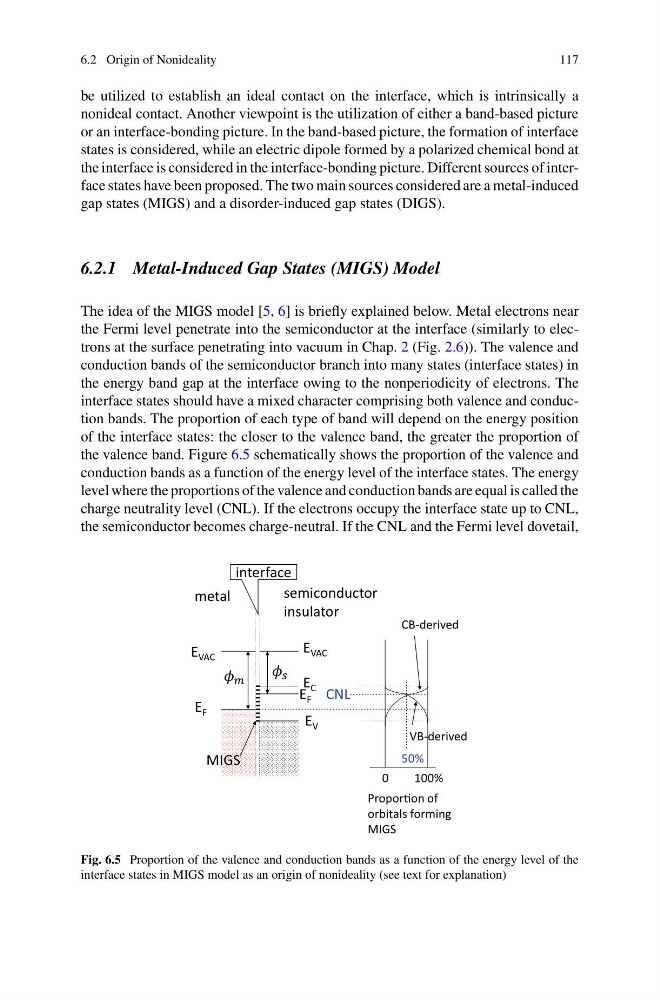
the valence band. Figure 6.5 schematically shows the proportion of the valence and
conduction bands as a function of the energy level of the interface states. The energy
level where the proportions of the valence and conduction bands are equal is called the
charge neutrality level (CNL). If the electrons occupy the interface state up to CNL,
the semiconductor becomes charge-neutral. If the CNL and the Fermi level dovetail,
metal
semiconductor
insulator
E F
E VAC
E VAC
E C
E V
E F CNL
MIGS
0
100%
VB-derived
CB-derived
50%
interface
ProporƟon of
orbitals forming
MIGS
Fig. 6.5 Proportion of the valence and conduction bands as a function of the energy level of the
interface states in MIGS model as an origin of nonideality (see text for explanation)
117
be utilized to establish an ideal contact on the interface, which is intrinsically a
nonideal contact. Another viewpoint is the utilization of either a band-based picture
or an interface-bonding picture. In the band-based picture, the formation of interface
states is considered, while an electric dipole formed by a polarized chemical bond at
the interface is considered in the interface-bonding picture. Different sources of interface states have been proposed. The two main sources considered are a metal-induced
gap states (MIGS) and a disorder-induced gap states (DIGS).
6.2.1 Metal-Induced Gap States (MIGS) Model
The idea of the MIGS model [5, 6] is briefly explained below. Metal electrons near
the Fermi level penetrate into the semiconductor at the interface (similarly to electrons at the surface penetrating into vacuum in Chap. 2 (Fig. 2.6)). The valence and
conduction bands of the semiconductor branch into many states (interface states) in
the energy band gap at the interface owing to the nonperiodicity of electrons. The
interface states should have a mixed character comprising both valence and conduction bands. The proportion of each type of band will depend on the energy position
of the interface states: the closer to the valence band, the greater the proportion of
the valence band. Figure 6.5 schematically shows the proportion of the valence and
conduction bands as a function of the energy level of the interface states. The energy
level where the proportions of the valence and conduction bands are equal is called the
charge neutrality level (CNL). If the electrons occupy the interface state up to CNL,
the semiconductor becomes charge-neutral. If the CNL and the Fermi level dovetail,
metal
semiconductor
insulator
E F
E VAC
E VAC
E C
E V
E F CNL
MIGS
0
100%
VB-derived
CB-derived
50%
interface
ProporƟon of
orbitals forming
MIGS
Fig. 6.5 Proportion of the valence and conduction bands as a function of the energy level of the
interface states in MIGS model as an origin of nonideality (see text for explanation)