

3 Retinoic Acid-Regulated Target Genes During Development …
67
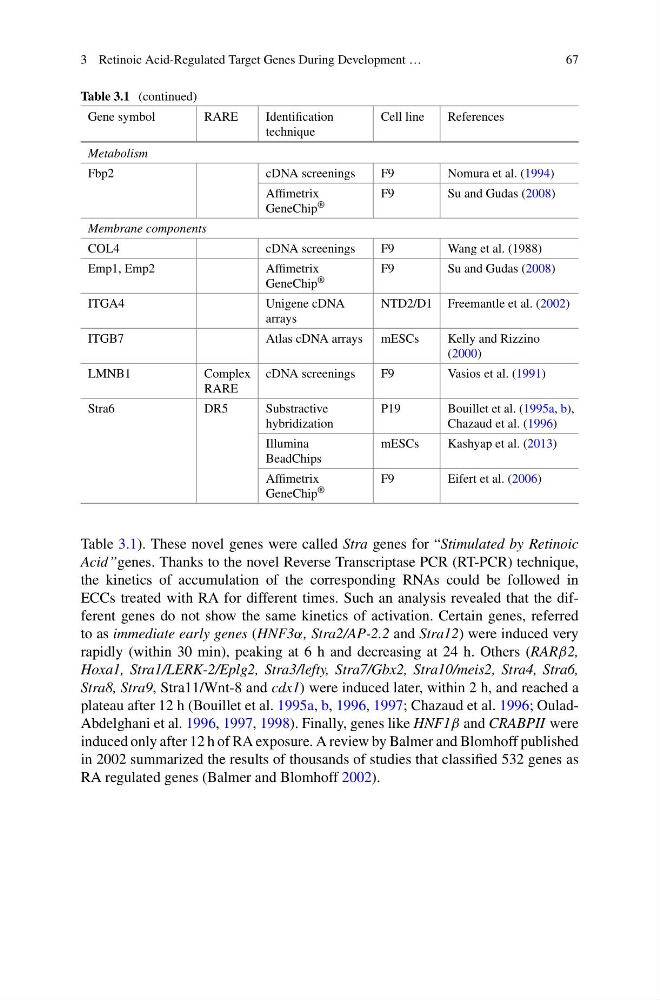
Table 3.1 (continued)
Gene symbol
RARE
Identification
technique
Cell line
References
Metabolism
Fbp2
cDNA screenings
F9
Nomura et al. (1994)
Affimetrix
GeneChip ®
F9
Su and Gudas (2008)
Membrane components
COL4
cDNA screenings
F9
Wang et al. (1988)
Emp1, Emp2
Affimetrix
GeneChip ®
F9
Su and Gudas (2008)
ITGA4
Unigene cDNA
arrays
NTD2/D1 Freemantle et al. (2002)
ITGB7
Atlas cDNA arrays mESCs
Kelly and Rizzino
(2000)
LMNB1
Complex
RARE
cDNA screenings
F9
Vasios et al. (1991)
Stra6
DR5
Substractive
hybridization
P19
Bouillet et al. (1995a, b),
Chazaud et al. (1996)
Illumina
BeadChips
mESCs
Kashyap et al. (2013)
Affimetrix
GeneChip ®
F9
Eifert et al. (2006)
Table 3.1). These novel genes were called Stra genes for “Stimulated by Retinoic
Acid”genes. Thanks to the novel Reverse Transcriptase PCR (RT-PCR) technique,
the kinetics of accumulation of the corresponding RNAs could be followed in
ECCs treated with RA for different times. Such an analysis revealed that the different genes do not show the same kinetics of activation. Certain genes, referred
to as immediate early genes (HNF3α, Stra2/AP-2.2 and Stra12) were induced very
rapidly (within 30 min), peaking at 6 h and decreasing at 24 h. Others (RARβ2,
Hoxa1, Stra1/LERK-2/Eplg2, Stra3/lefty, Stra7/Gbx2, Stra10/meis2, Stra4, Stra6,
Stra8, Stra9, Stra11/Wnt-8 and cdx1) were induced later, within 2 h, and reached a
plateau after 12 h (Bouillet et al. 1995a, b, 1996, 1997; Chazaud et al. 1996; OuladAbdelghani et al. 1996, 1997, 1998). Finally, genes like HNF1β and CRABPII were
induced only after 12 h of RA exposure. A review by Balmer and Blomhoff published
in 2002 summarized the results of thousands of studies that classified 532 genes as
RA regulated genes (Balmer and Blomhoff 2002).
67
Table 3.1 (continued)
Gene symbol
RARE
Identification
technique
Cell line
References
Metabolism
Fbp2
cDNA screenings
F9
Nomura et al. (1994)
Affimetrix
GeneChip ®
F9
Su and Gudas (2008)
Membrane components
COL4
cDNA screenings
F9
Wang et al. (1988)
Emp1, Emp2
Affimetrix
GeneChip ®
F9
Su and Gudas (2008)
ITGA4
Unigene cDNA
arrays
NTD2/D1 Freemantle et al. (2002)
ITGB7
Atlas cDNA arrays mESCs
Kelly and Rizzino
(2000)
LMNB1
Complex
RARE
cDNA screenings
F9
Vasios et al. (1991)
Stra6
DR5
Substractive
hybridization
P19
Bouillet et al. (1995a, b),
Chazaud et al. (1996)
Illumina
BeadChips
mESCs
Kashyap et al. (2013)
Affimetrix
GeneChip ®
F9
Eifert et al. (2006)
Table 3.1). These novel genes were called Stra genes for “Stimulated by Retinoic
Acid”genes. Thanks to the novel Reverse Transcriptase PCR (RT-PCR) technique,
the kinetics of accumulation of the corresponding RNAs could be followed in
ECCs treated with RA for different times. Such an analysis revealed that the different genes do not show the same kinetics of activation. Certain genes, referred
to as immediate early genes (HNF3α, Stra2/AP-2.2 and Stra12) were induced very
rapidly (within 30 min), peaking at 6 h and decreasing at 24 h. Others (RARβ2,
Hoxa1, Stra1/LERK-2/Eplg2, Stra3/lefty, Stra7/Gbx2, Stra10/meis2, Stra4, Stra6,
Stra8, Stra9, Stra11/Wnt-8 and cdx1) were induced later, within 2 h, and reached a
plateau after 12 h (Bouillet et al. 1995a, b, 1996, 1997; Chazaud et al. 1996; OuladAbdelghani et al. 1996, 1997, 1998). Finally, genes like HNF1β and CRABPII were
induced only after 12 h of RA exposure. A review by Balmer and Blomhoff published
in 2002 summarized the results of thousands of studies that classified 532 genes as
RA regulated genes (Balmer and Blomhoff 2002).