

42
L. Quadro and E. K. Spiegler
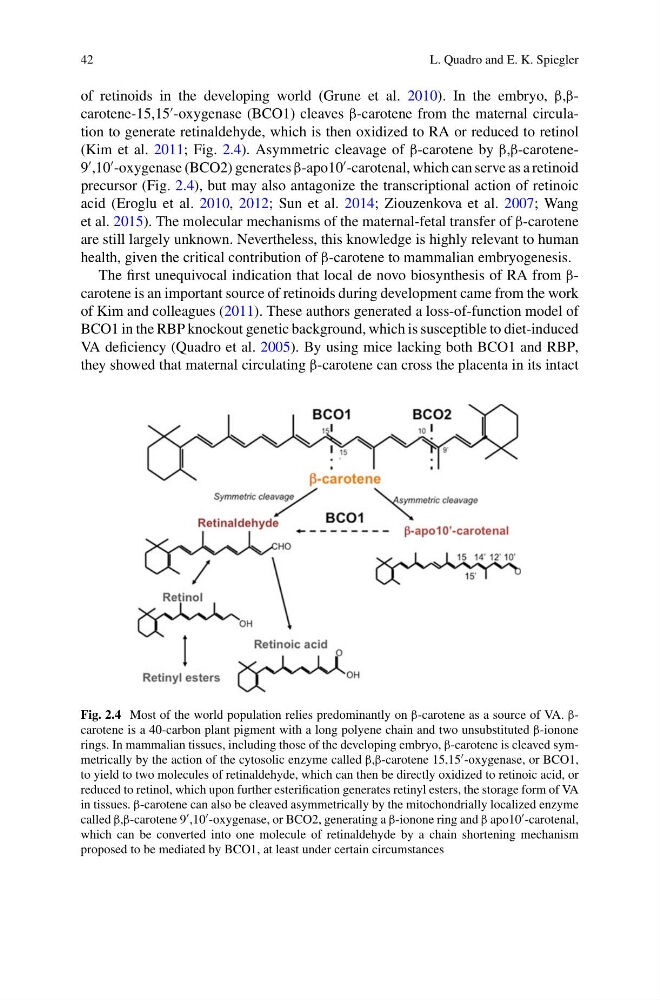
of retinoids in the developing world (Grune et al. 2010). In the embryo, β,βcarotene-15,15
-oxygenase (BCO1) cleaves β-carotene from the maternal circulation to generate retinaldehyde, which is then oxidized to RA or reduced to retinol
(Kim et al. 2011; Fig. 2.4). Asymmetric cleavage of β-carotene by β,β-carotene9
,10
-oxygenase (BCO2) generates β-apo10
-carotenal, which can serve as a retinoid
precursor (Fig. 2.4), but may also antagonize the transcriptional action of retinoic
acid (Eroglu et al. 2010, 2012; Sun et al. 2014; Ziouzenkova et al. 2007; Wang
et al. 2015). The molecular mechanisms of the maternal-fetal transfer of β-carotene
are still largely unknown. Nevertheless, this knowledge is highly relevant to human
health, given the critical contribution of β-carotene to mammalian embryogenesis.
The first unequivocal indication that local de novo biosynthesis of RA from βcarotene is an important source of retinoids during development came from the work
of Kim and colleagues (2011). These authors generated a loss-of-function model of
BCO1 in the RBP knockout genetic background, which is susceptible to diet-induced
VA deficiency (Quadro et al. 2005). By using mice lacking both BCO1 and RBP,
they showed that maternal circulating β-carotene can cross the placenta in its intact
Fig. 2.4 Most of the world population relies predominantly on β-carotene as a source of VA. βcarotene is a 40-carbon plant pigment with a long polyene chain and two unsubstituted β-ionone
rings. In mammalian tissues, including those of the developing embryo, β-carotene is cleaved symmetrically by the action of the cytosolic enzyme called β,β-carotene 15,15 -oxygenase, or BCO1,
to yield to two molecules of retinaldehyde, which can then be directly oxidized to retinoic acid, or
reduced to retinol, which upon further esterification generates retinyl esters, the storage form of VA
in tissues. β-carotene can also be cleaved asymmetrically by the mitochondrially localized enzyme
called β,β-carotene 9 ,10 -oxygenase, or BCO2, generating a β-ionone ring and β apo10 -carotenal,
which can be converted into one molecule of retinaldehyde by a chain shortening mechanism
proposed to be mediated by BCO1, at least under certain circumstances
L. Quadro and E. K. Spiegler
of retinoids in the developing world (Grune et al. 2010). In the embryo, β,βcarotene-15,15
-oxygenase (BCO1) cleaves β-carotene from the maternal circulation to generate retinaldehyde, which is then oxidized to RA or reduced to retinol
(Kim et al. 2011; Fig. 2.4). Asymmetric cleavage of β-carotene by β,β-carotene9
,10
-oxygenase (BCO2) generates β-apo10
-carotenal, which can serve as a retinoid
precursor (Fig. 2.4), but may also antagonize the transcriptional action of retinoic
acid (Eroglu et al. 2010, 2012; Sun et al. 2014; Ziouzenkova et al. 2007; Wang
et al. 2015). The molecular mechanisms of the maternal-fetal transfer of β-carotene
are still largely unknown. Nevertheless, this knowledge is highly relevant to human
health, given the critical contribution of β-carotene to mammalian embryogenesis.
The first unequivocal indication that local de novo biosynthesis of RA from βcarotene is an important source of retinoids during development came from the work
of Kim and colleagues (2011). These authors generated a loss-of-function model of
BCO1 in the RBP knockout genetic background, which is susceptible to diet-induced
VA deficiency (Quadro et al. 2005). By using mice lacking both BCO1 and RBP,
they showed that maternal circulating β-carotene can cross the placenta in its intact
Fig. 2.4 Most of the world population relies predominantly on β-carotene as a source of VA. βcarotene is a 40-carbon plant pigment with a long polyene chain and two unsubstituted β-ionone
rings. In mammalian tissues, including those of the developing embryo, β-carotene is cleaved symmetrically by the action of the cytosolic enzyme called β,β-carotene 15,15 -oxygenase, or BCO1,
to yield to two molecules of retinaldehyde, which can then be directly oxidized to retinoic acid, or
reduced to retinol, which upon further esterification generates retinyl esters, the storage form of VA
in tissues. β-carotene can also be cleaved asymmetrically by the mitochondrially localized enzyme
called β,β-carotene 9 ,10 -oxygenase, or BCO2, generating a β-ionone ring and β apo10 -carotenal,
which can be converted into one molecule of retinaldehyde by a chain shortening mechanism
proposed to be mediated by BCO1, at least under certain circumstances