

186
W. R. Jackman and Y. Gibert
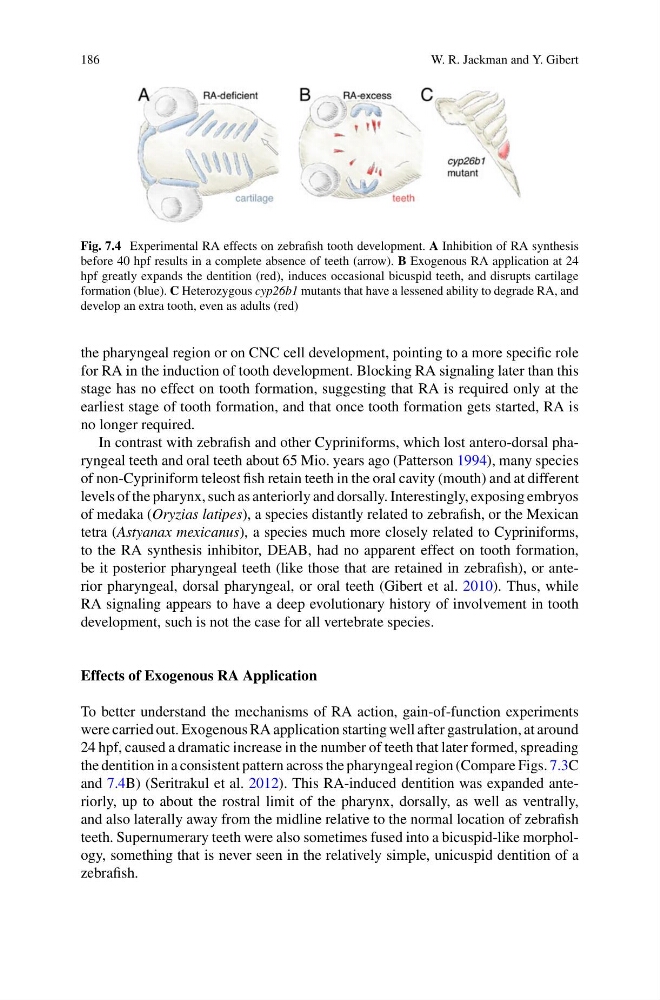
Fig. 7.4 Experimental RA effects on zebrafish tooth development. A Inhibition of RA synthesis
before 40 hpf results in a complete absence of teeth (arrow). B Exogenous RA application at 24
hpf greatly expands the dentition (red), induces occasional bicuspid teeth, and disrupts cartilage
formation (blue). C Heterozygous cyp26b1 mutants that have a lessened ability to degrade RA, and
develop an extra tooth, even as adults (red)
the pharyngeal region or on CNC cell development, pointing to a more specific role
for RA in the induction of tooth development. Blocking RA signaling later than this
stage has no effect on tooth formation, suggesting that RA is required only at the
earliest stage of tooth formation, and that once tooth formation gets started, RA is
no longer required.
In contrast with zebrafish and other Cypriniforms, which lost antero-dorsal pharyngeal teeth and oral teeth about 65 Mio. years ago (Patterson 1994), many species
of non-Cypriniform teleost fish retain teeth in the oral cavity (mouth) and at different
levels of the pharynx, such as anteriorly and dorsally. Interestingly, exposing embryos
of medaka (Oryzias latipes), a species distantly related to zebrafish, or the Mexican
tetra (Astyanax mexicanus), a species much more closely related to Cypriniforms,
to the RA synthesis inhibitor, DEAB, had no apparent effect on tooth formation,
be it posterior pharyngeal teeth (like those that are retained in zebrafish), or anterior pharyngeal, dorsal pharyngeal, or oral teeth (Gibert et al. 2010). Thus, while
RA signaling appears to have a deep evolutionary history of involvement in tooth
development, such is not the case for all vertebrate species.
Effects of Exogenous RA Application
To better understand the mechanisms of RA action, gain-of-function experiments
were carried out. Exogenous RA application starting well after gastrulation, at around
24 hpf, caused a dramatic increase in the number of teeth that later formed, spreading
the dentition in a consistent pattern across the pharyngeal region (Compare Figs. 7.3C
and 7.4B) (Seritrakul et al. 2012). This RA-induced dentition was expanded anteriorly, up to about the rostral limit of the pharynx, dorsally, as well as ventrally,
and also laterally away from the midline relative to the normal location of zebrafish
teeth. Supernumerary teeth were also sometimes fused into a bicuspid-like morphology, something that is never seen in the relatively simple, unicuspid dentition of a
zebrafish.
W. R. Jackman and Y. Gibert
Fig. 7.4 Experimental RA effects on zebrafish tooth development. A Inhibition of RA synthesis
before 40 hpf results in a complete absence of teeth (arrow). B Exogenous RA application at 24
hpf greatly expands the dentition (red), induces occasional bicuspid teeth, and disrupts cartilage
formation (blue). C Heterozygous cyp26b1 mutants that have a lessened ability to degrade RA, and
develop an extra tooth, even as adults (red)
the pharyngeal region or on CNC cell development, pointing to a more specific role
for RA in the induction of tooth development. Blocking RA signaling later than this
stage has no effect on tooth formation, suggesting that RA is required only at the
earliest stage of tooth formation, and that once tooth formation gets started, RA is
no longer required.
In contrast with zebrafish and other Cypriniforms, which lost antero-dorsal pharyngeal teeth and oral teeth about 65 Mio. years ago (Patterson 1994), many species
of non-Cypriniform teleost fish retain teeth in the oral cavity (mouth) and at different
levels of the pharynx, such as anteriorly and dorsally. Interestingly, exposing embryos
of medaka (Oryzias latipes), a species distantly related to zebrafish, or the Mexican
tetra (Astyanax mexicanus), a species much more closely related to Cypriniforms,
to the RA synthesis inhibitor, DEAB, had no apparent effect on tooth formation,
be it posterior pharyngeal teeth (like those that are retained in zebrafish), or anterior pharyngeal, dorsal pharyngeal, or oral teeth (Gibert et al. 2010). Thus, while
RA signaling appears to have a deep evolutionary history of involvement in tooth
development, such is not the case for all vertebrate species.
Effects of Exogenous RA Application
To better understand the mechanisms of RA action, gain-of-function experiments
were carried out. Exogenous RA application starting well after gastrulation, at around
24 hpf, caused a dramatic increase in the number of teeth that later formed, spreading
the dentition in a consistent pattern across the pharyngeal region (Compare Figs. 7.3C
and 7.4B) (Seritrakul et al. 2012). This RA-induced dentition was expanded anteriorly, up to about the rostral limit of the pharynx, dorsally, as well as ventrally,
and also laterally away from the midline relative to the normal location of zebrafish
teeth. Supernumerary teeth were also sometimes fused into a bicuspid-like morphology, something that is never seen in the relatively simple, unicuspid dentition of a
zebrafish.