

166
H. A. Marquez and F. Chen
In fact, during induction of mouse primordial lung, endogenous RA integrates not
only TGFβ but also the WNT pathway in the control of FGF10 expression (Chen et al.
2010). WNT activation is dependent on local repression of its antagonist, Dickkopf
WNT signaling pathway inhibitor 1 (Dkk1), by endogenous RA (Chen et al. 2010).
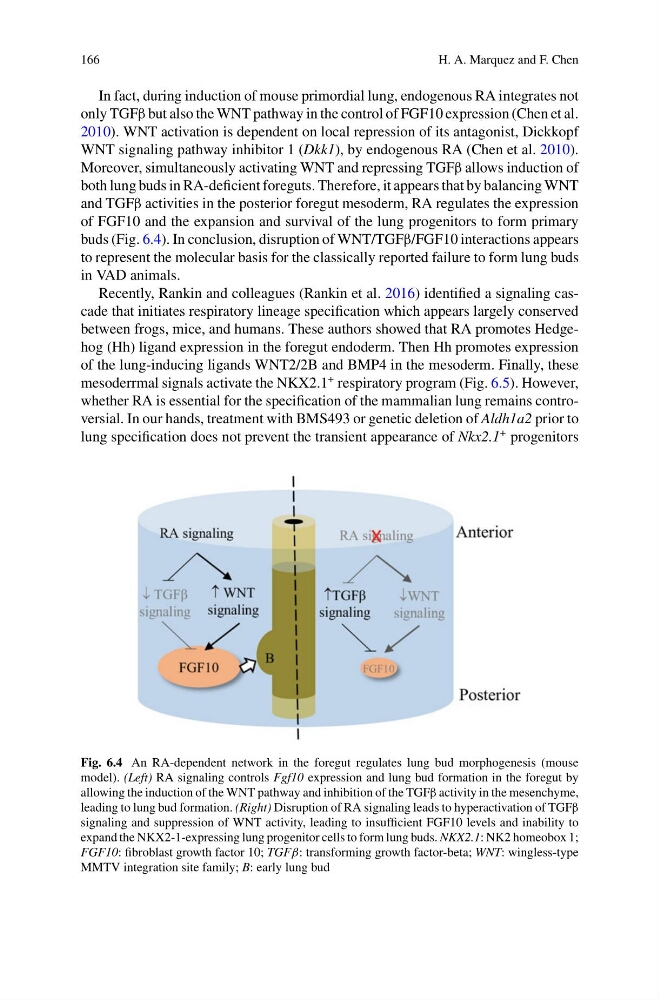
Moreover, simultaneously activating WNT and repressing TGFβ allows induction of
both lung buds in RA-deficient foreguts. Therefore, it appears that by balancing WNT
and TGFβ activities in the posterior foregut mesoderm, RA regulates the expression
of FGF10 and the expansion and survival of the lung progenitors to form primary
buds (Fig. 6.4). In conclusion, disruption of WNT/TGFβ/FGF10 interactions appears
to represent the molecular basis for the classically reported failure to form lung buds
in VAD animals.
Recently, Rankin and colleagues (Rankin et al. 2016) identified a signaling cascade that initiates respiratory lineage specification which appears largely conserved
between frogs, mice, and humans. These authors showed that RA promotes Hedgehog (Hh) ligand expression in the foregut endoderm. Then Hh promotes expression
of the lung-inducing ligands WNT2/2B and BMP4 in the mesoderm. Finally, these
mesoderrmal signals activate the NKX2.1
+ respiratory program (Fig. 6.5). However,
whether RA is essential for the specification of the mammalian lung remains controversial. In our hands, treatment with BMS493 or genetic deletion of Aldh1a2 prior to
lung specification does not prevent the transient appearance of Nkx2.1
+ progenitors
Fig. 6.4 An RA-dependent network in the foregut regulates lung bud morphogenesis (mouse
model). (Left) RA signaling controls Fgf10 expression and lung bud formation in the foregut by
allowing the induction of the WNT pathway and inhibition of the TGFβ activity in the mesenchyme,
leading to lung bud formation. (Right) Disruption of RA signaling leads to hyperactivation of TGFβ
signaling and suppression of WNT activity, leading to insufficient FGF10 levels and inability to
expand the NKX2-1-expressing lung progenitor cells to form lung buds. NKX2.1: NK2 homeobox 1;
FGF10: fibroblast growth factor 10; TGFβ: transforming growth factor-beta; WNT: wingless-type
MMTV integration site family; B: early lung bud
H. A. Marquez and F. Chen
In fact, during induction of mouse primordial lung, endogenous RA integrates not
only TGFβ but also the WNT pathway in the control of FGF10 expression (Chen et al.
2010). WNT activation is dependent on local repression of its antagonist, Dickkopf
WNT signaling pathway inhibitor 1 (Dkk1), by endogenous RA (Chen et al. 2010).
Moreover, simultaneously activating WNT and repressing TGFβ allows induction of
both lung buds in RA-deficient foreguts. Therefore, it appears that by balancing WNT
and TGFβ activities in the posterior foregut mesoderm, RA regulates the expression
of FGF10 and the expansion and survival of the lung progenitors to form primary
buds (Fig. 6.4). In conclusion, disruption of WNT/TGFβ/FGF10 interactions appears
to represent the molecular basis for the classically reported failure to form lung buds
in VAD animals.
Recently, Rankin and colleagues (Rankin et al. 2016) identified a signaling cascade that initiates respiratory lineage specification which appears largely conserved
between frogs, mice, and humans. These authors showed that RA promotes Hedgehog (Hh) ligand expression in the foregut endoderm. Then Hh promotes expression
of the lung-inducing ligands WNT2/2B and BMP4 in the mesoderm. Finally, these
mesoderrmal signals activate the NKX2.1
+ respiratory program (Fig. 6.5). However,
whether RA is essential for the specification of the mammalian lung remains controversial. In our hands, treatment with BMS493 or genetic deletion of Aldh1a2 prior to
lung specification does not prevent the transient appearance of Nkx2.1
+ progenitors
Fig. 6.4 An RA-dependent network in the foregut regulates lung bud morphogenesis (mouse
model). (Left) RA signaling controls Fgf10 expression and lung bud formation in the foregut by
allowing the induction of the WNT pathway and inhibition of the TGFβ activity in the mesenchyme,
leading to lung bud formation. (Right) Disruption of RA signaling leads to hyperactivation of TGFβ
signaling and suppression of WNT activity, leading to insufficient FGF10 levels and inability to
expand the NKX2-1-expressing lung progenitor cells to form lung buds. NKX2.1: NK2 homeobox 1;
FGF10: fibroblast growth factor 10; TGFβ: transforming growth factor-beta; WNT: wingless-type
MMTV integration site family; B: early lung bud