

6
M. A. Asson-Batres
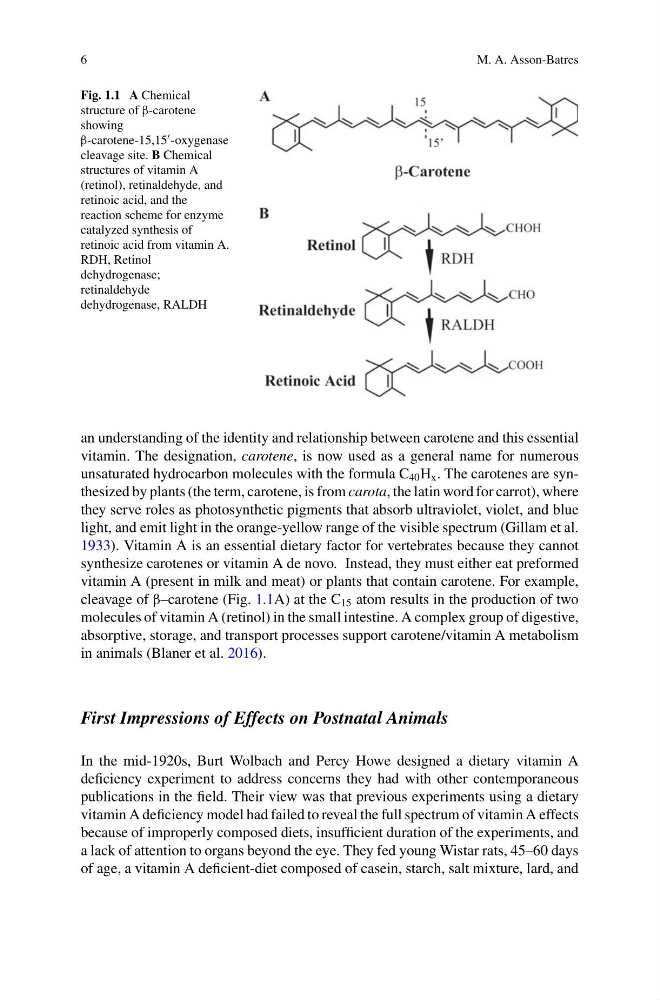
Fig. 1.1 A Chemical
structure of β-carotene
showing
β-carotene-15,15 -oxygenase
cleavage site. B Chemical
structures of vitamin A
(retinol), retinaldehyde, and
retinoic acid, and the
reaction scheme for enzyme
catalyzed synthesis of
retinoic acid from vitamin A.
RDH, Retinol
dehydrogenase;
retinaldehyde
dehydrogenase, RALDH
an understanding of the identity and relationship between carotene and this essential
vitamin. The designation, carotene, is now used as a general name for numerous
unsaturated hydrocarbon molecules with the formula C 40 H x . The carotenes are synthesized by plants (the term, carotene, is from carota, the latin word for carrot), where
they serve roles as photosynthetic pigments that absorb ultraviolet, violet, and blue
light, and emit light in the orange-yellow range of the visible spectrum (Gillam et al.
1933). Vitamin A is an essential dietary factor for vertebrates because they cannot
synthesize carotenes or vitamin A de novo. Instead, they must either eat preformed
vitamin A (present in milk and meat) or plants that contain carotene. For example,
cleavage of β–carotene (Fig. 1.1A) at the C 15 atom results in the production of two
molecules of vitamin A (retinol) in the small intestine. A complex group of digestive,
absorptive, storage, and transport processes support carotene/vitamin A metabolism
in animals (Blaner et al. 2016).
First Impressions of Effects on Postnatal Animals
In the mid-1920s, Burt Wolbach and Percy Howe designed a dietary vitamin A
deficiency experiment to address concerns they had with other contemporaneous
publications in the field. Their view was that previous experiments using a dietary
vitamin A deficiency model had failed to reveal the full spectrum of vitamin A effects
because of improperly composed diets, insufficient duration of the experiments, and
a lack of attention to organs beyond the eye. They fed young Wistar rats, 45–60 days
of age, a vitamin A deficient-diet composed of casein, starch, salt mixture, lard, and
M. A. Asson-Batres
Fig. 1.1 A Chemical
structure of β-carotene
showing
β-carotene-15,15 -oxygenase
cleavage site. B Chemical
structures of vitamin A
(retinol), retinaldehyde, and
retinoic acid, and the
reaction scheme for enzyme
catalyzed synthesis of
retinoic acid from vitamin A.
RDH, Retinol
dehydrogenase;
retinaldehyde
dehydrogenase, RALDH
an understanding of the identity and relationship between carotene and this essential
vitamin. The designation, carotene, is now used as a general name for numerous
unsaturated hydrocarbon molecules with the formula C 40 H x . The carotenes are synthesized by plants (the term, carotene, is from carota, the latin word for carrot), where
they serve roles as photosynthetic pigments that absorb ultraviolet, violet, and blue
light, and emit light in the orange-yellow range of the visible spectrum (Gillam et al.
1933). Vitamin A is an essential dietary factor for vertebrates because they cannot
synthesize carotenes or vitamin A de novo. Instead, they must either eat preformed
vitamin A (present in milk and meat) or plants that contain carotene. For example,
cleavage of β–carotene (Fig. 1.1A) at the C 15 atom results in the production of two
molecules of vitamin A (retinol) in the small intestine. A complex group of digestive,
absorptive, storage, and transport processes support carotene/vitamin A metabolism
in animals (Blaner et al. 2016).
First Impressions of Effects on Postnatal Animals
In the mid-1920s, Burt Wolbach and Percy Howe designed a dietary vitamin A
deficiency experiment to address concerns they had with other contemporaneous
publications in the field. Their view was that previous experiments using a dietary
vitamin A deficiency model had failed to reveal the full spectrum of vitamin A effects
because of improperly composed diets, insufficient duration of the experiments, and
a lack of attention to organs beyond the eye. They fed young Wistar rats, 45–60 days
of age, a vitamin A deficient-diet composed of casein, starch, salt mixture, lard, and