

126
E. Perl and J. S. Waxman
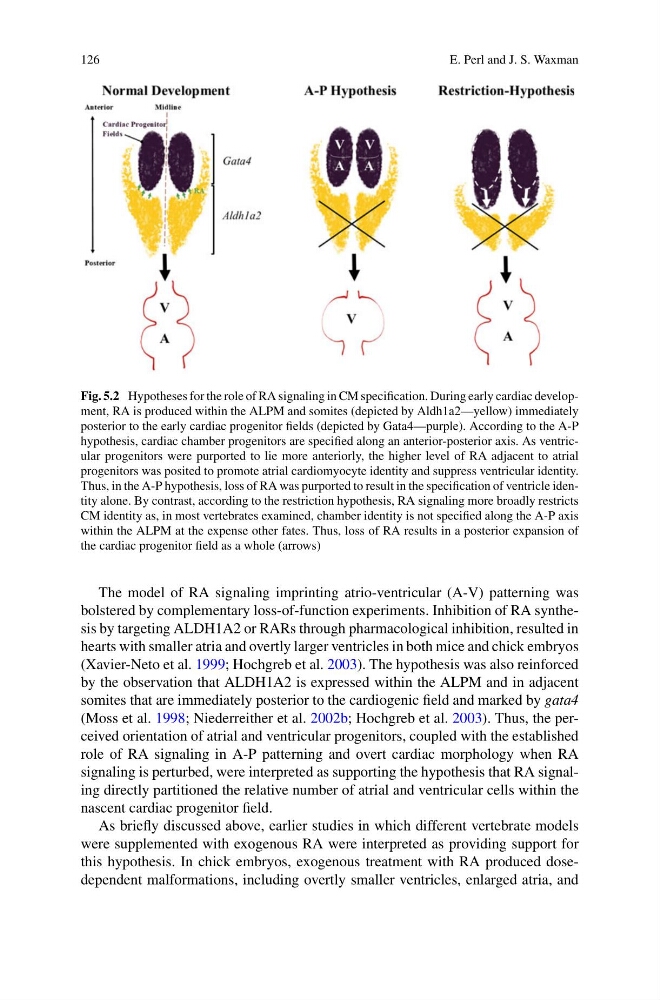
Fig. 5.2 Hypotheses for the role of RA signaling in CM specification. During early cardiac development, RA is produced within the ALPM and somites (depicted by Aldh1a2—yellow) immediately
posterior to the early cardiac progenitor fields (depicted by Gata4—purple). According to the A-P
hypothesis, cardiac chamber progenitors are specified along an anterior-posterior axis. As ventricular progenitors were purported to lie more anteriorly, the higher level of RA adjacent to atrial
progenitors was posited to promote atrial cardiomyocyte identity and suppress ventricular identity.
Thus, in the A-P hypothesis, loss of RA was purported to result in the specification of ventricle identity alone. By contrast, according to the restriction hypothesis, RA signaling more broadly restricts
CM identity as, in most vertebrates examined, chamber identity is not specified along the A-P axis
within the ALPM at the expense other fates. Thus, loss of RA results in a posterior expansion of
the cardiac progenitor field as a whole (arrows)
The model of RA signaling imprinting atrio-ventricular (A-V) patterning was
bolstered by complementary loss-of-function experiments. Inhibition of RA synthesis by targeting ALDH1A2 or RARs through pharmacological inhibition, resulted in
hearts with smaller atria and overtly larger ventricles in both mice and chick embryos
(Xavier-Neto et al. 1999; Hochgreb et al. 2003). The hypothesis was also reinforced
by the observation that ALDH1A2 is expressed within the ALPM and in adjacent
somites that are immediately posterior to the cardiogenic field and marked by gata4
(Moss et al. 1998; Niederreither et al. 2002b; Hochgreb et al. 2003). Thus, the perceived orientation of atrial and ventricular progenitors, coupled with the established
role of RA signaling in A-P patterning and overt cardiac morphology when RA
signaling is perturbed, were interpreted as supporting the hypothesis that RA signaling directly partitioned the relative number of atrial and ventricular cells within the
nascent cardiac progenitor field.
As briefly discussed above, earlier studies in which different vertebrate models
were supplemented with exogenous RA were interpreted as providing support for
this hypothesis. In chick embryos, exogenous treatment with RA produced dosedependent malformations, including overtly smaller ventricles, enlarged atria, and
E. Perl and J. S. Waxman
Fig. 5.2 Hypotheses for the role of RA signaling in CM specification. During early cardiac development, RA is produced within the ALPM and somites (depicted by Aldh1a2—yellow) immediately
posterior to the early cardiac progenitor fields (depicted by Gata4—purple). According to the A-P
hypothesis, cardiac chamber progenitors are specified along an anterior-posterior axis. As ventricular progenitors were purported to lie more anteriorly, the higher level of RA adjacent to atrial
progenitors was posited to promote atrial cardiomyocyte identity and suppress ventricular identity.
Thus, in the A-P hypothesis, loss of RA was purported to result in the specification of ventricle identity alone. By contrast, according to the restriction hypothesis, RA signaling more broadly restricts
CM identity as, in most vertebrates examined, chamber identity is not specified along the A-P axis
within the ALPM at the expense other fates. Thus, loss of RA results in a posterior expansion of
the cardiac progenitor field as a whole (arrows)
The model of RA signaling imprinting atrio-ventricular (A-V) patterning was
bolstered by complementary loss-of-function experiments. Inhibition of RA synthesis by targeting ALDH1A2 or RARs through pharmacological inhibition, resulted in
hearts with smaller atria and overtly larger ventricles in both mice and chick embryos
(Xavier-Neto et al. 1999; Hochgreb et al. 2003). The hypothesis was also reinforced
by the observation that ALDH1A2 is expressed within the ALPM and in adjacent
somites that are immediately posterior to the cardiogenic field and marked by gata4
(Moss et al. 1998; Niederreither et al. 2002b; Hochgreb et al. 2003). Thus, the perceived orientation of atrial and ventricular progenitors, coupled with the established
role of RA signaling in A-P patterning and overt cardiac morphology when RA
signaling is perturbed, were interpreted as supporting the hypothesis that RA signaling directly partitioned the relative number of atrial and ventricular cells within the
nascent cardiac progenitor field.
As briefly discussed above, earlier studies in which different vertebrate models
were supplemented with exogenous RA were interpreted as providing support for
this hypothesis. In chick embryos, exogenous treatment with RA produced dosedependent malformations, including overtly smaller ventricles, enlarged atria, and