

4 RA Signaling in Limb Development and Regeneration …
97
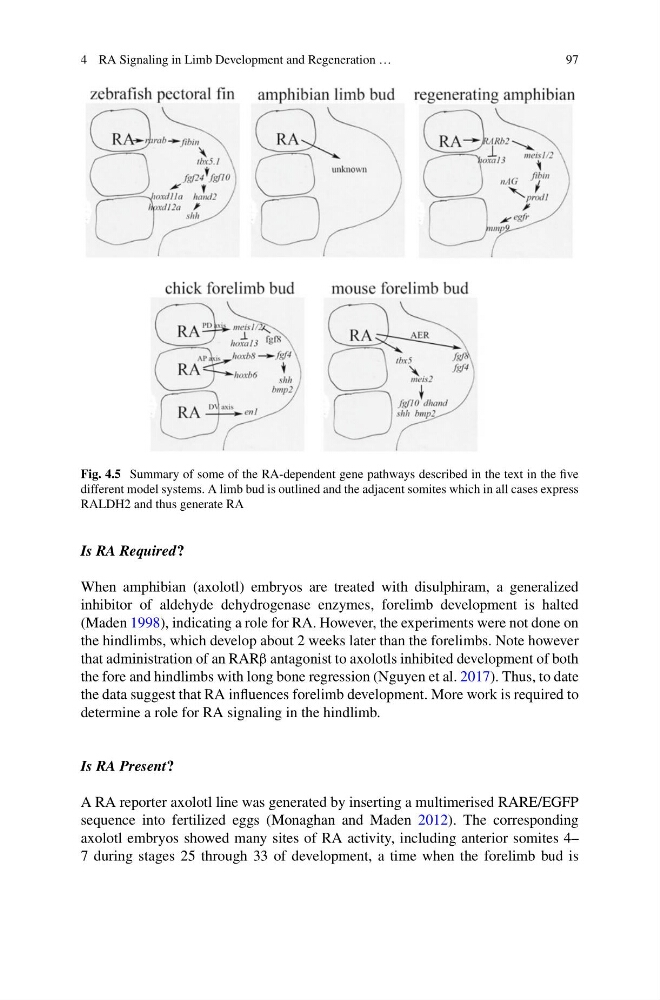
Fig. 4.5 Summary of some of the RA-dependent gene pathways described in the text in the five
different model systems. A limb bud is outlined and the adjacent somites which in all cases express
RALDH2 and thus generate RA
Is RA Required?
When amphibian (axolotl) embryos are treated with disulphiram, a generalized
inhibitor of aldehyde dehydrogenase enzymes, forelimb development is halted
(Maden 1998), indicating a role for RA. However, the experiments were not done on
the hindlimbs, which develop about 2 weeks later than the forelimbs. Note however
that administration of an RARβ antagonist to axolotls inhibited development of both
the fore and hindlimbs with long bone regression (Nguyen et al. 2017). Thus, to date
the data suggest that RA influences forelimb development. More work is required to
determine a role for RA signaling in the hindlimb.
Is RA Present?
A RA reporter axolotl line was generated by inserting a multimerised RARE/EGFP
sequence into fertilized eggs (Monaghan and Maden 2012). The corresponding
axolotl embryos showed many sites of RA activity, including anterior somites 4–
7 during stages 25 through 33 of development, a time when the forelimb bud is
97
Fig. 4.5 Summary of some of the RA-dependent gene pathways described in the text in the five
different model systems. A limb bud is outlined and the adjacent somites which in all cases express
RALDH2 and thus generate RA
Is RA Required?
When amphibian (axolotl) embryos are treated with disulphiram, a generalized
inhibitor of aldehyde dehydrogenase enzymes, forelimb development is halted
(Maden 1998), indicating a role for RA. However, the experiments were not done on
the hindlimbs, which develop about 2 weeks later than the forelimbs. Note however
that administration of an RARβ antagonist to axolotls inhibited development of both
the fore and hindlimbs with long bone regression (Nguyen et al. 2017). Thus, to date
the data suggest that RA influences forelimb development. More work is required to
determine a role for RA signaling in the hindlimb.
Is RA Present?
A RA reporter axolotl line was generated by inserting a multimerised RARE/EGFP
sequence into fertilized eggs (Monaghan and Maden 2012). The corresponding
axolotl embryos showed many sites of RA activity, including anterior somites 4–
7 during stages 25 through 33 of development, a time when the forelimb bud is