

4 OPV with a Crystalline Organic Pigment Active Layer Up to 10 μm
8 1
Optical efficiency
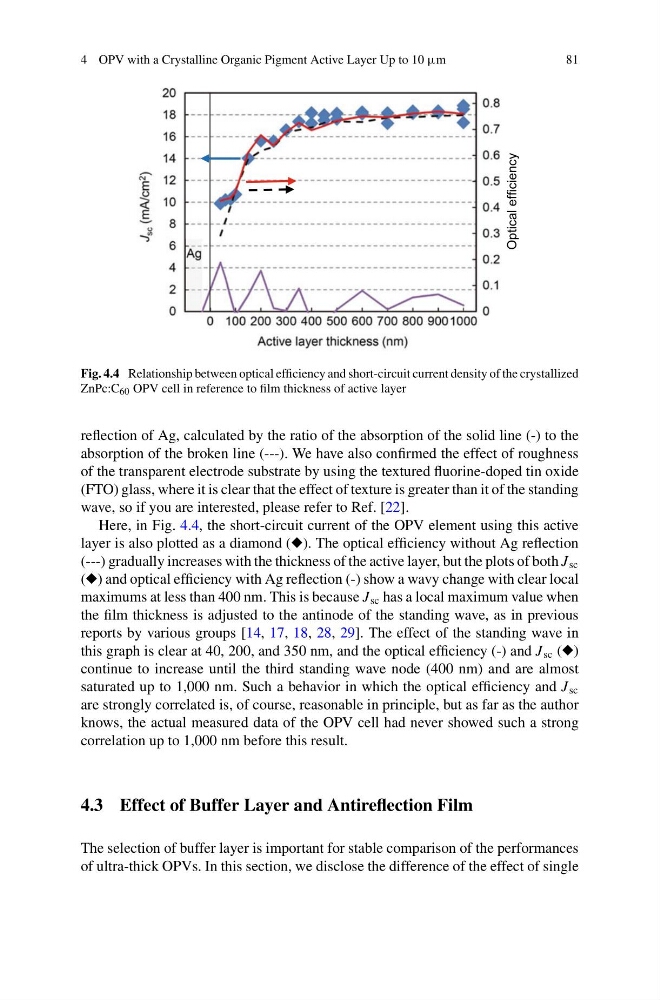
Fig. 4.4 Relationship between optical efficiency and short-circuit current density of the crystallized
ZnPc:C 60 OPV cell in reference to film thickness of active layer
reflection of Ag, calculated by the ratio of the absorption of the solid line (-) to the
absorption of the broken line (---). We have also confirmed the effect of roughness
of the transparent electrode substrate by using the textured fluorine-doped tin oxide
(FTO) glass, where it is clear that the effect of texture is greater than it of the standing
wave, so if you are interested, please refer to Ref. [22].
Here, in Fig. 4.4, the short-circuit current of the OPV element using this active
layer is also plotted as a diamond (◆). The optical efficiency without Ag reflection
(---) gradually increases with the thickness of the active layer, but the plots of both J sc
(◆) and optical efficiency with Ag reflection (-) show a wavy change with clear local
maximums at less than 400 nm. This is because J sc has a local maximum value when
the film thickness is adjusted to the antinode of the standing wave, as in previous
reports by various groups [14, 17, 18, 28, 29]. The effect of the standing wave in
this graph is clear at 40, 200, and 350 nm, and the optical efficiency (-) and J sc (◆)
continue to increase until the third standing wave node (400 nm) and are almost
saturated up to 1,000 nm. Such a behavior in which the optical efficiency and J sc
are strongly correlated is, of course, reasonable in principle, but as far as the author
knows, the actual measured data of the OPV cell had never showed such a strong
correlation up to 1,000 nm before this result.
4.3 Effect of Buffer Layer and Antireflection Film
The selection of buffer layer is important for stable comparison of the performances
of ultra-thick OPVs. In this section, we disclose the difference of the effect of single
8 1
Optical efficiency
Fig. 4.4 Relationship between optical efficiency and short-circuit current density of the crystallized
ZnPc:C 60 OPV cell in reference to film thickness of active layer
reflection of Ag, calculated by the ratio of the absorption of the solid line (-) to the
absorption of the broken line (---). We have also confirmed the effect of roughness
of the transparent electrode substrate by using the textured fluorine-doped tin oxide
(FTO) glass, where it is clear that the effect of texture is greater than it of the standing
wave, so if you are interested, please refer to Ref. [22].
Here, in Fig. 4.4, the short-circuit current of the OPV element using this active
layer is also plotted as a diamond (◆). The optical efficiency without Ag reflection
(---) gradually increases with the thickness of the active layer, but the plots of both J sc
(◆) and optical efficiency with Ag reflection (-) show a wavy change with clear local
maximums at less than 400 nm. This is because J sc has a local maximum value when
the film thickness is adjusted to the antinode of the standing wave, as in previous
reports by various groups [14, 17, 18, 28, 29]. The effect of the standing wave in
this graph is clear at 40, 200, and 350 nm, and the optical efficiency (-) and J sc (◆)
continue to increase until the third standing wave node (400 nm) and are almost
saturated up to 1,000 nm. Such a behavior in which the optical efficiency and J sc
are strongly correlated is, of course, reasonable in principle, but as far as the author
knows, the actual measured data of the OPV cell had never showed such a strong
correlation up to 1,000 nm before this result.
4.3 Effect of Buffer Layer and Antireflection Film
The selection of buffer layer is important for stable comparison of the performances
of ultra-thick OPVs. In this section, we disclose the difference of the effect of single