

70
M. Hiramoto
ITO
MoO 3
BCP
Al
C8-BTBT/
PTCDI-C8
ITO
MoO 3
BCP
Al
C8-BTBT
PTCDI-C8
Sapphire
C8-BTBT
PTCDI-C8
Lateral
Vertical
blended
100
nm
-0.04
-0.02
0
0.02
0.04
0.06
0.08
-1.5
-1
-0.5
0
0.5
1
1.5
Current density / mA cm -2
Voltage / V
Lateral
blended
Vertical
Ag/
MoO 3
Ag/
BCP
100
nm
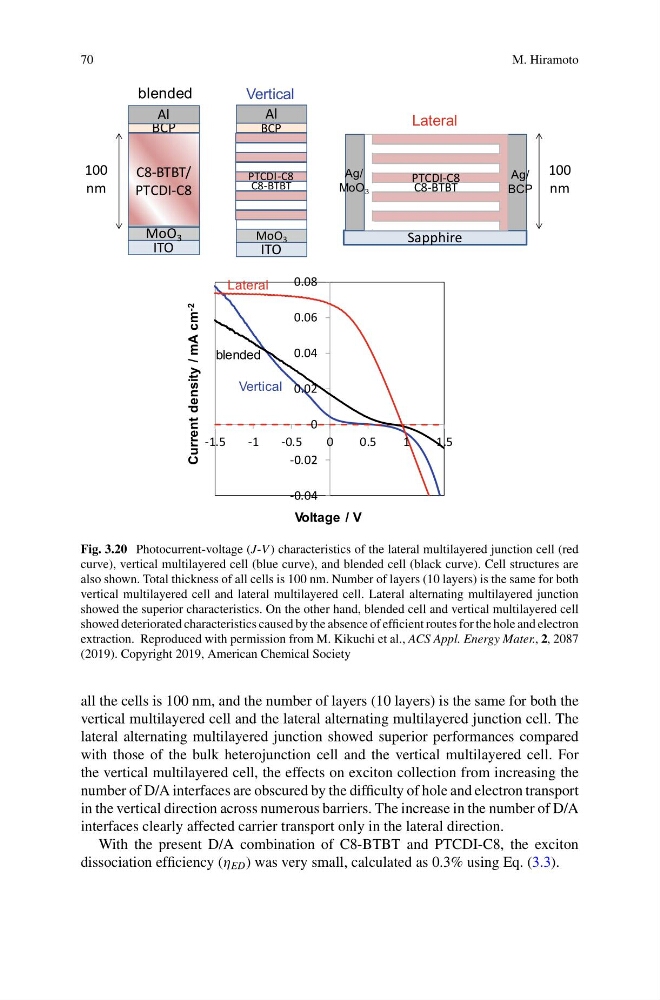
Fig. 3.20 Photocurrent-voltage (J-V ) characteristics of the lateral multilayered junction cell (red
curve), vertical multilayered cell (blue curve), and blended cell (black curve). Cell structures are
also shown. Total thickness of all cells is 100 nm. Number of layers (10 layers) is the same for both
vertical multilayered cell and lateral multilayered cell. Lateral alternating multilayered junction
showed the superior characteristics. On the other hand, blended cell and vertical multilayered cell
showed deteriorated characteristics caused by the absence of efficient routes for the hole and electron
extraction. Reproduced with permission from M. Kikuchi et al., ACS Appl. Energy Mater., 2, 2087
(2019). Copyright 2019, American Chemical Society
all the cells is 100 nm, and the number of layers (10 layers) is the same for both the
vertical multilayered cell and the lateral alternating multilayered junction cell. The
lateral alternating multilayered junction showed superior performances compared
with those of the bulk heterojunction cell and the vertical multilayered cell. For
the vertical multilayered cell, the effects on exciton collection from increasing the
number of D/A interfaces are obscured by the difficulty of hole and electron transport
in the vertical direction across numerous barriers. The increase in the number of D/A
interfaces clearly affected carrier transport only in the lateral direction.
With the present D/A combination of C8-BTBT and PTCDI-C8, the exciton
dissociation efficiency (η ED ) was very small, calculated as 0.3% using Eq. (3.3).
M. Hiramoto
ITO
MoO 3
BCP
Al
C8-BTBT/
PTCDI-C8
ITO
MoO 3
BCP
Al
C8-BTBT
PTCDI-C8
Sapphire
C8-BTBT
PTCDI-C8
Lateral
Vertical
blended
100
nm
-0.04
-0.02
0
0.02
0.04
0.06
0.08
-1.5
-1
-0.5
0
0.5
1
1.5
Current density / mA cm -2
Voltage / V
Lateral
blended
Vertical
Ag/
MoO 3
Ag/
BCP
100
nm
Fig. 3.20 Photocurrent-voltage (J-V ) characteristics of the lateral multilayered junction cell (red
curve), vertical multilayered cell (blue curve), and blended cell (black curve). Cell structures are
also shown. Total thickness of all cells is 100 nm. Number of layers (10 layers) is the same for both
vertical multilayered cell and lateral multilayered cell. Lateral alternating multilayered junction
showed the superior characteristics. On the other hand, blended cell and vertical multilayered cell
showed deteriorated characteristics caused by the absence of efficient routes for the hole and electron
extraction. Reproduced with permission from M. Kikuchi et al., ACS Appl. Energy Mater., 2, 2087
(2019). Copyright 2019, American Chemical Society
all the cells is 100 nm, and the number of layers (10 layers) is the same for both the
vertical multilayered cell and the lateral alternating multilayered junction cell. The
lateral alternating multilayered junction showed superior performances compared
with those of the bulk heterojunction cell and the vertical multilayered cell. For
the vertical multilayered cell, the effects on exciton collection from increasing the
number of D/A interfaces are obscured by the difficulty of hole and electron transport
in the vertical direction across numerous barriers. The increase in the number of D/A
interfaces clearly affected carrier transport only in the lateral direction.
With the present D/A combination of C8-BTBT and PTCDI-C8, the exciton
dissociation efficiency (η ED ) was very small, calculated as 0.3% using Eq. (3.3).