

9 Parts-Per-Million-Level Doping Effects …
219
9.2.1 Charge Transfer
In the case of inorganic semiconductors such as silicon, the behavior of dopants
is determined by their valence. For p-type doping, a boron atom, which has three
valence electrons, acts as an acceptor in a crystal of Si atoms, which have four valence
electrons. A hole near the negatively ionized boron atom (B
− ) can be generated
with a significantly small activation energy of 45 meV [31]. The holes are released
thermally, and the ionization rate at room temperature (RT) can reach 100%.
In the case of OSCs, the behavior of dopants is not determined by their valence,
as solid-state molecules are only bound by van der Waals forces, and no chemical
bonds exist. Doping is caused by the charge transfer between the dopant molecule and
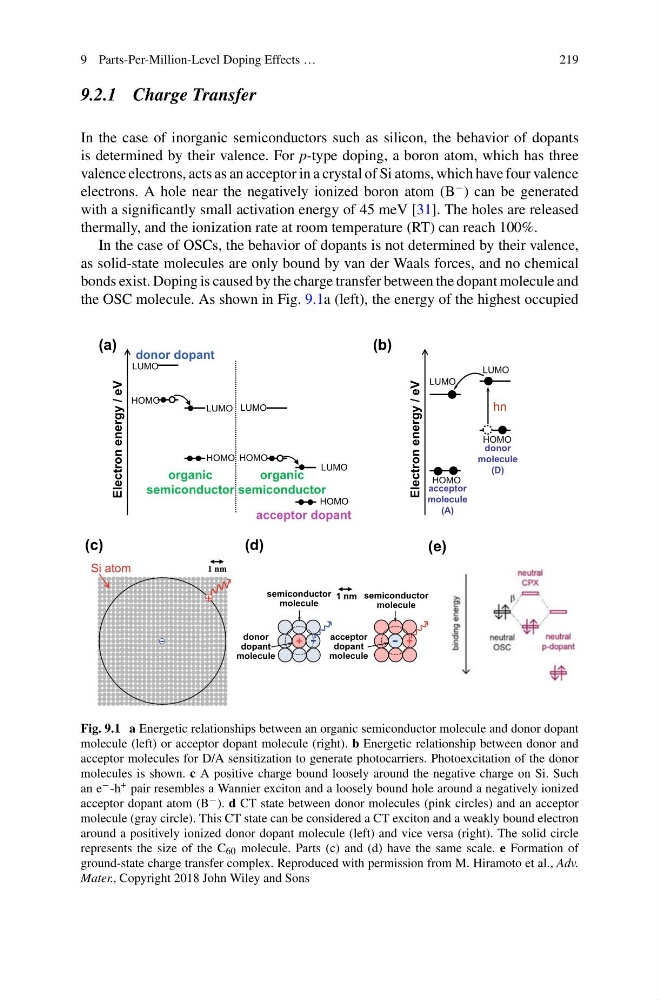
the OSC molecule. As shown in Fig. 9.1a (left), the energy of the highest occupied
(a)
(c)
(d)
(b)
1 nm
Si atom
-
+
(e)
LUMO
HOMO
donor dopant
acceptor dopant
Electron energy / eV
organic
semiconductor
organic
semiconductor
LUMO
HOMO
LUMO
HOMO
LUMO
HOMO
LUMO
hn
HOMO
LUMO
HOMO
acceptor
molecule
(A)
donor
molecule
(D)
Electron energy /
eV
- +
1 nm
acceptor
dopant
molecule
semiconductor
molecule
-
+
donor
dopant
molecule
semiconductor
molecule
Fig. 9.1 a Energetic relationships between an organic semiconductor molecule and donor dopant
molecule (left) or acceptor dopant molecule (right). b Energetic relationship between donor and
acceptor molecules for D/A sensitization to generate photocarriers. Photoexcitation of the donor
molecules is shown. c A positive charge bound loosely around the negative charge on Si. Such
an e − -h + pair resembles a Wannier exciton and a loosely bound hole around a negatively ionized
acceptor dopant atom (B − ). d CT state between donor molecules (pink circles) and an acceptor
molecule (gray circle). This CT state can be considered a CT exciton and a weakly bound electron
around a positively ionized donor dopant molecule (left) and vice versa (right). The solid circle
represents the size of the C 60 molecule. Parts (c) and (d) have the same scale. e Formation of
ground-state charge transfer complex. Reproduced with permission from M. Hiramoto et al., Adv.
Mater., Copyright 2018 John Wiley and Sons
219
9.2.1 Charge Transfer
In the case of inorganic semiconductors such as silicon, the behavior of dopants
is determined by their valence. For p-type doping, a boron atom, which has three
valence electrons, acts as an acceptor in a crystal of Si atoms, which have four valence
electrons. A hole near the negatively ionized boron atom (B
− ) can be generated
with a significantly small activation energy of 45 meV [31]. The holes are released
thermally, and the ionization rate at room temperature (RT) can reach 100%.
In the case of OSCs, the behavior of dopants is not determined by their valence,
as solid-state molecules are only bound by van der Waals forces, and no chemical
bonds exist. Doping is caused by the charge transfer between the dopant molecule and
the OSC molecule. As shown in Fig. 9.1a (left), the energy of the highest occupied
(a)
(c)
(d)
(b)
1 nm
Si atom
-
+
(e)
LUMO
HOMO
donor dopant
acceptor dopant
Electron energy / eV
organic
semiconductor
organic
semiconductor
LUMO
HOMO
LUMO
HOMO
LUMO
HOMO
LUMO
hn
HOMO
LUMO
HOMO
acceptor
molecule
(A)
donor
molecule
(D)
Electron energy /
eV
- +
1 nm
acceptor
dopant
molecule
semiconductor
molecule
-
+
donor
dopant
molecule
semiconductor
molecule
Fig. 9.1 a Energetic relationships between an organic semiconductor molecule and donor dopant
molecule (left) or acceptor dopant molecule (right). b Energetic relationship between donor and
acceptor molecules for D/A sensitization to generate photocarriers. Photoexcitation of the donor
molecules is shown. c A positive charge bound loosely around the negative charge on Si. Such
an e − -h + pair resembles a Wannier exciton and a loosely bound hole around a negatively ionized
acceptor dopant atom (B − ). d CT state between donor molecules (pink circles) and an acceptor
molecule (gray circle). This CT state can be considered a CT exciton and a weakly bound electron
around a positively ionized donor dopant molecule (left) and vice versa (right). The solid circle
represents the size of the C 60 molecule. Parts (c) and (d) have the same scale. e Formation of
ground-state charge transfer complex. Reproduced with permission from M. Hiramoto et al., Adv.
Mater., Copyright 2018 John Wiley and Sons