

8 Open-Circuit Voltage in Organic Solar Cells
209
In conclusion, the monolayer cascade energy landscape weakens the Coulomb
binding energy at the interface; thus, destabilization of E CT and charge generation
without thermal activation are realized. Therefore, the monolayer cascade energy
landscape at the D/A interface is an ideal structure for achieving higher V OC and FF.
8.3.5 Importance of Donor/Acceptor Interfacial Crystallinity
to Reduce Open-Circuit Voltage Loss in Organic Solar
Cells
The relationship between the energetic structure at the D/A interface and V OC has
been discussed in the Sect. 8.3.4. In the following Sects. 8.3.5 and 8.3.6 , strategies
to increase V OC by suppressing charge recombination are presented.
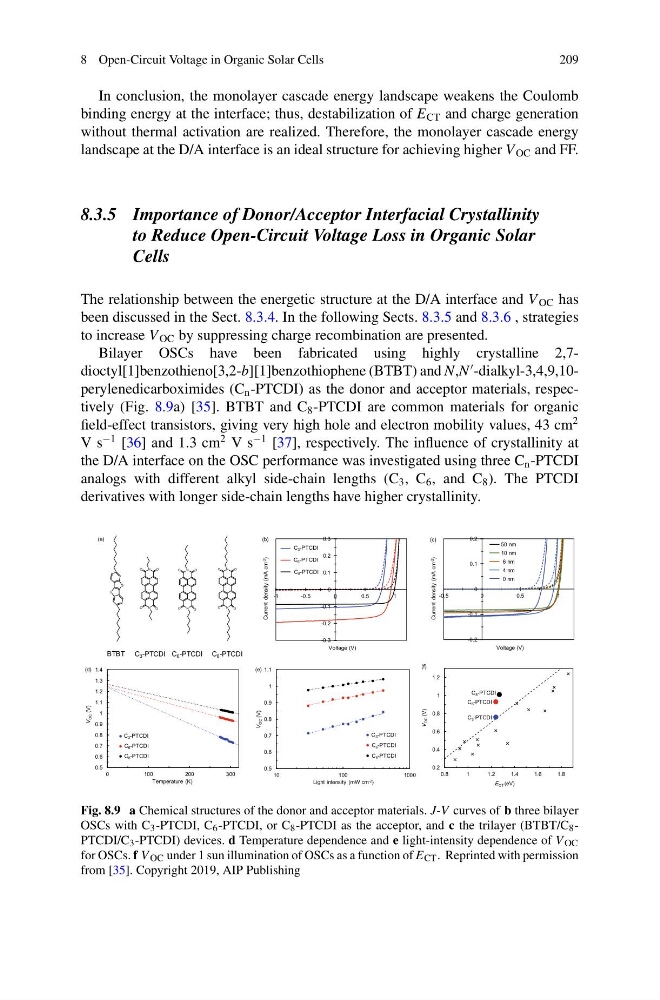
Bilayer OSCs have been fabricated using highly crystalline 2,7dioctyl[1]benzothieno[3,2-b][1]benzothiophene (BTBT) and N,N
-dialkyl-3,4,9,10perylenedicarboximides (C n -PTCDI) as the donor and acceptor materials, respectively (Fig. 8.9a) [35]. BTBT and C 8 -PTCDI are common materials for organic
field-effect transistors, giving very high hole and electron mobility values, 43 cm
2
V s
−1 [36] and 1.3 cm
2 V s
−1 [37], respectively. The influence of crystallinity at
the D/A interface on the OSC performance was investigated using three C n -PTCDI
analogs with different alkyl side-chain lengths (C 3 , C 6 , and C 8 ). The PTCDI
derivatives with longer side-chain lengths have higher crystallinity.
BTBT
(a)
C 8 -PTCDI
C 6 -PTCDI
C 3 -PTCDI
Current density (mA cm -2
)
Voltage (V)
(b)
-0.3
-0.2
-0.1
0
0.1
0.2
0.3
-1
-0.5
0
0.5
1
C3
C6
C8 C8-PTCDI
C3-PTCDI
C6-PTCDI
Current density (mA cm -2
)
Voltage (V)
(c)
-0.2
-0.1
0
0.1
0.2
-0.5
0
0.5
1
C8-light
10nm-light
6nm-light
4nm-light
C3-light
4 nm
10 nm
6 nm
50 nm
0 nm
Temperature (K)
VOC (V)
Light intensity (mW cm -2 )
0.5
0.6
0.7
0.8
0.9
1
1.1
0
0
0
1
0
0
1
0
1
C3
C6
C8 C8-PTCDI
C3-PTCDI
C6-PTCDI
VOC (V)
(d)
(e)
0.5
0.6
0.7
0.8
0.9
1
1.1
1.2
1.3
1.4
0
100
200
300
C3
C6
C8 C8-PTCDI
C3-PTCDI
C6-PTCDI
ECT (eV)
VOC (V)
(f)
0.2
0.4
0.6
0.8
1
1.2
0.8
1
1.2
1.4
1.6
1.8
C8-PTCDI
C3-PTCDI
C6-PTCDI
Fig. 8.9 a Chemical structures of the donor and acceptor materials. J-V curves of b three bilayer
OSCs with C 3 -PTCDI, C 6 -PTCDI, or C 8 -PTCDI as the acceptor, and c the trilayer (BTBT/C 8 -
PTCDI/C 3 -PTCDI) devices. d Temperature dependence and e light-intensity dependence of V OC
for OSCs. f V OC under 1 sun illumination of OSCs as a function of E CT . Reprinted with permission
from [35]. Copyright 2019, AIP Publishing
209
In conclusion, the monolayer cascade energy landscape weakens the Coulomb
binding energy at the interface; thus, destabilization of E CT and charge generation
without thermal activation are realized. Therefore, the monolayer cascade energy
landscape at the D/A interface is an ideal structure for achieving higher V OC and FF.
8.3.5 Importance of Donor/Acceptor Interfacial Crystallinity
to Reduce Open-Circuit Voltage Loss in Organic Solar
Cells
The relationship between the energetic structure at the D/A interface and V OC has
been discussed in the Sect. 8.3.4. In the following Sects. 8.3.5 and 8.3.6 , strategies
to increase V OC by suppressing charge recombination are presented.
Bilayer OSCs have been fabricated using highly crystalline 2,7dioctyl[1]benzothieno[3,2-b][1]benzothiophene (BTBT) and N,N
-dialkyl-3,4,9,10perylenedicarboximides (C n -PTCDI) as the donor and acceptor materials, respectively (Fig. 8.9a) [35]. BTBT and C 8 -PTCDI are common materials for organic
field-effect transistors, giving very high hole and electron mobility values, 43 cm
2
V s
−1 [36] and 1.3 cm
2 V s
−1 [37], respectively. The influence of crystallinity at
the D/A interface on the OSC performance was investigated using three C n -PTCDI
analogs with different alkyl side-chain lengths (C 3 , C 6 , and C 8 ). The PTCDI
derivatives with longer side-chain lengths have higher crystallinity.
BTBT
(a)
C 8 -PTCDI
C 6 -PTCDI
C 3 -PTCDI
Current density (mA cm -2
)
Voltage (V)
(b)
-0.3
-0.2
-0.1
0
0.1
0.2
0.3
-1
-0.5
0
0.5
1
C3
C6
C8 C8-PTCDI
C3-PTCDI
C6-PTCDI
Current density (mA cm -2
)
Voltage (V)
(c)
-0.2
-0.1
0
0.1
0.2
-0.5
0
0.5
1
C8-light
10nm-light
6nm-light
4nm-light
C3-light
4 nm
10 nm
6 nm
50 nm
0 nm
Temperature (K)
VOC (V)
Light intensity (mW cm -2 )
0.5
0.6
0.7
0.8
0.9
1
1.1
0
0
0
1
0
0
1
0
1
C3
C6
C8 C8-PTCDI
C3-PTCDI
C6-PTCDI
VOC (V)
(d)
(e)
0.5
0.6
0.7
0.8
0.9
1
1.1
1.2
1.3
1.4
0
100
200
300
C3
C6
C8 C8-PTCDI
C3-PTCDI
C6-PTCDI
ECT (eV)
VOC (V)
(f)
0.2
0.4
0.6
0.8
1
1.2
0.8
1
1.2
1.4
1.6
1.8
C8-PTCDI
C3-PTCDI
C6-PTCDI
Fig. 8.9 a Chemical structures of the donor and acceptor materials. J-V curves of b three bilayer
OSCs with C 3 -PTCDI, C 6 -PTCDI, or C 8 -PTCDI as the acceptor, and c the trilayer (BTBT/C 8 -
PTCDI/C 3 -PTCDI) devices. d Temperature dependence and e light-intensity dependence of V OC
for OSCs. f V OC under 1 sun illumination of OSCs as a function of E CT . Reprinted with permission
from [35]. Copyright 2019, AIP Publishing