

198
S. Izawa
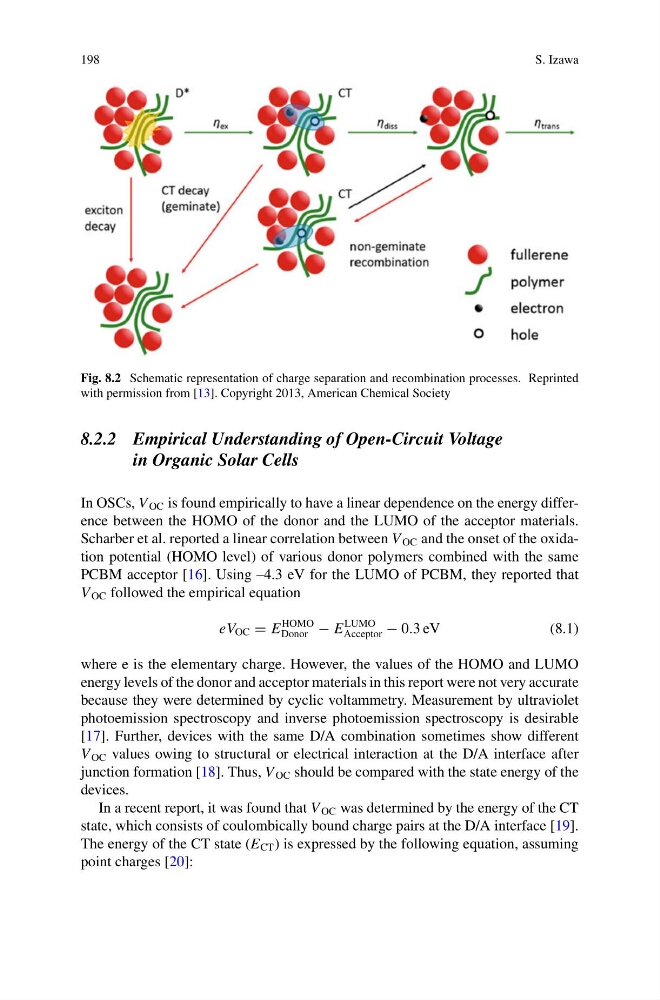
Fig. 8.2 Schematic representation of charge separation and recombination processes. Reprinted
with permission from [13]. Copyright 2013, American Chemical Society
8.2.2 Empirical Understanding of Open-Circuit Voltage
in Organic Solar Cells
In OSCs, V OC is found empirically to have a linear dependence on the energy difference between the HOMO of the donor and the LUMO of the acceptor materials.
Scharber et al. reported a linear correlation between V OC and the onset of the oxidation potential (HOMO level) of various donor polymers combined with the same
PCBM acceptor [16]. Using –4.3 eV for the LUMO of PCBM, they reported that
V OC followed the empirical equation
eV OC = E
HOMO
Donor − E
LUMO
Acceptor − 0.3 eV
(8.1)
where e is the elementary charge. However, the values of the HOMO and LUMO
energy levels of the donor and acceptor materials in this report were not very accurate
because they were determined by cyclic voltammetry. Measurement by ultraviolet
photoemission spectroscopy and inverse photoemission spectroscopy is desirable
[17]. Further, devices with the same D/A combination sometimes show different
V OC values owing to structural or electrical interaction at the D/A interface after
junction formation [18]. Thus, V OC should be compared with the state energy of the
devices.
In a recent report, it was found that V OC was determined by the energy of the CT
state, which consists of coulombically bound charge pairs at the D/A interface [19].
The energy of the CT state (E CT ) is expressed by the following equation, assuming
point charges [20]:
S. Izawa
Fig. 8.2 Schematic representation of charge separation and recombination processes. Reprinted
with permission from [13]. Copyright 2013, American Chemical Society
8.2.2 Empirical Understanding of Open-Circuit Voltage
in Organic Solar Cells
In OSCs, V OC is found empirically to have a linear dependence on the energy difference between the HOMO of the donor and the LUMO of the acceptor materials.
Scharber et al. reported a linear correlation between V OC and the onset of the oxidation potential (HOMO level) of various donor polymers combined with the same
PCBM acceptor [16]. Using –4.3 eV for the LUMO of PCBM, they reported that
V OC followed the empirical equation
eV OC = E
HOMO
Donor − E
LUMO
Acceptor − 0.3 eV
(8.1)
where e is the elementary charge. However, the values of the HOMO and LUMO
energy levels of the donor and acceptor materials in this report were not very accurate
because they were determined by cyclic voltammetry. Measurement by ultraviolet
photoemission spectroscopy and inverse photoemission spectroscopy is desirable
[17]. Further, devices with the same D/A combination sometimes show different
V OC values owing to structural or electrical interaction at the D/A interface after
junction formation [18]. Thus, V OC should be compared with the state energy of the
devices.
In a recent report, it was found that V OC was determined by the energy of the CT
state, which consists of coulombically bound charge pairs at the D/A interface [19].
The energy of the CT state (E CT ) is expressed by the following equation, assuming
point charges [20]: