

196
S. Izawa
8.2 Theoretical Background of Open-Circuit Voltage
in Organic Solar Cells
This section summarizes the theoretical background of V OC in OSCs, beginning
with an explanation of the charge generation and recombination mechanism. Subsequently, the empirical understanding of V OC , and the models explaining how V OC in
OSCs is determined are described.
8.2.1 Photoconversion Mechanisms in Organic Solar Cells
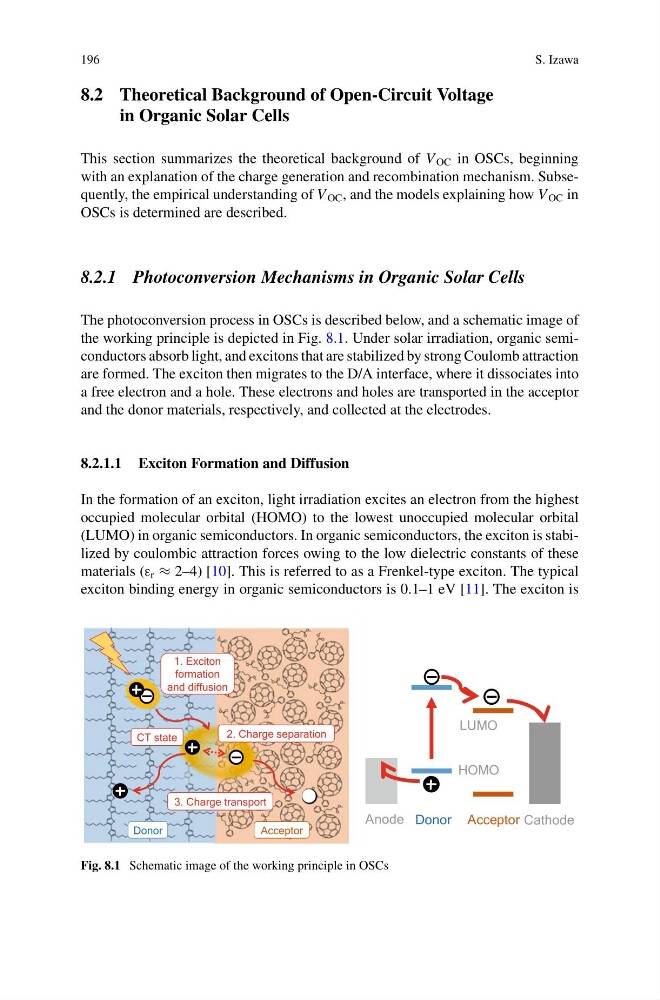
The photoconversion process in OSCs is described below, and a schematic image of
the working principle is depicted in Fig. 8.1. Under solar irradiation, organic semiconductors absorb light, and excitons that are stabilized by strong Coulomb attraction
are formed. The exciton then migrates to the D/A interface, where it dissociates into
a free electron and a hole. These electrons and holes are transported in the acceptor
and the donor materials, respectively, and collected at the electrodes.
8.2.1.1 Exciton Formation and Diffusion
In the formation of an exciton, light irradiation excites an electron from the highest
occupied molecular orbital (HOMO) to the lowest unoccupied molecular orbital
(LUMO) in organic semiconductors. In organic semiconductors, the exciton is stabilized by coulombic attraction forces owing to the low dielectric constants of these
materials (ε r ≈ 2–4) [10]. This is referred to as a Frenkel-type exciton. The typical
exciton binding energy in organic semiconductors is 0.1–1 eV [11]. The exciton is
Fig. 8.1 Schematic image of the working principle in OSCs
S. Izawa
8.2 Theoretical Background of Open-Circuit Voltage
in Organic Solar Cells
This section summarizes the theoretical background of V OC in OSCs, beginning
with an explanation of the charge generation and recombination mechanism. Subsequently, the empirical understanding of V OC , and the models explaining how V OC in
OSCs is determined are described.
8.2.1 Photoconversion Mechanisms in Organic Solar Cells
The photoconversion process in OSCs is described below, and a schematic image of
the working principle is depicted in Fig. 8.1. Under solar irradiation, organic semiconductors absorb light, and excitons that are stabilized by strong Coulomb attraction
are formed. The exciton then migrates to the D/A interface, where it dissociates into
a free electron and a hole. These electrons and holes are transported in the acceptor
and the donor materials, respectively, and collected at the electrodes.
8.2.1.1 Exciton Formation and Diffusion
In the formation of an exciton, light irradiation excites an electron from the highest
occupied molecular orbital (HOMO) to the lowest unoccupied molecular orbital
(LUMO) in organic semiconductors. In organic semiconductors, the exciton is stabilized by coulombic attraction forces owing to the low dielectric constants of these
materials (ε r ≈ 2–4) [10]. This is referred to as a Frenkel-type exciton. The typical
exciton binding energy in organic semiconductors is 0.1–1 eV [11]. The exciton is
Fig. 8.1 Schematic image of the working principle in OSCs