

164
T. Fujita
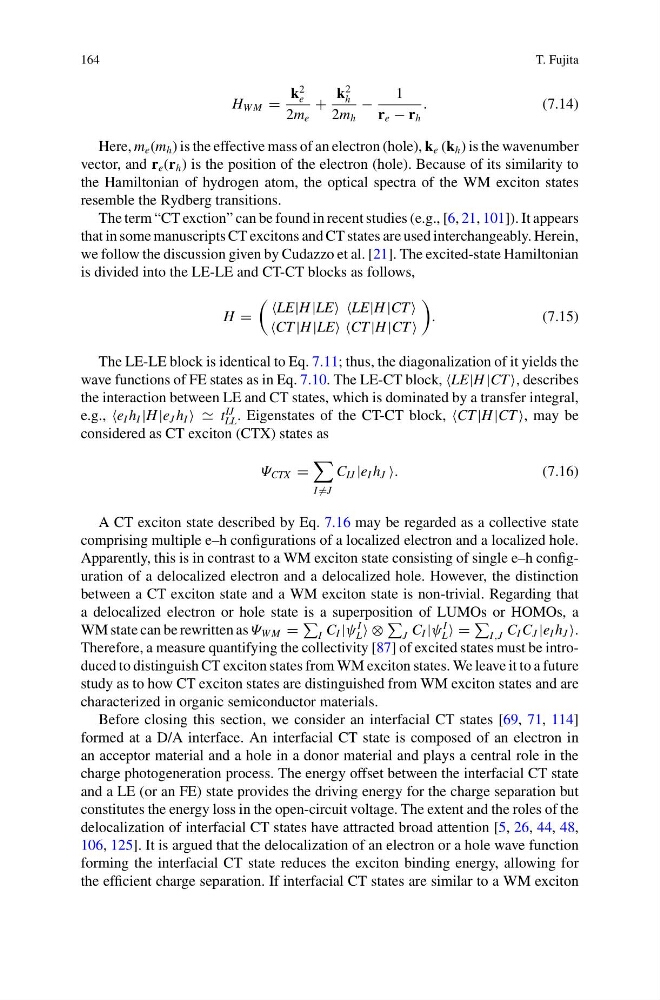
H W M =
k
2
e
2m e
+
k
2
h
2m h
−
1
r e − r h
.
(7.14)
Here, m e (m h ) is the effective mass of an electron (hole), k e (k h ) is the wavenumber
vector, and r e (r h ) is the position of the electron (hole). Because of its similarity to
the Hamiltonian of hydrogen atom, the optical spectra of the WM exciton states
resemble the Rydberg transitions.
The term “CT exction” can be found in recent studies (e.g., [6, 21, 101]). It appears
that in some manuscripts CT excitons and CT states are used interchangeably. Herein,
we follow the discussion given by Cudazzo et al. [21]. The excited-state Hamiltonian
is divided into the LE-LE and CT-CT blocks as follows,
H =
LE|H |LE LE|H |CT
CT |H |LE CT |H |CT
.
(7.15)
The LE-LE block is identical to Eq. 7.11; thus, the diagonalization of it yields the
wave functions of FE states as in Eq. 7.10. The LE-CT block, LE|H |CT , describes
the interaction between LE and CT states, which is dominated by a transfer integral,
e.g., e I h I |H |e J h I t
IJ
LL . Eigenstates of the CT-CT block, CT |H |CT , may be
considered as CT exciton (CTX) states as
Ψ CTX =
I =J
C IJ |e I h J .
(7.16)
A CT exciton state described by Eq. 7.16 may be regarded as a collective state
comprising multiple e–h configurations of a localized electron and a localized hole.
Apparently, this is in contrast to a WM exciton state consisting of single e–h configuration of a delocalized electron and a delocalized hole. However, the distinction
between a CT exciton state and a WM exciton state is non-trivial. Regarding that
a delocalized electron or hole state is a superposition of LUMOs or HOMOs, a
WM state can be rewritten as Ψ W M =
I C I |ψ
I
L ⊗
J C I |ψ
I
L =
I ,J C I C J |e I h J .
Therefore, a measure quantifying the collectivity [87] of excited states must be introduced to distinguish CT exciton states from WM exciton states. We leave it to a future
study as to how CT exciton states are distinguished from WM exciton states and are
characterized in organic semiconductor materials.
Before closing this section, we consider an interfacial CT states [69, 71, 114]
formed at a D/A interface. An interfacial CT state is composed of an electron in
an acceptor material and a hole in a donor material and plays a central role in the
charge photogeneration process. The energy offset between the interfacial CT state
and a LE (or an FE) state provides the driving energy for the charge separation but
constitutes the energy loss in the open-circuit voltage. The extent and the roles of the
delocalization of interfacial CT states have attracted broad attention [5, 26, 44, 48,
106, 125]. It is argued that the delocalization of an electron or a hole wave function
forming the interfacial CT state reduces the exciton binding energy, allowing for
the efficient charge separation. If interfacial CT states are similar to a WM exciton
T. Fujita
H W M =
k
2
e
2m e
+
k
2
h
2m h
−
1
r e − r h
.
(7.14)
Here, m e (m h ) is the effective mass of an electron (hole), k e (k h ) is the wavenumber
vector, and r e (r h ) is the position of the electron (hole). Because of its similarity to
the Hamiltonian of hydrogen atom, the optical spectra of the WM exciton states
resemble the Rydberg transitions.
The term “CT exction” can be found in recent studies (e.g., [6, 21, 101]). It appears
that in some manuscripts CT excitons and CT states are used interchangeably. Herein,
we follow the discussion given by Cudazzo et al. [21]. The excited-state Hamiltonian
is divided into the LE-LE and CT-CT blocks as follows,
H =
LE|H |LE LE|H |CT
CT |H |LE CT |H |CT
.
(7.15)
The LE-LE block is identical to Eq. 7.11; thus, the diagonalization of it yields the
wave functions of FE states as in Eq. 7.10. The LE-CT block, LE|H |CT , describes
the interaction between LE and CT states, which is dominated by a transfer integral,
e.g., e I h I |H |e J h I t
IJ
LL . Eigenstates of the CT-CT block, CT |H |CT , may be
considered as CT exciton (CTX) states as
Ψ CTX =
I =J
C IJ |e I h J .
(7.16)
A CT exciton state described by Eq. 7.16 may be regarded as a collective state
comprising multiple e–h configurations of a localized electron and a localized hole.
Apparently, this is in contrast to a WM exciton state consisting of single e–h configuration of a delocalized electron and a delocalized hole. However, the distinction
between a CT exciton state and a WM exciton state is non-trivial. Regarding that
a delocalized electron or hole state is a superposition of LUMOs or HOMOs, a
WM state can be rewritten as Ψ W M =
I C I |ψ
I
L ⊗
J C I |ψ
I
L =
I ,J C I C J |e I h J .
Therefore, a measure quantifying the collectivity [87] of excited states must be introduced to distinguish CT exciton states from WM exciton states. We leave it to a future
study as to how CT exciton states are distinguished from WM exciton states and are
characterized in organic semiconductor materials.
Before closing this section, we consider an interfacial CT states [69, 71, 114]
formed at a D/A interface. An interfacial CT state is composed of an electron in
an acceptor material and a hole in a donor material and plays a central role in the
charge photogeneration process. The energy offset between the interfacial CT state
and a LE (or an FE) state provides the driving energy for the charge separation but
constitutes the energy loss in the open-circuit voltage. The extent and the roles of the
delocalization of interfacial CT states have attracted broad attention [5, 26, 44, 48,
106, 125]. It is argued that the delocalization of an electron or a hole wave function
forming the interfacial CT state reduces the exciton binding energy, allowing for
the efficient charge separation. If interfacial CT states are similar to a WM exciton