

100
I. Osaka
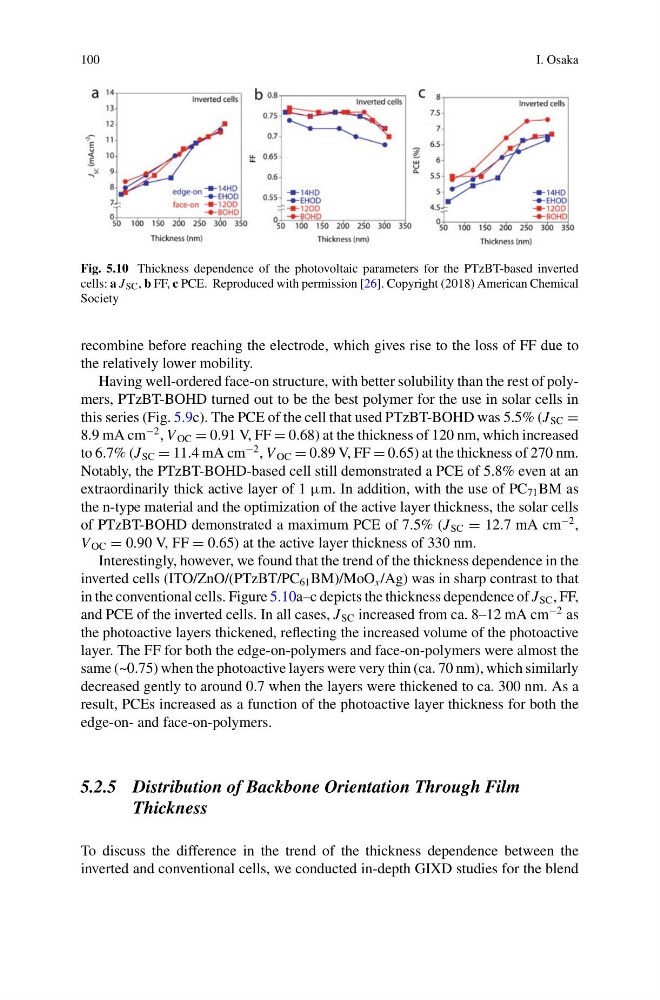
Fig. 5.10 Thickness dependence of the photovoltaic parameters for the PTzBT-based inverted
cells: a J SC , b FF, c PCE. Reproduced with permission [26]. Copyright (2018) American Chemical
Society
recombine before reaching the electrode, which gives rise to the loss of FF due to
the relatively lower mobility.
Having well-ordered face-on structure, with better solubility than the rest of polymers, PTzBT-BOHD turned out to be the best polymer for the use in solar cells in
this series (Fig. 5.9c). The PCE of the cell that used PTzBT-BOHD was 5.5% (J SC =
8.9 mA cm
−2 , V OC = 0.91 V, FF = 0.68) at the thickness of 120 nm, which increased
to 6.7% (J SC = 11.4 mA cm
−2 , V OC = 0.89 V, FF = 0.65) at the thickness of 270 nm.
Notably, the PTzBT-BOHD-based cell still demonstrated a PCE of 5.8% even at an
extraordinarily thick active layer of 1 μm. In addition, with the use of PC 71 BM as
the n-type material and the optimization of the active layer thickness, the solar cells
of PTzBT-BOHD demonstrated a maximum PCE of 7.5% (J SC = 12.7 mA cm
−2 ,
V OC = 0.90 V, FF = 0.65) at the active layer thickness of 330 nm.
Interestingly, however, we found that the trend of the thickness dependence in the
inverted cells (ITO/ZnO/(PTzBT/PC 61 BM)/MoO x /Ag) was in sharp contrast to that
in the conventional cells. Figure 5.10a–c depicts the thickness dependence of J SC , FF,
and PCE of the inverted cells. In all cases, J SC increased from ca. 8–12 mA cm
−2 as
the photoactive layers thickened, reflecting the increased volume of the photoactive
layer. The FF for both the edge-on-polymers and face-on-polymers were almost the
same (~0.75) when the photoactive layers were very thin (ca. 70 nm), which similarly
decreased gently to around 0.7 when the layers were thickened to ca. 300 nm. As a
result, PCEs increased as a function of the photoactive layer thickness for both the
edge-on- and face-on-polymers.
5.2.5 Distribution of Backbone Orientation Through Film
Thickness
To discuss the difference in the trend of the thickness dependence between the
inverted and conventional cells, we conducted in-depth GIXD studies for the blend
I. Osaka
Fig. 5.10 Thickness dependence of the photovoltaic parameters for the PTzBT-based inverted
cells: a J SC , b FF, c PCE. Reproduced with permission [26]. Copyright (2018) American Chemical
Society
recombine before reaching the electrode, which gives rise to the loss of FF due to
the relatively lower mobility.
Having well-ordered face-on structure, with better solubility than the rest of polymers, PTzBT-BOHD turned out to be the best polymer for the use in solar cells in
this series (Fig. 5.9c). The PCE of the cell that used PTzBT-BOHD was 5.5% (J SC =
8.9 mA cm
−2 , V OC = 0.91 V, FF = 0.68) at the thickness of 120 nm, which increased
to 6.7% (J SC = 11.4 mA cm
−2 , V OC = 0.89 V, FF = 0.65) at the thickness of 270 nm.
Notably, the PTzBT-BOHD-based cell still demonstrated a PCE of 5.8% even at an
extraordinarily thick active layer of 1 μm. In addition, with the use of PC 71 BM as
the n-type material and the optimization of the active layer thickness, the solar cells
of PTzBT-BOHD demonstrated a maximum PCE of 7.5% (J SC = 12.7 mA cm
−2 ,
V OC = 0.90 V, FF = 0.65) at the active layer thickness of 330 nm.
Interestingly, however, we found that the trend of the thickness dependence in the
inverted cells (ITO/ZnO/(PTzBT/PC 61 BM)/MoO x /Ag) was in sharp contrast to that
in the conventional cells. Figure 5.10a–c depicts the thickness dependence of J SC , FF,
and PCE of the inverted cells. In all cases, J SC increased from ca. 8–12 mA cm
−2 as
the photoactive layers thickened, reflecting the increased volume of the photoactive
layer. The FF for both the edge-on-polymers and face-on-polymers were almost the
same (~0.75) when the photoactive layers were very thin (ca. 70 nm), which similarly
decreased gently to around 0.7 when the layers were thickened to ca. 300 nm. As a
result, PCEs increased as a function of the photoactive layer thickness for both the
edge-on- and face-on-polymers.
5.2.5 Distribution of Backbone Orientation Through Film
Thickness
To discuss the difference in the trend of the thickness dependence between the
inverted and conventional cells, we conducted in-depth GIXD studies for the blend