

98
I. Osaka
-15
-10
-5
0
5
-0.2
0
0.2
0.4
0.6
0.8
1
200nm
270nm
400nm
540nm
810nm
1020nm
330 nm
Voltage (V)
Current density (mA/cm 2
)
(PC 71 BM)
0
20
40
60
80
100
300
400
500
600
700
800
10HD (200nm)
10OD (190nm)
12HD (200nm)
12OD (210nm)
14HD (200nm)
14OD (190nm)
EHHD (190nm)
EHOD (190nm)
BOBO (190nm)
BOHD (200nm)
BOOD (190nm)
EQE (%)
Wavelength (nm)
a
b
-15
-10
-5
0
5
-0.2
0
0.2
0.4
0.6
0.8
1
10HD (200nm)
10OD (190nm)
12HD (200nm)
12OD (210nm)
14HD (200nm)
14OD (190nm)
EHHD (190nm)
EHOD (190nm)
BOBO (190nm)
BOHD (200nm)
BOOD (190nm)
Voltage (V)
Current density (mA/cm
2
)
7
8
9
10
11
12
100 150 200 250 300 350 400 450
12HD (bimodal)
14HD (edge-on)
12OD (face-on)
14OD (bimodal)
EHOD (edge-on)
BOHD (face-on)
J
SC (mA/cm 2
)
Thickness (nm)
c
d
e
f
face-on
edge-on
bimodal
face-on
edge-on
bimodal
3.5
4
4.5
5
5.5
6
6.5
7
100 150 200 250 300 350 400 450
PCE (%)
Thickness (nm)
0.4
0.45
0.5
0.55
0.6
0.65
0.7
100 150 200 250 300 350 400 450
FF
Thickness (nm)
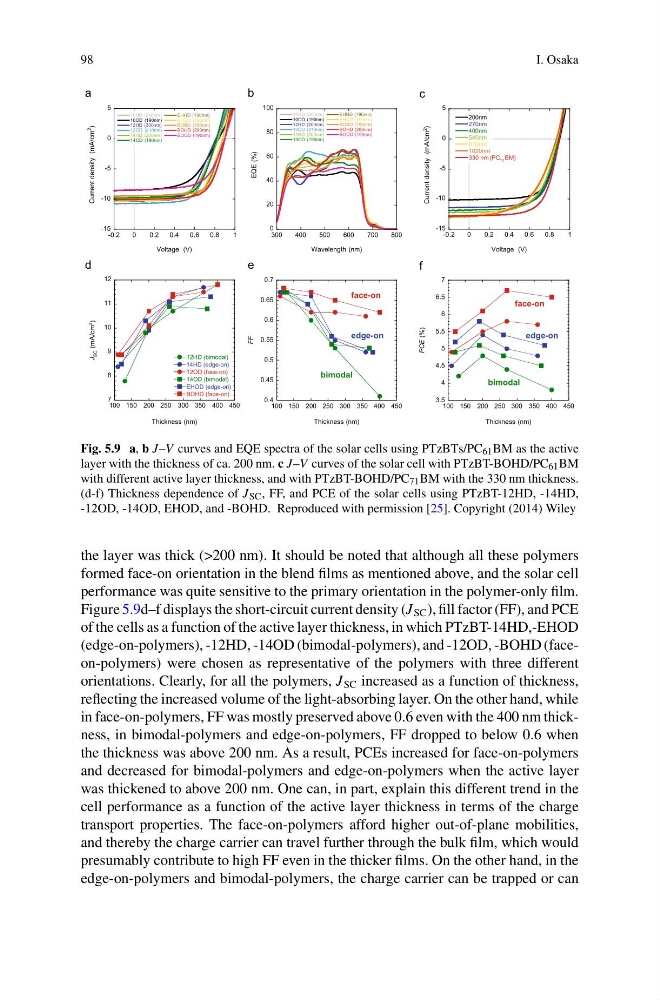
Fig. 5.9 a, b J–V curves and EQE spectra of the solar cells using PTzBTs/PC 61 BM as the active
layer with the thickness of ca. 200 nm. c J–V curves of the solar cell with PTzBT-BOHD/PC 61 BM
with different active layer thickness, and with PTzBT-BOHD/PC 71 BM with the 330 nm thickness.
(d-f) Thickness dependence of J SC , FF, and PCE of the solar cells using PTzBT-12HD, -14HD,
-12OD, -14OD, EHOD, and -BOHD. Reproduced with permission [25]. Copyright (2014) Wiley
the layer was thick (>200 nm). It should be noted that although all these polymers
formed face-on orientation in the blend films as mentioned above, and the solar cell
performance was quite sensitive to the primary orientation in the polymer-only film.
Figure 5.9d–f displays the short-circuit current density (J SC ), fill factor (FF), and PCE
of the cells as a function of the active layer thickness, in which PTzBT-14HD,-EHOD
(edge-on-polymers), -12HD, -14OD (bimodal-polymers), and -12OD, -BOHD (faceon-polymers) were chosen as representative of the polymers with three different
orientations. Clearly, for all the polymers, J SC increased as a function of thickness,
reflecting the increased volume of the light-absorbing layer. On the other hand, while
in face-on-polymers, FF was mostly preserved above 0.6 even with the 400 nm thickness, in bimodal-polymers and edge-on-polymers, FF dropped to below 0.6 when
the thickness was above 200 nm. As a result, PCEs increased for face-on-polymers
and decreased for bimodal-polymers and edge-on-polymers when the active layer
was thickened to above 200 nm. One can, in part, explain this different trend in the
cell performance as a function of the active layer thickness in terms of the charge
transport properties. The face-on-polymers afford higher out-of-plane mobilities,
and thereby the charge carrier can travel further through the bulk film, which would
presumably contribute to high FF even in the thicker films. On the other hand, in the
edge-on-polymers and bimodal-polymers, the charge carrier can be trapped or can
I. Osaka
-15
-10
-5
0
5
-0.2
0
0.2
0.4
0.6
0.8
1
200nm
270nm
400nm
540nm
810nm
1020nm
330 nm
Voltage (V)
Current density (mA/cm 2
)
(PC 71 BM)
0
20
40
60
80
100
300
400
500
600
700
800
10HD (200nm)
10OD (190nm)
12HD (200nm)
12OD (210nm)
14HD (200nm)
14OD (190nm)
EHHD (190nm)
EHOD (190nm)
BOBO (190nm)
BOHD (200nm)
BOOD (190nm)
EQE (%)
Wavelength (nm)
a
b
-15
-10
-5
0
5
-0.2
0
0.2
0.4
0.6
0.8
1
10HD (200nm)
10OD (190nm)
12HD (200nm)
12OD (210nm)
14HD (200nm)
14OD (190nm)
EHHD (190nm)
EHOD (190nm)
BOBO (190nm)
BOHD (200nm)
BOOD (190nm)
Voltage (V)
Current density (mA/cm
2
)
7
8
9
10
11
12
100 150 200 250 300 350 400 450
12HD (bimodal)
14HD (edge-on)
12OD (face-on)
14OD (bimodal)
EHOD (edge-on)
BOHD (face-on)
J
SC (mA/cm 2
)
Thickness (nm)
c
d
e
f
face-on
edge-on
bimodal
face-on
edge-on
bimodal
3.5
4
4.5
5
5.5
6
6.5
7
100 150 200 250 300 350 400 450
PCE (%)
Thickness (nm)
0.4
0.45
0.5
0.55
0.6
0.65
0.7
100 150 200 250 300 350 400 450
FF
Thickness (nm)
Fig. 5.9 a, b J–V curves and EQE spectra of the solar cells using PTzBTs/PC 61 BM as the active
layer with the thickness of ca. 200 nm. c J–V curves of the solar cell with PTzBT-BOHD/PC 61 BM
with different active layer thickness, and with PTzBT-BOHD/PC 71 BM with the 330 nm thickness.
(d-f) Thickness dependence of J SC , FF, and PCE of the solar cells using PTzBT-12HD, -14HD,
-12OD, -14OD, EHOD, and -BOHD. Reproduced with permission [25]. Copyright (2014) Wiley
the layer was thick (>200 nm). It should be noted that although all these polymers
formed face-on orientation in the blend films as mentioned above, and the solar cell
performance was quite sensitive to the primary orientation in the polymer-only film.
Figure 5.9d–f displays the short-circuit current density (J SC ), fill factor (FF), and PCE
of the cells as a function of the active layer thickness, in which PTzBT-14HD,-EHOD
(edge-on-polymers), -12HD, -14OD (bimodal-polymers), and -12OD, -BOHD (faceon-polymers) were chosen as representative of the polymers with three different
orientations. Clearly, for all the polymers, J SC increased as a function of thickness,
reflecting the increased volume of the light-absorbing layer. On the other hand, while
in face-on-polymers, FF was mostly preserved above 0.6 even with the 400 nm thickness, in bimodal-polymers and edge-on-polymers, FF dropped to below 0.6 when
the thickness was above 200 nm. As a result, PCEs increased for face-on-polymers
and decreased for bimodal-polymers and edge-on-polymers when the active layer
was thickened to above 200 nm. One can, in part, explain this different trend in the
cell performance as a function of the active layer thickness in terms of the charge
transport properties. The face-on-polymers afford higher out-of-plane mobilities,
and thereby the charge carrier can travel further through the bulk film, which would
presumably contribute to high FF even in the thicker films. On the other hand, in the
edge-on-polymers and bimodal-polymers, the charge carrier can be trapped or can