

370 S. KILPELÄINEN ET AL.
it comes to activating and engaging customers, some of whom need to
become prosumers and providers of resources. Agreement prevails on the
need for consumers to take a stronger role in the energy system, but not
everyone agrees on how to support such greater involvement.
Some of the transition pressures ahead are well illustrated by returning
to the position of bioenergy in the Finnish energy system. There is a
vested interest in bioenergy, still the most important source of Finnish
renewable energy. However, so far bioenergy is used as a base-load
resource providing electricity and heat while biomass itself offers energy
storage services. Whether the actors relying on bioenergy can adapt to a
situation where the relative share of wind and solar power increases and
prices possibly decrease; where new, smart grid reliant solutions emerge,
also in the form of storage capacity, and where bioenergy may have to
assume also back-up power functions, remains to be seen. Such adaptation
will lead to a different business model, and the answer to this a question
has implications for R&D policies, employment as well as export income
regarding what types of products biomass is in the future converted to.
So far, energy policies have done little to address these questions of wider
societal importance.
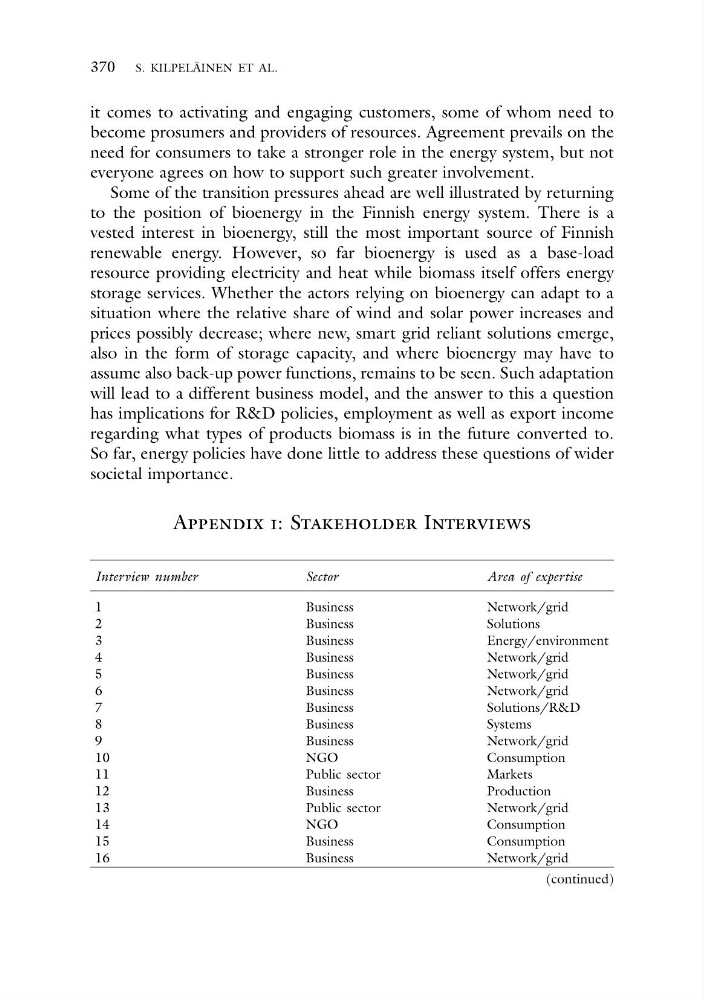
Appendix 1: Stakeholder Interviews
Interview number
Sector
Area of expertise
1
Business
Network/grid
2
Business
Solutions
3
Business
Energy/environment
4
Business
Network/grid
5
Business
Network/grid
6
Business
Network/grid
7
Business
Solutions/R&D
8
Business
Systems
9
Business
Network/grid
10
NGO
Consumption
11
Public sector
Markets
12
Business
Production
13
Public sector
Network/grid
14
NGO
Consumption
15
Business
Consumption
16
Business
Network/grid
(continued)
it comes to activating and engaging customers, some of whom need to
become prosumers and providers of resources. Agreement prevails on the
need for consumers to take a stronger role in the energy system, but not
everyone agrees on how to support such greater involvement.
Some of the transition pressures ahead are well illustrated by returning
to the position of bioenergy in the Finnish energy system. There is a
vested interest in bioenergy, still the most important source of Finnish
renewable energy. However, so far bioenergy is used as a base-load
resource providing electricity and heat while biomass itself offers energy
storage services. Whether the actors relying on bioenergy can adapt to a
situation where the relative share of wind and solar power increases and
prices possibly decrease; where new, smart grid reliant solutions emerge,
also in the form of storage capacity, and where bioenergy may have to
assume also back-up power functions, remains to be seen. Such adaptation
will lead to a different business model, and the answer to this a question
has implications for R&D policies, employment as well as export income
regarding what types of products biomass is in the future converted to.
So far, energy policies have done little to address these questions of wider
societal importance.
Appendix 1: Stakeholder Interviews
Interview number
Sector
Area of expertise
1
Business
Network/grid
2
Business
Solutions
3
Business
Energy/environment
4
Business
Network/grid
5
Business
Network/grid
6
Business
Network/grid
7
Business
Solutions/R&D
8
Business
Systems
9
Business
Network/grid
10
NGO
Consumption
11
Public sector
Markets
12
Business
Production
13
Public sector
Network/grid
14
NGO
Consumption
15
Business
Consumption
16
Business
Network/grid
(continued)