

14 RENEWABLE ENERGY IN FINLAND: FROM A PRODUCTION-CENTRIC …
357
utility, is developing a 120 MW underground heat storage facility to a
cave formerly used for oil storage (Helen 2018).
Multiple modelling studies of the Finnish energy system up to 2050
(Kiviluoma et al. 2018; Ikäheimo et al. 2019; Kiviluoma 2013; Child
and Breyer 2016; Child et al. 2017; Zakari et al. 2015) lend support to
the vision of an energy system that is able to integrate high shares of
renewable energy (Holttinen 2017). These studies focus on the technical
capacities and possibilities to identify cost-effective solutions for developing the Finnish energy system. In this chapter, we are arguing that this
shift is not only a technological and infrastructural shift, but also a societal one. Thus, the ways in which the field of stakeholders is changing are
of special interest to us. We will ask questions relating to the views and
positions of incumbent actors as well as emerging actors.
The reorganisation of the field of stakeholders
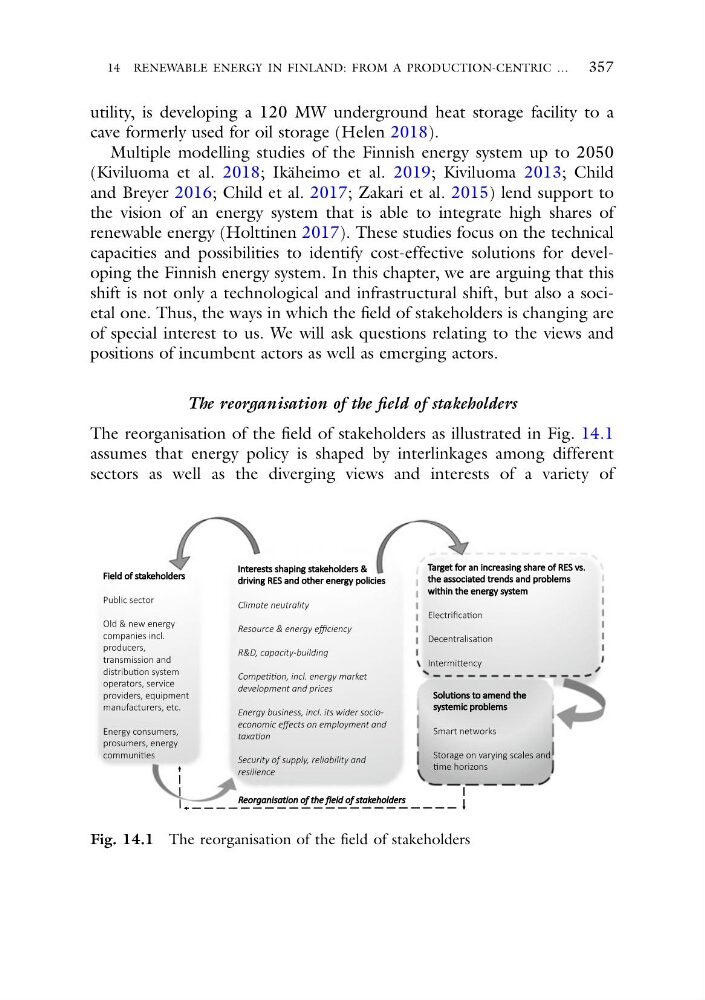
The reorganisation of the field of stakeholders as illustrated in Fig. 14.1
assumes that energy policy is shaped by interlinkages among different
sectors as well as the diverging views and interests of a variety of
Fig. 14.1 The reorganisation of the field of stakeholders
357
utility, is developing a 120 MW underground heat storage facility to a
cave formerly used for oil storage (Helen 2018).
Multiple modelling studies of the Finnish energy system up to 2050
(Kiviluoma et al. 2018; Ikäheimo et al. 2019; Kiviluoma 2013; Child
and Breyer 2016; Child et al. 2017; Zakari et al. 2015) lend support to
the vision of an energy system that is able to integrate high shares of
renewable energy (Holttinen 2017). These studies focus on the technical
capacities and possibilities to identify cost-effective solutions for developing the Finnish energy system. In this chapter, we are arguing that this
shift is not only a technological and infrastructural shift, but also a societal one. Thus, the ways in which the field of stakeholders is changing are
of special interest to us. We will ask questions relating to the views and
positions of incumbent actors as well as emerging actors.
The reorganisation of the field of stakeholders
The reorganisation of the field of stakeholders as illustrated in Fig. 14.1
assumes that energy policy is shaped by interlinkages among different
sectors as well as the diverging views and interests of a variety of
Fig. 14.1 The reorganisation of the field of stakeholders