

83
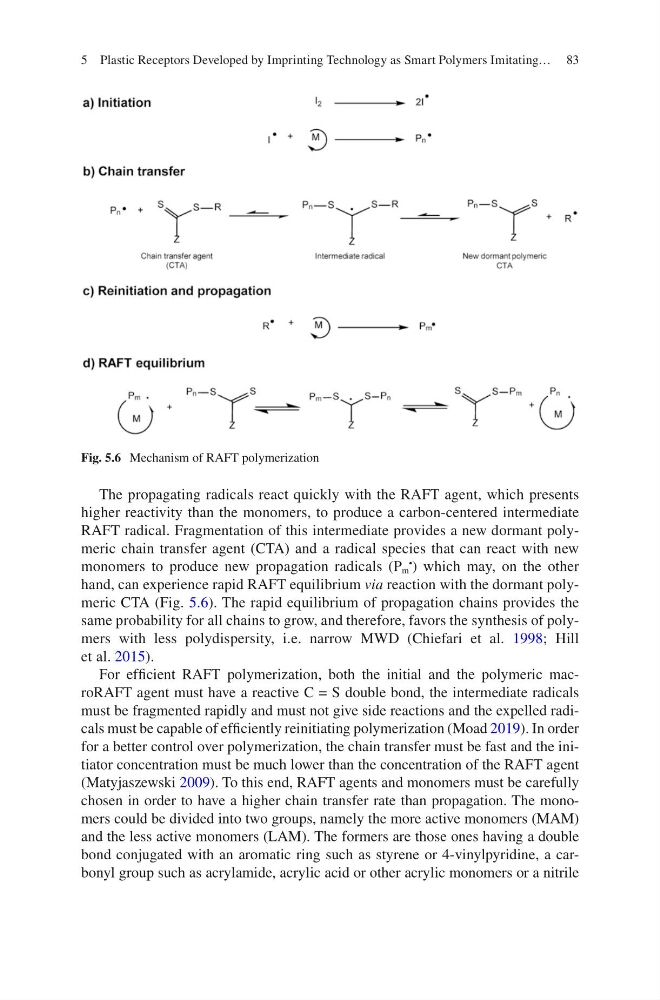
The propagating radicals react quickly with the RAFT agent, which presents
higher reactivity than the monomers, to produce a carbon-centered intermediate
RAFT radical. Fragmentation of this intermediate provides a new dormant polymeric chain transfer agent (CTA) and a radical species that can react with new
monomers to produce new propagation radicals (P m
•
) which may, on the other
hand, can experience rapid RAFT equilibrium via reaction with the dormant polymeric CTA (Fig. 5.6). The rapid equilibrium of propagation chains provides the
same probability for all chains to grow, and therefore, favors the synthesis of polymers with less polydispersity, i.e. narrow MWD (Chiefari et al. 1998; Hill
et al. 2015).
For efficient RAFT polymerization, both the initial and the polymeric macroRAFT agent must have a reactive C = S double bond, the intermediate radicals
must be fragmented rapidly and must not give side reactions and the expelled radicals must be capable of efficiently reinitiating polymerization (Moad 2019). In order
for a better control over polymerization, the chain transfer must be fast and the initiator concentration must be much lower than the concentration of the RAFT agent
(Matyjaszewski 2009). To this end, RAFT agents and monomers must be carefully
chosen in order to have a higher chain transfer rate than propagation. The monomers could be divided into two groups, namely the more active monomers (MAM)
and the less active monomers (LAM). The formers are those ones having a double
bond conjugated with an aromatic ring such as styrene or 4-vinylpyridine, a carbonyl group such as acrylamide, acrylic acid or other acrylic monomers or a nitrile
Fig. 5.6 Mechanism of RAFT polymerization
5 Plastic Receptors Developed by Imprinting Technology as Smart Polymers Imitating…
The propagating radicals react quickly with the RAFT agent, which presents
higher reactivity than the monomers, to produce a carbon-centered intermediate
RAFT radical. Fragmentation of this intermediate provides a new dormant polymeric chain transfer agent (CTA) and a radical species that can react with new
monomers to produce new propagation radicals (P m
•
) which may, on the other
hand, can experience rapid RAFT equilibrium via reaction with the dormant polymeric CTA (Fig. 5.6). The rapid equilibrium of propagation chains provides the
same probability for all chains to grow, and therefore, favors the synthesis of polymers with less polydispersity, i.e. narrow MWD (Chiefari et al. 1998; Hill
et al. 2015).
For efficient RAFT polymerization, both the initial and the polymeric macroRAFT agent must have a reactive C = S double bond, the intermediate radicals
must be fragmented rapidly and must not give side reactions and the expelled radicals must be capable of efficiently reinitiating polymerization (Moad 2019). In order
for a better control over polymerization, the chain transfer must be fast and the initiator concentration must be much lower than the concentration of the RAFT agent
(Matyjaszewski 2009). To this end, RAFT agents and monomers must be carefully
chosen in order to have a higher chain transfer rate than propagation. The monomers could be divided into two groups, namely the more active monomers (MAM)
and the less active monomers (LAM). The formers are those ones having a double
bond conjugated with an aromatic ring such as styrene or 4-vinylpyridine, a carbonyl group such as acrylamide, acrylic acid or other acrylic monomers or a nitrile
Fig. 5.6 Mechanism of RAFT polymerization
5 Plastic Receptors Developed by Imprinting Technology as Smart Polymers Imitating…