

71
5.2 Polymerization Mechanisms
5.2.1 Free Radical Polymerization (FRP)
FRP has been the main method for synthesizing MIPs so far and is the simplest
technique for large-scale preparation of imprinted polymers using acrylic or vinyl
monomers (Haupt et al. 2012). Here, the functional monomers and the target compound, called template, are dissolved in a given amount of solvent resulting in a
more or less stable complex governed more frequently by non-covalent interactions,
but not limited to. Non-covalent imprinting has been, by far, the most widely used
imprinting approach for MIP development (Yilmaz et al. 2004), mainly due to its
versatility, the large amount of available monomers and its faster binding kinetics
compared to others, such as the covalent approach (Sellergren and Hall 2001). The
prepolymerization complex mentioned above is later immobilized in a highly crosslinked 3D polymer network due to the addition of a crosslinking monomer to the
polymerization mixture. This reaction starts thanks to an initiator, which decomposes into two active radicals that react with double bonds to initiate chain polymerization (Belbruno 2019).
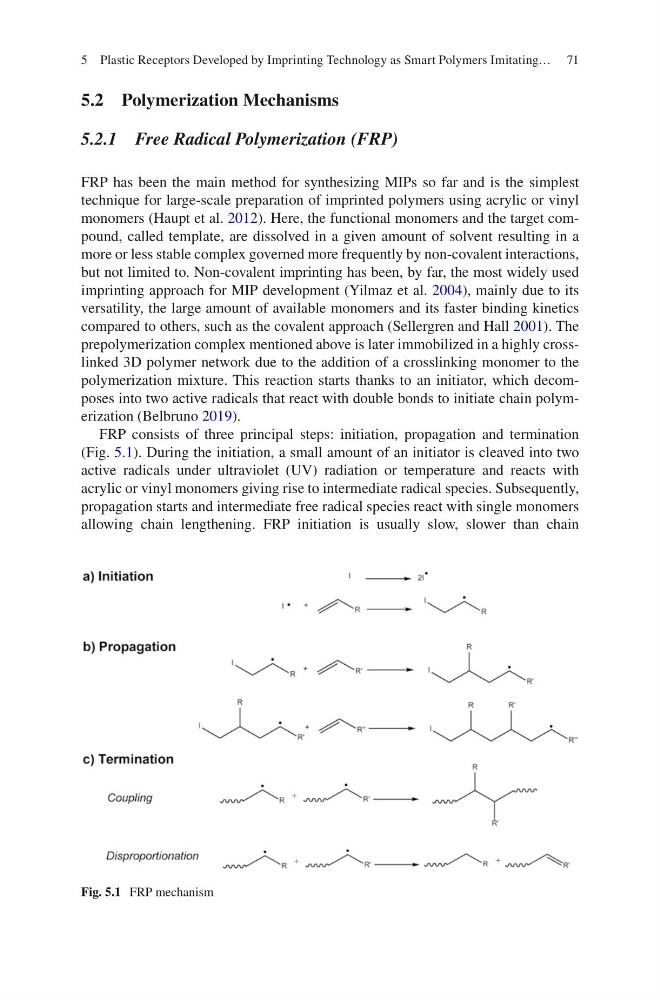
FRP consists of three principal steps: initiation, propagation and termination
(Fig. 5.1). During the initiation, a small amount of an initiator is cleaved into two
active radicals under ultraviolet (UV) radiation or temperature and reacts with
acrylic or vinyl monomers giving rise to intermediate radical species. Subsequently,
propagation starts and intermediate free radical species react with single monomers
allowing chain lengthening. FRP initiation is usually slow, slower than chain
Fig. 5.1 FRP mechanism
5 Plastic Receptors Developed by Imprinting Technology as Smart Polymers Imitating…
5.2 Polymerization Mechanisms
5.2.1 Free Radical Polymerization (FRP)
FRP has been the main method for synthesizing MIPs so far and is the simplest
technique for large-scale preparation of imprinted polymers using acrylic or vinyl
monomers (Haupt et al. 2012). Here, the functional monomers and the target compound, called template, are dissolved in a given amount of solvent resulting in a
more or less stable complex governed more frequently by non-covalent interactions,
but not limited to. Non-covalent imprinting has been, by far, the most widely used
imprinting approach for MIP development (Yilmaz et al. 2004), mainly due to its
versatility, the large amount of available monomers and its faster binding kinetics
compared to others, such as the covalent approach (Sellergren and Hall 2001). The
prepolymerization complex mentioned above is later immobilized in a highly crosslinked 3D polymer network due to the addition of a crosslinking monomer to the
polymerization mixture. This reaction starts thanks to an initiator, which decomposes into two active radicals that react with double bonds to initiate chain polymerization (Belbruno 2019).
FRP consists of three principal steps: initiation, propagation and termination
(Fig. 5.1). During the initiation, a small amount of an initiator is cleaved into two
active radicals under ultraviolet (UV) radiation or temperature and reacts with
acrylic or vinyl monomers giving rise to intermediate radical species. Subsequently,
propagation starts and intermediate free radical species react with single monomers
allowing chain lengthening. FRP initiation is usually slow, slower than chain
Fig. 5.1 FRP mechanism
5 Plastic Receptors Developed by Imprinting Technology as Smart Polymers Imitating…