

44
Wang et al. 2012; Xu et al. 2009; Xue et al. 2009, 2010, 2012; Yang et al. 2005;
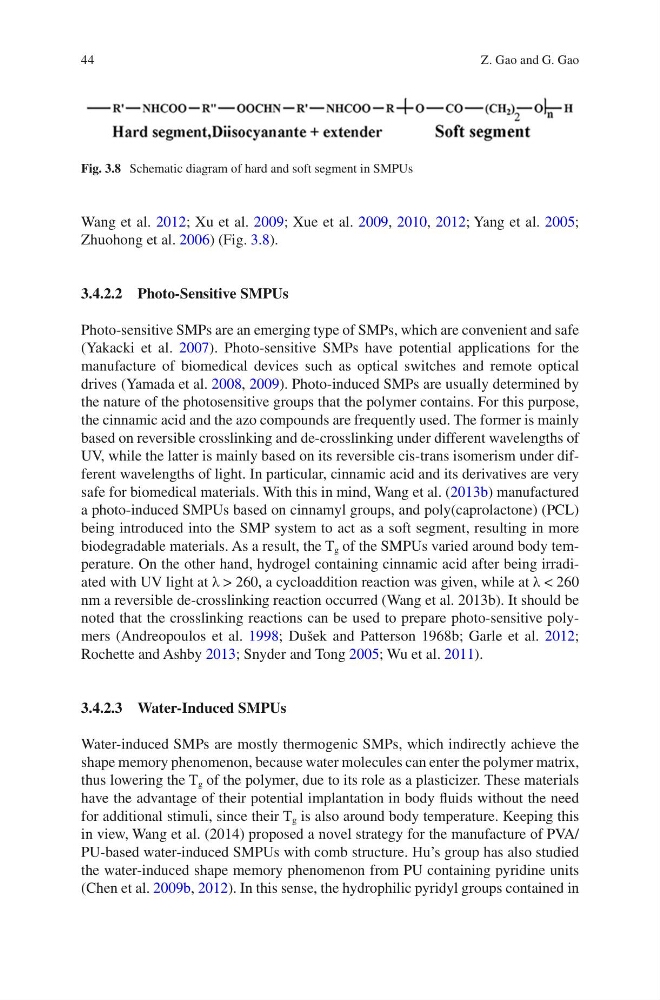
Zhuohong et al. 2006) (Fig. 3.8).
3.4.2.2 Photo-Sensitive SMPUs
Photo-sensitive SMPs are an emerging type of SMPs, which are convenient and safe
(Yakacki et al. 2007). Photo-sensitive SMPs have potential applications for the
manufacture of biomedical devices such as optical switches and remote optical
drives (Yamada et al. 2008, 2009). Photo-induced SMPs are usually determined by
the nature of the photosensitive groups that the polymer contains. For this purpose,
the cinnamic acid and the azo compounds are frequently used. The former is mainly
based on reversible crosslinking and de-crosslinking under different wavelengths of
UV, while the latter is mainly based on its reversible cis-trans isomerism under different wavelengths of light. In particular, cinnamic acid and its derivatives are very
safe for biomedical materials. With this in mind, Wang et al. (2013b) manufactured
a photo-induced SMPUs based on cinnamyl groups, and poly(caprolactone) (PCL)
being introduced into the SMP system to act as a soft segment, resulting in more
biodegradable materials. As a result, the T g of the SMPUs varied around body temperature. On the other hand, hydrogel containing cinnamic acid after being irradiated with UV light at λ > 260, a cycloaddition reaction was given, while at λ < 260
nm a reversible de-crosslinking reaction occurred (Wang et al. 2013b). It should be
noted that the crosslinking reactions can be used to prepare photo-sensitive polymers (Andreopoulos et al. 1998; Dušek and Patterson 1968b; Garle et al. 2012;
Rochette and Ashby 2013; Snyder and Tong 2005; Wu et al. 2011).
3.4.2.3 Water-Induced SMPUs
Water-induced SMPs are mostly thermogenic SMPs, which indirectly achieve the
shape memory phenomenon, because water molecules can enter the polymer matrix,
thus lowering the T g of the polymer, due to its role as a plasticizer. These materials
have the advantage of their potential implantation in body fluids without the need
for additional stimuli, since their T g is also around body temperature. Keeping this
in view, Wang et al. (2014) proposed a novel strategy for the manufacture of PVA/
PU-based water-induced SMPUs with comb structure. Hu’s group has also studied
the water-induced shape memory phenomenon from PU containing pyridine units
(Chen et al. 2009b, 2012). In this sense, the hydrophilic pyridyl groups contained in
Fig. 3.8 Schematic diagram of hard and soft segment in SMPUs
Z. Gao and G. Gao
Wang et al. 2012; Xu et al. 2009; Xue et al. 2009, 2010, 2012; Yang et al. 2005;
Zhuohong et al. 2006) (Fig. 3.8).
3.4.2.2 Photo-Sensitive SMPUs
Photo-sensitive SMPs are an emerging type of SMPs, which are convenient and safe
(Yakacki et al. 2007). Photo-sensitive SMPs have potential applications for the
manufacture of biomedical devices such as optical switches and remote optical
drives (Yamada et al. 2008, 2009). Photo-induced SMPs are usually determined by
the nature of the photosensitive groups that the polymer contains. For this purpose,
the cinnamic acid and the azo compounds are frequently used. The former is mainly
based on reversible crosslinking and de-crosslinking under different wavelengths of
UV, while the latter is mainly based on its reversible cis-trans isomerism under different wavelengths of light. In particular, cinnamic acid and its derivatives are very
safe for biomedical materials. With this in mind, Wang et al. (2013b) manufactured
a photo-induced SMPUs based on cinnamyl groups, and poly(caprolactone) (PCL)
being introduced into the SMP system to act as a soft segment, resulting in more
biodegradable materials. As a result, the T g of the SMPUs varied around body temperature. On the other hand, hydrogel containing cinnamic acid after being irradiated with UV light at λ > 260, a cycloaddition reaction was given, while at λ < 260
nm a reversible de-crosslinking reaction occurred (Wang et al. 2013b). It should be
noted that the crosslinking reactions can be used to prepare photo-sensitive polymers (Andreopoulos et al. 1998; Dušek and Patterson 1968b; Garle et al. 2012;
Rochette and Ashby 2013; Snyder and Tong 2005; Wu et al. 2011).
3.4.2.3 Water-Induced SMPUs
Water-induced SMPs are mostly thermogenic SMPs, which indirectly achieve the
shape memory phenomenon, because water molecules can enter the polymer matrix,
thus lowering the T g of the polymer, due to its role as a plasticizer. These materials
have the advantage of their potential implantation in body fluids without the need
for additional stimuli, since their T g is also around body temperature. Keeping this
in view, Wang et al. (2014) proposed a novel strategy for the manufacture of PVA/
PU-based water-induced SMPUs with comb structure. Hu’s group has also studied
the water-induced shape memory phenomenon from PU containing pyridine units
(Chen et al. 2009b, 2012). In this sense, the hydrophilic pyridyl groups contained in
Fig. 3.8 Schematic diagram of hard and soft segment in SMPUs
Z. Gao and G. Gao