

41
of host-guest interactions (β-CD-ferrocene (Fc) and β-CD-adamantane (Ad)) to
develop a series of redox-induced SMGs under oxidation conditions. In this way,
two temporary shapes could be controlled by tuning the redox stimuli. Thereby, the
self-healing and expansion-contraction performance were integrated into this hostguest hydrogel.
Tomatsu et al. (2006) also separately manufactured two redox-induced SMGs
via host-guest interactions from CD-chitosan (CD-Cs) and poly(ethyleneimine)-Fc
(Fc-PEI), and they were then mixed in an aqueous solution of glutaraldehyde
(chemical crosslinker) with the aim of reacting the amino groups of the two polymers, thus forming a chemically and physically crosslinked hydrogel. In particular,
the chemical crosslinking sites were used as a stationary phase, while the redox
sensitive physical crosslinking sites acted as a reversible phase. The gel could thus
be directly oxidized and reduced using ammonium cerium nitrate and sodium
hydrogen sulfite, respectively. These redox-induced SMPs could also be indirectly
oxidized by glucose.
3.4.1.5 Applications of SMGs
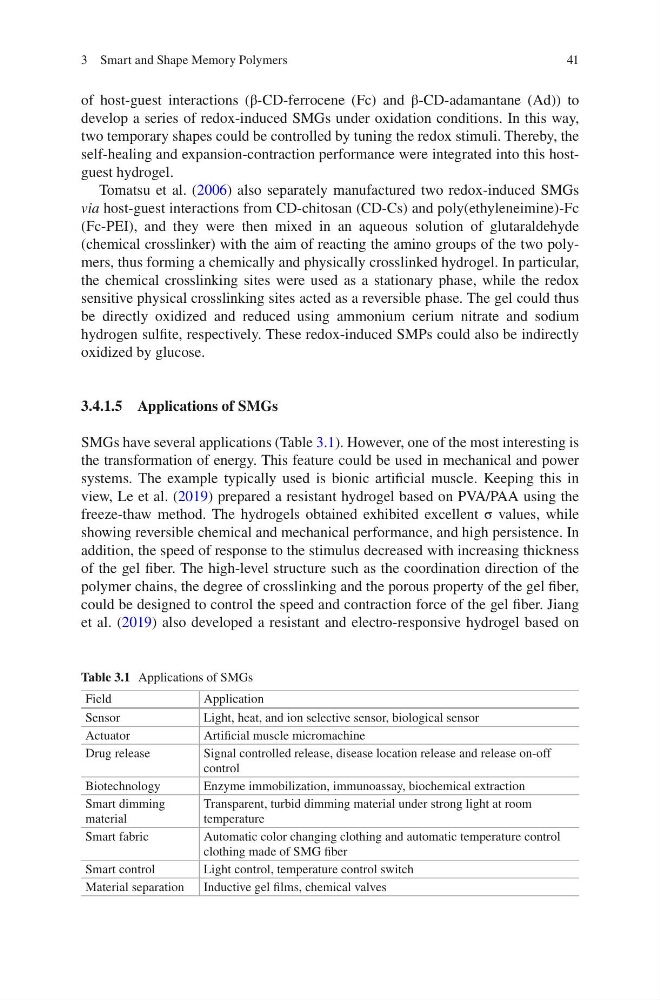
SMGs have several applications (Table 3.1). However, one of the most interesting is
the transformation of energy. This feature could be used in mechanical and power
systems. The example typically used is bionic artificial muscle. Keeping this in
view, Le et al. (2019) prepared a resistant hydrogel based on PVA/PAA using the
freeze-thaw method. The hydrogels obtained exhibited excellent σ values, while
showing reversible chemical and mechanical performance, and high persistence. In
addition, the speed of response to the stimulus decreased with increasing thickness
of the gel fiber. The high-level structure such as the coordination direction of the
polymer chains, the degree of crosslinking and the porous property of the gel fiber,
could be designed to control the speed and contraction force of the gel fiber. Jiang
et al. (2019) also developed a resistant and electro-responsive hydrogel based on
Table 3.1 Applications of SMGs
Field
Application
Sensor
Light, heat, and ion selective sensor, biological sensor
Actuator
Artificial muscle micromachine
Drug release
Signal controlled release, disease location release and release on-off
control
Biotechnology
Enzyme immobilization, immunoassay, biochemical extraction
Smart dimming
material
Transparent, turbid dimming material under strong light at room
temperature
Smart fabric
Automatic color changing clothing and automatic temperature control
clothing made of SMG fiber
Smart control
Light control, temperature control switch
Material separation
Inductive gel films, chemical valves
3 Smart and Shape Memory Polymers
of host-guest interactions (β-CD-ferrocene (Fc) and β-CD-adamantane (Ad)) to
develop a series of redox-induced SMGs under oxidation conditions. In this way,
two temporary shapes could be controlled by tuning the redox stimuli. Thereby, the
self-healing and expansion-contraction performance were integrated into this hostguest hydrogel.
Tomatsu et al. (2006) also separately manufactured two redox-induced SMGs
via host-guest interactions from CD-chitosan (CD-Cs) and poly(ethyleneimine)-Fc
(Fc-PEI), and they were then mixed in an aqueous solution of glutaraldehyde
(chemical crosslinker) with the aim of reacting the amino groups of the two polymers, thus forming a chemically and physically crosslinked hydrogel. In particular,
the chemical crosslinking sites were used as a stationary phase, while the redox
sensitive physical crosslinking sites acted as a reversible phase. The gel could thus
be directly oxidized and reduced using ammonium cerium nitrate and sodium
hydrogen sulfite, respectively. These redox-induced SMPs could also be indirectly
oxidized by glucose.
3.4.1.5 Applications of SMGs
SMGs have several applications (Table 3.1). However, one of the most interesting is
the transformation of energy. This feature could be used in mechanical and power
systems. The example typically used is bionic artificial muscle. Keeping this in
view, Le et al. (2019) prepared a resistant hydrogel based on PVA/PAA using the
freeze-thaw method. The hydrogels obtained exhibited excellent σ values, while
showing reversible chemical and mechanical performance, and high persistence. In
addition, the speed of response to the stimulus decreased with increasing thickness
of the gel fiber. The high-level structure such as the coordination direction of the
polymer chains, the degree of crosslinking and the porous property of the gel fiber,
could be designed to control the speed and contraction force of the gel fiber. Jiang
et al. (2019) also developed a resistant and electro-responsive hydrogel based on
Table 3.1 Applications of SMGs
Field
Application
Sensor
Light, heat, and ion selective sensor, biological sensor
Actuator
Artificial muscle micromachine
Drug release
Signal controlled release, disease location release and release on-off
control
Biotechnology
Enzyme immobilization, immunoassay, biochemical extraction
Smart dimming
material
Transparent, turbid dimming material under strong light at room
temperature
Smart fabric
Automatic color changing clothing and automatic temperature control
clothing made of SMG fiber
Smart control
Light control, temperature control switch
Material separation
Inductive gel films, chemical valves
3 Smart and Shape Memory Polymers